SCHW‑P‑J: Vendor signals that matter to preferred‑stock investors
The Charles Schwab Corporation operates a diversified financial services platform that monetizes through client assets, trading and advisory fees, interest spread from banking activities, and asset‑management products; holders of SCHW‑P‑J sit in the preferred capital stack and are exposed to the firm’s operational stability and cash‑flow continuity rather than day‑to‑day trading performance. For investors and operators evaluating supplier risk, the vendor footprint reveals reliance on established index providers for portfolio construction and on branded‑content vendors for client engagement — two supplier classes with different risk profiles and different implications for stability and reputational exposure. Explore the broader supplier map at NullExposure for additional context: https://nullexposure.com/
What the supplier list tells an investor about how Schwab runs its business
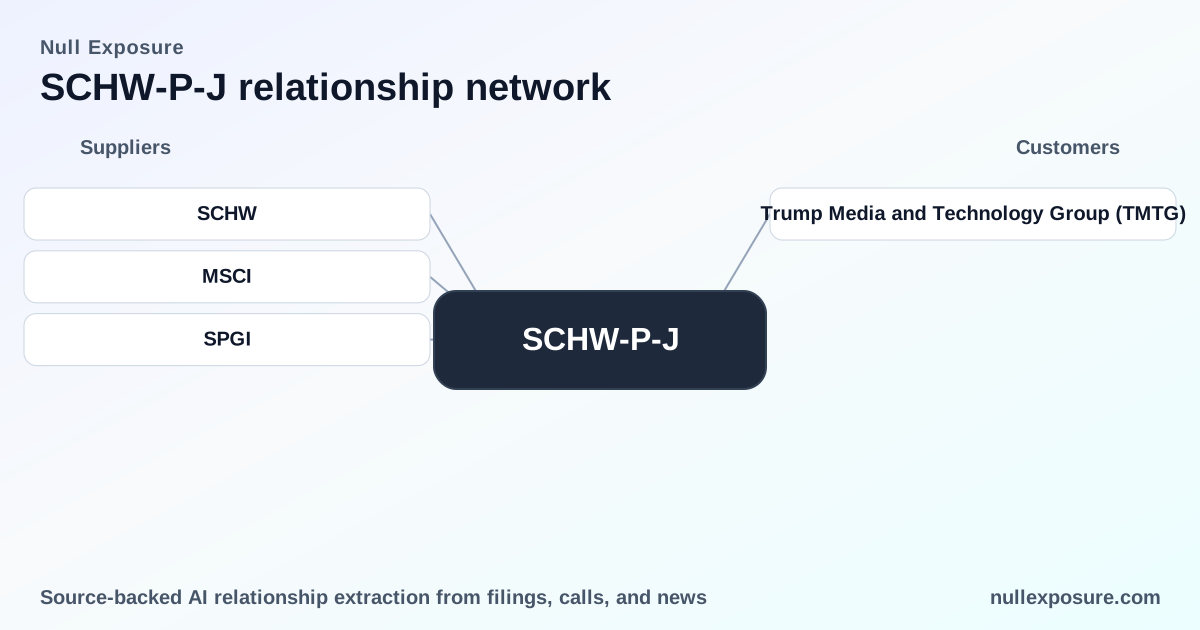
Charles Schwab’s external relationships documented here split into brand/content services and index/benchmark providers. That dual approach aligns with a two‑track commercial strategy: one track drives client acquisition and retention through content and marketing, the other underpins product functionality and investment performance via third‑party indices.
- Contracting posture: Schwab uses strategic, brand‑level engagements for marketing and well‑established licensing agreements for indices; this reflects a supplier posture that balances negotiated partnerships with standardized licensing.
- Concentration and criticality: Index providers are functionally critical to product offerings where licensed benchmarks determine fund construction and client outcomes; marketing partners are important for distribution and brand, but are replaceable with lower operational friction.
- Maturity: Relationships with global index houses and established creative firms signal a mature vendor ecosystem rather than an early‑stage or ad‑hoc procurement model.
- Company‑level signal: The reviewed records contain no explicit contractual constraints or supplier disputes captured in the source set, which indicates no immediate supplier‑driven stress recorded for the examined period.
For a broader map of how counterparties shape issuer risk, view the NullExposure homepage: https://nullexposure.com/
The specific supplier relationships we found — what you need to know
Pacific Content — branded audio and content production
Schwab is listed among Pacific Content’s early branded‑audio clients, reflecting Schwab’s use of podcasting and branded content as a distribution and engagement channel; that relationship underscores Schwab’s investment in owned media to drive client acquisition and brand loyalty. According to Broadcast Dialogue coverage in April 2022, Pacific Content’s client roster included Charles Schwab alongside other major technology and financial brands.
MSCI — ESG benchmarking for personalized indexing
Schwab’s personalized indexing offering leverages MSCI’s KLD 400 Social Index as the basis for an ESG strategy, indicating reliance on third‑party ESG benchmarks to deliver differentiated product features to clients; using MSCI enables Schwab to outsource ESG signal delivery while focusing internal resources on client implementation. Investopedia’s coverage of Schwab’s Personalized Indexing in 2022 references the MSCI KLD 400 Social Index as part of the product’s ESG framework.
S&P (S&P Global / SPGI) — small‑cap benchmarking in product design
Schwab’s U.S. small‑cap strategy is built around the S&P SmallCap 600 Index, demonstrating dependency on S&P indices for market segment exposure in managed and index‑linked strategies; such licensing relationships are operationally material because benchmark selection drives product risk/return characteristics. Investopedia’s 2022 write‑up on Schwab’s Personalized Indexing highlights the S&P SmallCap 600 as the foundation for the small‑cap sleeve.
How these relationships influence risk and return for SCHW‑P‑J holders
Preferred‑stock investors prioritize predictable cash coverage and capital‑structure protections. The supplier footprint documented here points to several positive operational characteristics and a handful of vendor‑related risks:
- Positive: Use of established index houses (MSCI, S&P) reduces model and implementation risk because benchmarks are broadly recognized, licensed, and supported by mature data and governance processes. This supports product reliability and mitigates potential interruptions from obscure or single‑source providers.
- Positive: Investment in branded content through firms like Pacific Content supports client retention and scalability of distribution, which indirectly protects fee revenue and interest income over the medium term.
- Risk: Benchmark dependency is a single point of operational importance for index‑based products; changes in licensing terms, index methodology, or provider disputes can quickly alter product economics or necessitate redesigns.
- Risk: Reputational sensitivity from content partnerships requires active governance; branded content that conflicts with regulatory expectations or client sentiment can amplify reputational costs.
These supplier signals combine to indicate that Schwab runs with a strategic, low‑surprise vendor mix: established index partners for product backbone and specialized creative agencies for market-facing activities. That architecture supports cash‑flow predictability important to preferred holders, while exposing the firm to vendor licensing and reputational vectors that require active oversight.
Investor checklist — what to monitor going forward
- Monitor licensing disclosures and notes in filings for any material changes to index agreements or fees. Contractual shifts with index providers are a direct route to product margin pressure.
- Track marketing spend and brand‑engagement results tied to content programs. Deterioration in client acquisition metrics tied to branded content would reduce revenue growth optionality.
- Watch regulatory commentary on ESG benchmarks and index governance. Changes in ESG index standards can force product re‑positioning and affect AUM flows.
If you want a structured supplier risk summary and monitoring dashboard for SCHW‑P‑J and related securities, visit NullExposure: https://nullexposure.com/
Bottom line for operators and allocators
The supplier snapshot for Schwab underlines a deliberate balance between market‑standard index partners and specialist content vendors. That combination supports stable product delivery and client engagement while concentrating operational importance on index licensing and content governance. For holders of SCHW‑P‑J, these relationships translate into operational resilience with identifiable vendor risk vectors that are manageable through active counterparty oversight and contract monitoring.
For the full supplier universe and ongoing updates on Schwab counterparties, see the home research portal at NullExposure: https://nullexposure.com/