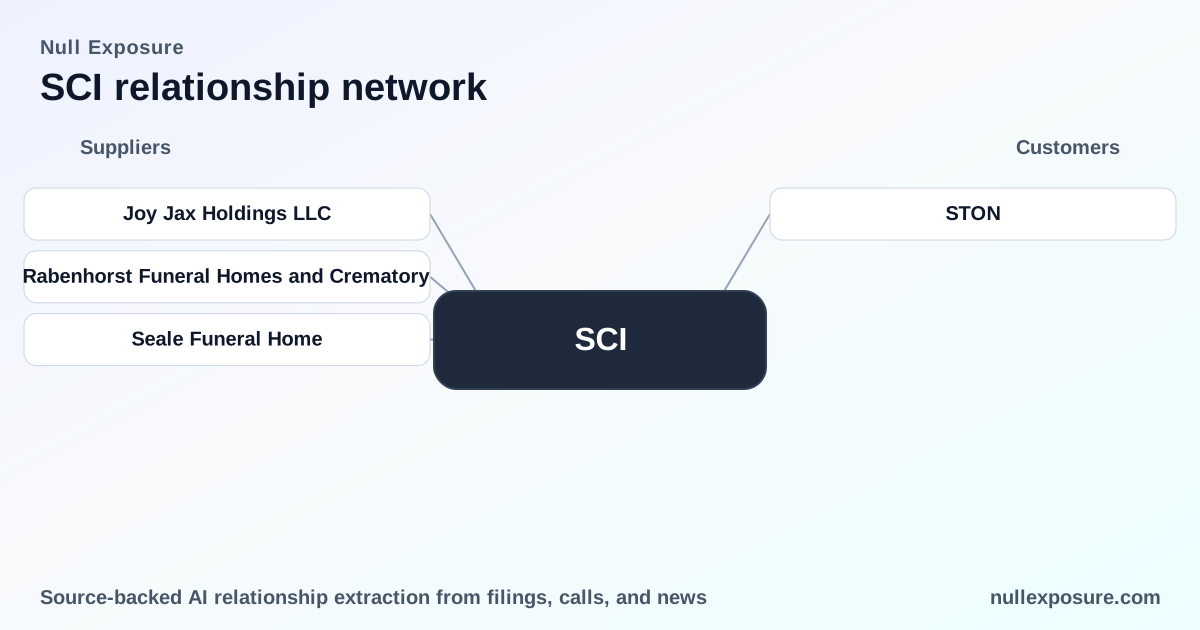
Service Corporation International (SCI): Supplier Relationship Briefing
Service Corporation International operates and monetizes a national death-care platform through a combination of operating revenue (funeral, cremation, cemetery services and merchandise) and capital returns from preneed trust arrangements and targeted acquisitions. The company leverages scale to acquire local funeral homes and real estate, consolidate operations, and extract margin through centralized services; its balance sheet and trust custody arrangements underpin working capital and cash conversion. With roughly $4.31B in trailing revenue and $1.32B of EBITDA, SCI is executing a roll-up strategy that mixes organic operations with small-to-medium acquisitions to sustain growth and margin expansion. Explore a vendor- and counterparty-focused profile at https://nullexposure.com/.
Why supplier relationships matter for investors: a short read
SCI’s supplier and counterparty footprint is not limited to venders of caskets and cemetery supplies; it extends to local sellers (funeral homes and property owners), real-estate counterparties, and large financial institutions that custody preneed trusts. Those ties determine near-term capex need, integration risk, and exposure to custody counterparty concentration. Investors should treat these relationships as part of SCI’s capital-allocation and operational risk map rather than peripheral procurement chatter.
If you evaluate supplier risk for strategic investments or partner diligence, start your workflow with the full profile at https://nullexposure.com/.
Deal-by-deal relationship summaries (what the press picked up)
Below are every relationship in the supplied results, presented with a plain-English summary and source.
-
Joy Jax Holdings LLC — In a local real-estate acquisition, SCI’s Florida subsidiary purchased a 0.69-acre property from Joy Jax Holdings LLC for $895,000 (transaction recorded July 15, 2020), signaling continued small-scale property purchases to support storefronts or service locations. According to a Jacksonville Daily Record article reporting on the July 2020 sale, SCI Funeral Services of Florida LLC paid $895,000 for the property (Jax Daily Record, July 2020). https://www.jaxdailyrecord.com/news/2020/jul/22/calico-corners-property-in-lakewood-sold-for-dollar895-000/
-
Rabenhorst Funeral Homes and Crematory — SCI executed a multi-property acquisition from Rabenhorst in three transactions totaling approximately $4.5 million, illustrating the company’s preference for clustered purchases that consolidate local market share rather than single-asset bolt-ons. A WBRZ report covering the purchase notes the Houston firm bought multiple properties from Rabenhorst in three separate transactions that totaled $4.5 million (WBRZ, FY2019 reporting). https://www.wbrz.com/news/rabenhorst-funeral-home-purchased-by-houston-based-company-for-4-5-million/
-
Seale Funeral Home — Earlier in the same acquisition cadence, SCI acquired Seale Funeral Home for $1.4 million, reflecting the routine scale and ticket size of the company’s local consolidation activity. WBRZ reported that SCI purchased Seale Funeral Home on Hooper Road for $1.4 million in FY2019 coverage of the deals. https://www.wbrz.com/news/rabenhorst-funeral-home-purchased-by-houston-based-company-for-4-5-million/
What these supplier ties reveal about operating posture and risks
These relationships underscore several company-level operating characteristics:
- Contracting posture: acquisitive buyer. SCI contracts as a purchaser of local businesses and real estate, typically executing small-to-mid-sized deals that plug into its regional networks rather than high-value one-off transformational M&A.
- Concentration signal: financial counterparty dependence. According to SCI’s disclosure, as of December 31, 2025, approximately 95% of its trusts were custodied by five large financial institutions, creating a counterparty concentration that is material to cash management and regulatory compliance.
- Criticality: operationally essential local assets. Funeral homes and cemetery property are critical operational assets—loss or mismanagement directly affects revenue and community presence.
- Maturity and institutionalization: high. SCI is a mature, widely held company (institutional ownership over 92% per the overview), which supports disciplined procurement and integration processes but also concentrates negotiation leverage and systemic counterparty exposure.
These traits should be treated as company-level signals; the custody concentration is a corporate disclosure rather than a relationship-specific attribute.
Strategic implications for investors and operators
The combination of frequent small acquisitions and centralized custody of preneed trusts generates a predictable set of implications:
- Integration execution matters more than headline multiples. Given the ticket size of disclosed deals ($0.9–$4.5M), value accrues from integrating operations, extracting cost synergies, and preserving local market share.
- Counterparty concentration is a funding and compliance risk. Having 95% of trusts with five large institutions concentrates settlement risk, operational dependency, and potential regulatory scrutiny; investors should prioritize counterparty resilience and diversification in diligence.
- Real-estate exposure is incremental but strategic. Property purchases like the Joy Jax lot are tactical investments that reduce occupancy risk and stabilize local presence; these moves are predictable tools in SCI’s playbook.
If you are modeling downside scenarios or vetting supplier risk for a portfolio position, a focused supplier diligence package will accelerate answers. Start that process here: https://nullexposure.com/.
Near-term monitoring checklist
- Confirm pace of local acquisitions and average ticket size versus prior years to detect acceleration or slowdown.
- Review trustee and custodian counterparty disclosures for concentration shifts away from the five major institutions cited as of Dec 31, 2025.
- Track regulatory notices around preneed trust accounting and state-specific burial/preneed regulations that could alter cash flow timing.
Bottom line and recommended next steps
SCI operates as a scale consolidator in the death-care sector, monetizing through services, merchandise, and preneed trust arrangements while sourcing growth from frequent local acquisitions. The supplier relationships summarized here—small property and funeral-home purchases—are routine and strategic, but their risk profile is dominated by the company-level concentration of trust custody and the operational necessity of successful integration.
For investors and operators preparing to engage with SCI or benchmark supplier risk, review custodial counterparty resiliency and acquisition integration metrics as priority items. Learn more about supplier intelligence and how these relationship signals map to investment decisions at https://nullexposure.com/.