Stepan Company (SCL) — Supplier Relationships and Operational Implications for Investors
Stepan is a global specialty-chemicals manufacturer that monetizes through B2B sales of surfactants, intermediates and specialty products to consumer and industrial intermediaries across North America, Europe, Latin America and Asia; its revenue is driven by volume, regional manufacturing footprint and pass-through of commodity feedstock costs. For investors, the key thesis is that Stepan operates as a manufacturing integrator with modest margin leverage and a deliberate supplier-contracted posture: it hedges commodity exposure, maintains diversified supplier coverage for major raw materials, and uses commercial arrangements (including tolling) to preserve customer access in regional markets. For a concise review of supplier exposures and partner arrangements, see the company page at Null Exposure: https://nullexposure.com/.
How that March 2026 Masurf deal keeps customers served in Southeast Asia
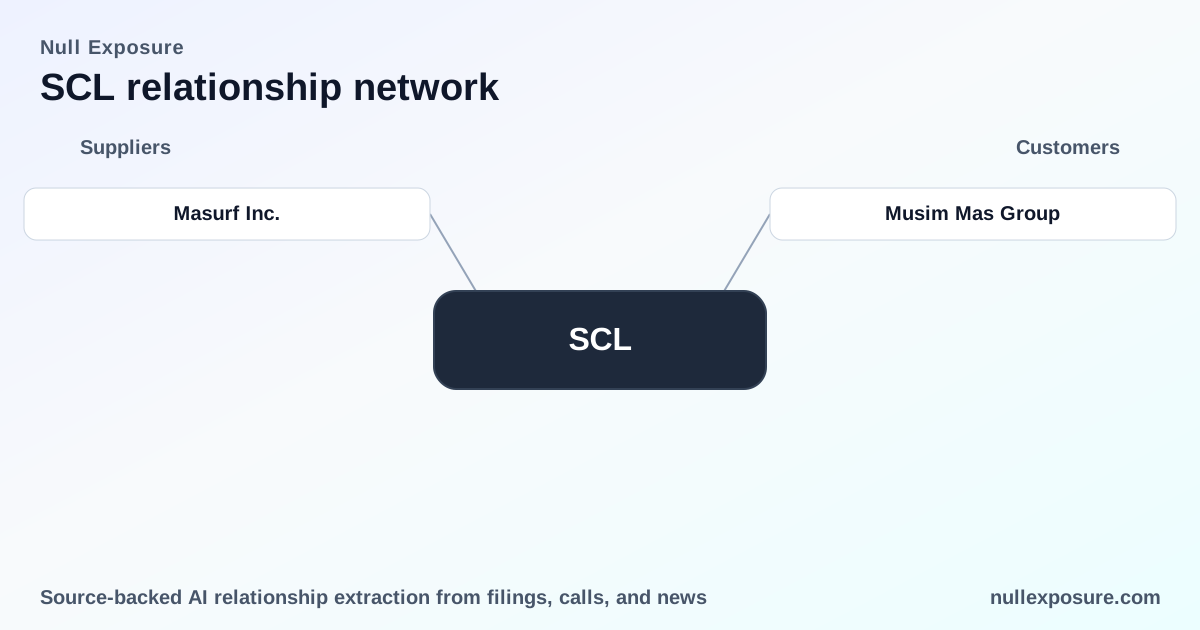
Stepan sold Philippine manufacturing assets and immediately entered a tolling agreement with Masurf Inc., allowing the company to continue serving Southeast Asian customers without interruption while shifting asset ownership. According to a ChemAnalyst news report on March 10, 2026, the post-close arrangement has Stepan-produced product flows preserved via tolling with Masurf, preserving revenue continuity and customer relationships in the region. (Source: ChemAnalyst, March 10, 2026 — coverage of sale and tolling agreement.)
Every supplier relationship found in the review
- Masurf Inc. — After divesting Philippine manufacturing assets, Stepan’s SPQI business unit will run product through a tolling agreement with Masurf, enabling uninterrupted service to Southeast Asian customers and continuity of commercial contracts. (ChemAnalyst coverage, March 10, 2026.)
This article reviews that relationship and places it in the context of company-wide supplier constraints and contract posture.
What the company-level constraints reveal about how Stepan manages suppliers
The available constraint excerpts form a coherent portrait of Stepan’s procurement and contracting behaviour:
- Short-term commodity hedging is a deliberate posture. The company disclosed open forward contracts for natural gas purchase volumes for 2025 (226,887 dekatherms) that hedge price exposure at a fixed cost, illustrating active short-term commodity risk management. This is a company filing disclosure as of December 31, 2024.
- Stepan acts as a buyer with broad supplier coverage. The firm states that 2025 contracts cover most forecasted requirements for major raw materials and that it is not substantially dependent on any single supplier, indicating a low-single-source concentration signal (company disclosure for 2025).
- Service-provider relationships and purchase obligations are part of normal operations. Filings note an investment management firm overseeing ETF investments and routine purchase obligations for raw materials, utilities and telecom services, which signals a mix of outsourced services and ongoing operational purchasing commitments (company disclosure).
Taken together, these items show a midsized chemical supplier that deliberately keeps commodity contracts short-term and diversified, preserves operational flexibility, and relies on third-party service providers for back-office and some operational functions.
Why the Masurf tolling arrangement matters to earnings and continuity
The Masurf tolling deal is not a simple vendor relationship — it is an operational continuity mechanism. Tolling preserves revenue and customer contracts while shifting capital ownership and operational risk to a third party. For investors this implies:
- Revenue continuity is preserved with minimal immediate capex from Stepan, supporting near-term top-line stability in Southeast Asia. (ChemAnalyst, March 10, 2026.)
- Margin impact depends on commercial terms and feedstock pass-through. If tolling is priced to preserve gross profit per unit, the effect on corporate margins will be neutral; if pricing transfers additional cost or capacity constraints to Stepan, margins could compress. Stepan’s overall operating margin was thin through the most recent period, which makes margin sensitivity material (company financials, FY2025).
- Liquidity and balance-sheet effects are favorable if asset sale proceeds reduce leverage, but the net impact depends on sale price, any contingent liabilities and the pricing schedule under the tolling contract (sale coverage reported in March 2026 press coverage).
For a deeper look at supplier and partner exposures across Stepan’s roster of arrangements, visit the Null Exposure supplier page at https://nullexposure.com/.
Operational and investment constraints to monitor
Investors should watch the following, each tied to the company-level signals above:
- Commodity price and hedging horizon. Short-term forward contracts limit long-dated price protection and leave Stepan exposed to multi-year commodity cycles; this necessitates monitoring natural gas and feedstock trends relative to contract renewal timelines.
- Supplier concentration and procurement flexibility. Public statements of broad coverage reduce single-vendor risk, but confirmatory diligence on contract tenor, volume thresholds and penalty clauses is necessary to judge true resilience.
- Tolling counterparty and execution risk. Tolling works only if the third party executes to spec and meets regulatory/quality standards; the Masurf arrangement preserves customers but creates counterparty reliance in that geography. (ChemAnalyst, March 10, 2026.)
- Margin sensitivity given low operating margin. Stepan’s current operating margin is compressed, so changes in commercial terms, feedstock pass-through or regional cost structures will have outsized earnings impact (company financials, FY2025).
If you require a structured supplier-risk scorecard or tracking of forthcoming contract renewals, Null Exposure provides tailored supplier monitoring — start here: https://nullexposure.com/.
Tactical investor takeaways and next steps
- Masurf tolling preserves revenue continuity in Southeast Asia but increases counterparty reliance; investors should seek contract-level transparency on pricing and duration to quantify margin impact.
- Company-level procurement signals show disciplined, short-term hedging and supplier diversification, which reduces single-vendor risk but leaves the company exposed to commodity cycles.
- Given a thin operating margin baseline, supplier agreements and tolling economics are material to near-term EPS outcomes.
For ongoing monitoring and to access structured supplier relationship intelligence for SCL and comparable names, explore Null Exposure: https://nullexposure.com/. For bespoke credit or M&A diligence around tolling arrangements and supplier counterparty risk, contact Null Exposure for a tailored engagement: https://nullexposure.com/.
Bottom line: Stepan’s Masurf tolling arrangement is a pragmatic commercial solution that protects revenue and customer continuity in Southeast Asia, while company-level disclosures show a calculated, short-term hedging and diversified procurement posture — both factors that investors should weigh when modeling margins and regional growth scenarios.