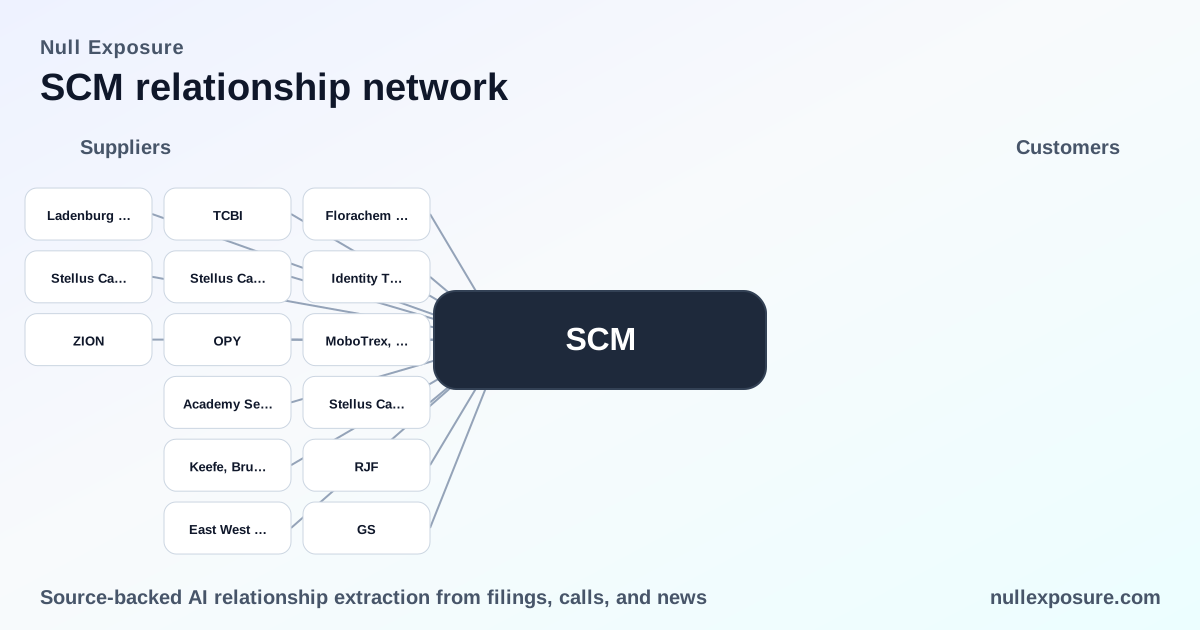
Stellus Capital Investment (SCM): Supplier Relationships and Operational Constraints investors should price in
Stellus Capital Investment Corporation is a closed-end business development company that earns management and incentive fees through an external adviser while collecting interest, fees, and capital gains from a diversified middle‑market credit portfolio. The company monetizes by deploying capital into senior secured loans, subordinated debt and selective equity positions; shareholders receive regular monthly dividends underpinned by fee income and portfolio yield. For investors assessing counterparty risk, the critical lens is not just portfolio credit quality but the concentrated operational dependency on external managers, placement agents and the credit facility syndicate that underwrite short‑term liquidity. Learn more about how we map supplier relationships at https://nullexposure.com/.
How Stellus runs and how that produces cash flow
Stellus is externally managed and administered: it pays an annual base management fee (1.75% of gross assets) plus incentive fees to its adviser, and it reimburses a portion of administrative overhead. Fee income to the external manager and recurring dividend distributions to shareholders are the two plumbing lines that determine shareholder returns. The company also uses a committed credit facility to amplify yield, making the bank lending syndicate an operational counterparty to monitor for covenant or funding stress. Given a trailing P/E near 8 and a materially covered dividend yield, investors should trade off yield stability against adviser concentration and leverage in the capital structure.
Supplier and external relationships to monitor
Below are every counterparty listed in SCM’s public results, with a short, investor‑oriented description and the source context for each mention.
- Florachem Corporation — Identified in SCM’s FY2024 10‑K as a distiller and supplier of natural citrus, pine and specialty inputs; this is a vendor mention in the 10‑K rather than a material counterparty to investment operations. According to SCM’s 2024 10‑K filing, Florachem is listed as a supplier (FY2024 10‑K).
- Identity Theft Guard Solutions, Inc. — Cited in the FY2024 10‑K for cyber breach response and monitoring services, implying SCM contracts out certain cybersecurity or monitoring capabilities (FY2024 10‑K).
- MoboTrex, LLC — Named in the FY2024 10‑K as a distributor and manufacturer of intelligent traffic solution equipment; listed among vendor relationships rather than portfolio investments (FY2024 10‑K).
- Stellus Capital Management, LLC / Stellus Capital Management — The company’s investment activities are externally managed and administered by Stellus Capital Management; the adviser receives base and incentive fees and furnishes office and administrative services. Multiple filings and press releases in 2025–2026 confirm this arrangement and note that Stellus Capital Management was set to be acquired by P10 (Finviz, PR Newswire, TradingView, and company filings across 2025–2026).
- Raymond James & Associates, Inc. — Served as lead book‑running manager on a 2025 offering for SCM, providing capital markets execution and placement services (finance.yahoo.com announcement, 2025).
- Goldman Sachs & Co. LLC — Named as a lead manager on the same offering, providing underwriting and distribution capability for SCM’s securities issuance (finance.yahoo.com announcement, 2025).
- Keefe, Bruyette & Woods, Inc. — Listed among lead managers for the 2025 offering; relevant for fixed‑income placement and distribution strategy (finance.yahoo.com announcement, 2025).
- Oppenheimer & Co. Inc. — Serving as a lead manager on the offering, participating in deal syndication and retail/institutional placement (finance.yahoo.com announcement, 2025).
- TCBI Securities, Inc. (doing business as Texas Capital Securities) — Named as a co‑manager on the 2025 offering, indicating regional distribution support and co‑manager responsibilities (finance.yahoo.com announcement, 2025).
- Academy Securities Inc. — Identified as a co‑manager in the 2025 transaction, helping syndicate and place the offering with investors (finance.yahoo.com announcement, 2025).
- East West Markets, LLC — Included among the 2025 co‑managers for the offering; another distribution channel for SCM securities (finance.yahoo.com announcement, 2025).
- Ladenburg Thalmann & Co. Inc. — Listed as a co‑manager on the 2025 capital raise, augmenting distribution reach (finance.yahoo.com announcement, 2025).
- Zions Bancorporation, N.A. dba Amegy Bank — Acts as administrative agent under SCM’s amended senior secured revolving credit agreement, a committed facility up to $335.0 million as of September 30, 2025; this is a critical liquidity counterparty for leverage and working capital (PR Newswire, 2025).
Why these relationships matter for valuation and downside
Institutional investors should view these supplier and capital markets relationships through three lenses: operational concentration, funding criticality, and market access.
- Operational concentration: The investment adviser and administrator (Stellus Capital Management) occupy a single point of failure for portfolio management, reporting and fee mechanics. Company disclosures across filings and press releases make clear the adviser provides day‑to‑day portfolio management and administrative functions (2024–2026 filings and press releases).
- Funding and covenant risk: The credit facility with Zions/Amegy is the primary committed liquidity line; its size and covenants directly affect the BDC’s ability to lever to target yields (PR Newswire, Q3 2025 filing).
- Capital markets access: Syndicate partners (Raymond James, Goldman Sachs, Keefe Bruyette & Woods, Oppenheimer and several co‑managers) determine SCM’s ability to raise equity or debt on acceptable terms; the 2025 offering roster demonstrates broad but not concentrated distribution support (finance.yahoo.com, 2025).
Operating model constraints that change the risk profile
The company disclosures provide explicit signals about how Stellus operates as a corporate counterparty:
- Contracting posture: long‑term renewal framework. The Investment Advisory Agreement continues year‑to‑year if approved by the board or a majority of holders and a majority of independent directors, which creates a renewable but not indefinite commitment for advisory services (company disclosure on advisory agreement).
- Name licensing is formalized. The firm holds a non‑exclusive, royalty‑free license to use the “Stellus Capital” name so long as the adviser or its affiliate remains the investment adviser — a direct contractual linkage to the adviser relationship (license agreement excerpt). This is an adviser‑specific obligation and increases switching friction.
- Primary role is service provision, not ownership. Stellus acts as investment adviser and administrator, furnishing personnel, facilities and back‑office services; fee flows and overhead reimbursements are explicitly documented and material to operating expenses (management and administration excerpts).
- Geography: domestic operating footprint. Senior management and adviser offices are concentrated in Houston with presence in Washington, D.C. and Charlotte — a North American operating base that shapes legal and regulatory exposure (company description).
- Relationship maturity and activity. Fees recorded for base management and amounts payable across consecutive years show an established, ongoing commercial relationship rather than a transient engagement (fee expense and payables disclosed for 2022–2024).
If you want a tailored counterparty risk brief or a concise supplier map for portfolio due diligence, start here: https://nullexposure.com/.
Bottom line and actionable signals for investors
- Adviser concentration is the single largest non‑credit risk: the adviser supplies both investment judgment and the administrative machinery that keeps the BDC running. Changes in adviser ownership (the P10 acquisition coverage in early 2026) or termination rights should be priced as operational event risk (TradingView and PR Newswire reports, 2026).
- Funding lines and syndicate breadth mitigate but do not eliminate rollover risk: the Amegy/Zions facility provides committed capacity, while a diversified group of underwriters supports capital raises. Monitor covenant tests, facility utilization and the terms of future offers, as these drive liquidity and the ability to sustain dividends.
- Minor vendor mentions (Florachem, MoboTrex, Identity Theft Guard) are operational housekeeping and not primary drivers of investment returns; they are worth monitoring for operational continuity but not valuation inflection.
For a structured supplier-risk assessment tied to portfolio and governance events, request a focused brief at https://nullexposure.com/. Investors should track adviser governance, credit facility covenants and placement agent activity as the highest‑impact data points over the next 12 months.