Scinai Immunotherapeutics (SCNI): supplier map, operational constraints, and what investors should price in
Scinai Immunotherapeutics builds and monetizes an early-stage biopharma platform by licensing and developing NanoAb immunotherapies and advancing a CDMO-enabled service line; revenue to date is limited and the company funds operations through equity instruments and strategic drawdowns under a SEPA facility while using third-party manufacturing and academic licences to progress its pipeline. Investors should view Scinai as a discovery-and-development operator whose value derives from intellectual property licensing, selective acquisitions, and commercial partnerships that de‑risk scale-up — not from steady operating cash flows. For a deeper supplier-risk view, visit https://nullexposure.com/.
How Scinai generates value and where supplier relationships fit
Scinai’s model is two-fold: (1) IP-first drug development — in‑licensing and advancing NanoAb candidates (including PC111) toward clinical proof-of-concept, and (2) CDMO and commercialization pathways — leveraging commercial partnerships and acquisitions (notably Recipharm Israel Ltd) to offer an integrated fill/finish and late-stage manufacturing capability. The company finances this progression through equity instruments (SEPA drawdowns) and commercial collaborations that shorten the route from lab to market. This hybrid model puts suppliers and licensors at the center of near-term execution risk and long-term value capture.
For a practical supplier-risk dashboard and supplier diligence, go to https://nullexposure.com/.
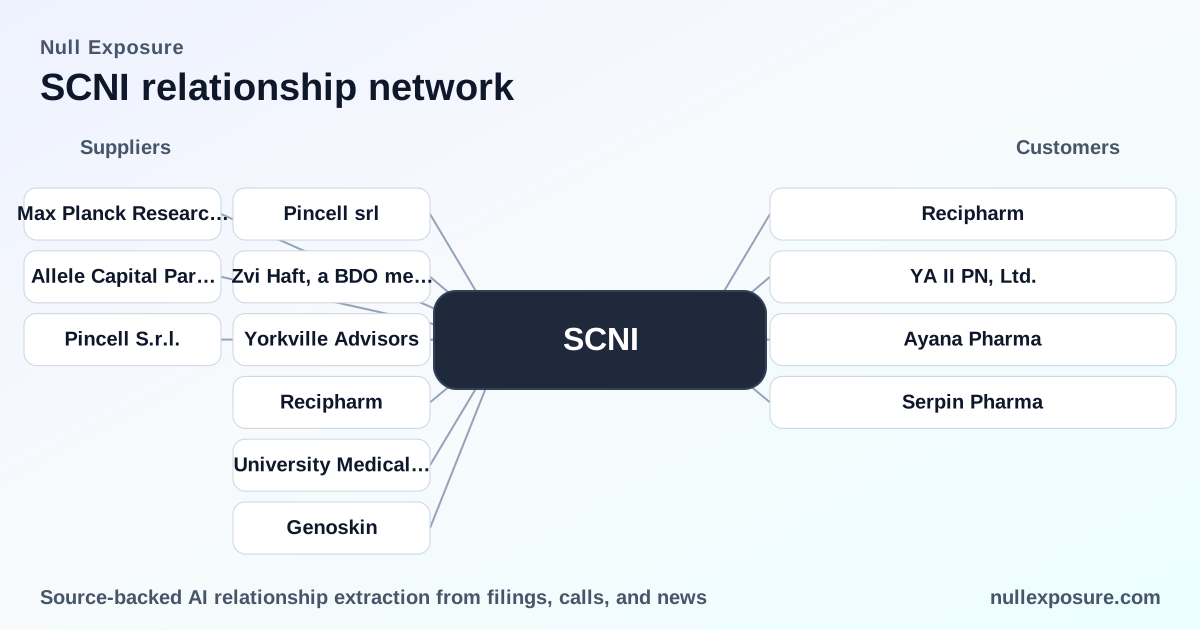
The supplier and partner map investors need in plain language
Below are every supplier / partner relationship reported in public releases and news; each entry is a concise, plain-English summary with an immediate source reference.
Pincell S.r.l.
Scinai holds a strategic option agreement to acquire Pincell S.r.l., which licensed PC111 — a first-in-class anti-Fas Ligand monoclonal antibody — into Scinai’s pipeline; Italian government clearances and licensing arrangements underpin that transaction. According to PR Newswire (FY2025), Pincell’s PC111 research is part of the package Scinai has licensed and is pursuing acquisition terms for (PR Newswire, 2026).
Recipharm
Recipharm is Scinai’s preferred partner for late‑stage clinical and commercial manufacturing, and Scinai completed the acquisition of Recipharm Israel Ltd to formalize a commercial collaboration offering clients a pathway from early development to scale manufacturing. Multiple corporate releases and industry reports document this strategic move and the preferred‑partner posture (PR Newswire; European Pharmaceutical Review; Morningstar, FY2026).
Max Planck Research Institute
Scinai acquired exclusive development and commercialization licenses for NanoAb patents from the Max Planck Research Institute, providing core intellectual property for autoimmune and infectious disease programs. The licensing arrangement is reported in coverage of the company’s IP acquisitions (Haaretz, FY2025).
University Medical Center in Göttingen
Scinai secured exclusive licenses for NanoAb technology from the University Medical Center Göttingen as part of the company’s research sourcing from German academic institutions, which expands the IP foundation for its NanoAb pipeline. This deal is described in reporting on Scinai’s academic-license acquisitions (Haaretz, FY2025).
Genoskin
Genoskin performed a preclinical human skin model study that evaluated the anti‑inflammatory effects of Scinai’s NanoAbs, producing promising translational data supporting the company’s therapeutic claims. The study and results were reported by BioSpace (FY2023).
Yorkville Advisors
Yorkville Advisors provides equity financing to Scinai under a Standby Equity Purchase Agreement (SEPA); recent drawdowns generated gross proceeds of $1.38 million, which the company used to support operations and CDMO expansion. This financing activity was disclosed in Scinai’s press releases (PR Newswire, FY2025).
Zvi Haft (a BDO member firm)
Investors ratified the appointment of Zvi Haft, a BDO member firm, as Scinai’s auditor for 2025 at the December shareholder meeting, signaling continuity in financial oversight alongside shareholder approvals for equity grants and share increases. The vote and auditor ratification were reported in The Globe and Mail (FY2025).
Allele Capital Partners
Allele Capital Partners is listed as Scinai’s investor-relations contact in corporate filings and annual reporting, indicating an outsourced IR relationship rather than an institutional strategic investor role. The contact listing appears in Scinai’s annual results release (PR Newswire, FY2025).
Operational constraints and what they imply for supplier risk
Scinai’s public disclosures and media coverage reveal key constraints that shape supplier exposure and contracting posture.
- Manufacturing dependence on academic/third‑party creators (named): Scinai explicitly states reliance on MPG (Max Planck) to create and supply NanoAbs for certain programs, establishing a direct supplier-criticality link to Max Planck and making that relationship operationally material for those programs (company excerpt referencing MPG). This elevates counterparty and IP-license risk where a single academic provider is the originator of core assets.
- Outsourced clinical and development services: The company acknowledges reliance on CROs, clinical data managers, medical institutions, and investigators to run trials; this is a company-level signal that Scinai’s operating model is heavily dependent on third-party service providers for trial execution and regulatory milestones (company disclosure excerpt).
- Preferred-partner CDMO posture: The acquisition of Recipharm Israel Ltd and the strategic commercial collaboration with Recipharm indicate a move from vendor relationships to preferred-partner status, which reduces transactional friction but increases concentration exposure if Recipharm capacity or technical suitability is constrained.
- Capital dependence on equity facilities: Drawdowns under the Yorkville SEPA suggest a funding model that is equity-financed and timing-sensitive, amplifying the importance of supplier terms that minimize cash burn during scale-up.
Together these constraints indicate high criticality of a small set of suppliers/licensors, moderate concentration risk in manufacturing partnerships, and an operating posture that outsources execution while consolidating late‑stage manufacturing control via acquisition.
(If you want a supplier-concentration scorecard and counterparty monitoring plan, see https://nullexposure.com/.)
Investment implications — risk checklist for operators and buyers
- IP concentration: Core NanoAb programs are anchored in licensed patents from Max Planck and Göttingen; licensors are strategic counterparties.
- Manufacturing concentration: Recipharm is the primary route to late-stage manufacturing; loss of access would delay commercialization.
- Funding runway: Reliance on SEPA drawdowns creates dilution and timing risk; investor appetite will determine pace of program advancement.
- Regulatory/geopolitical overlay: Cross-border licenses and an Italian acquisition involve additional regulatory clearances that affect timeline certainty.
- Operational maturity: Scinai is a development-stage firm with limited revenue (reported RevenueTTM), so supplier contracts and CDMO commitments are the levers that convert clinical progress into commercial optionality.
Final verdict and next steps for due diligence
Scinai is executing a classic small-cap biotech play: build IP through academic licences, validate in translational models, then capture scale via CDMO partnerships and selective acquisitions. For investors, the key exposures are IP‑license durability (Max Planck/Göttingen), manufacturing concentration (Recipharm), and financing cadence (Yorkville SEPA). These are the items to prioritize during supplier diligence and contract review.
If you are preparing counterparty diligence or a procurement exposure memo, begin with verified contract terms for the Max Planck license, the scope and capacity guarantees from Recipharm, and the mechanics of the SEPA facility. For tools and templates to operationalize that work, visit https://nullexposure.com/.
Disclaimer: This post synthesizes publicly reported relationships and company disclosures to frame supplier risks for investors and operators; it is not financial advice.