Social Commerce Partners (SCPQ): What the supplier map tells investors about the IPO plumbing
Social Commerce Partners Corporation monetizes by packaging social-commerce enablement under a public structure: the company sold units in a December 2025 IPO, with the financing structured so that units separate into Class A ordinary shares and warrants that now trade on Nasdaq. Revenue generation and valuation will depend on execution of its social-commerce products and successful market adoption, while capital markets relationships created at IPO become operationally critical partners for trading, transfer-agent services, and distribution. For investors evaluating counterparty risk and go-to-market durability, the immediate lens is not product metrics but the financial plumbing and concentration of market relationships that enable liquidity and shareholder servicing. Learn more on our research hub: https://nullexposure.com/
The short operating thesis for suppliers and capital partners
SCPQ is an early-stage public company whose external supplier footprint is dominated by capital markets service providers established at IPO. Its monetization is indirect at this stage: investor liquidity and capital access depend on the integrity of its underwriter, listing venue, and transfer agent rather than on large supplier contracts for core operations. That structure creates a set of operational dependencies where a small number of counterparties have outsized operational importance to shareholders and brokers.
- Concentration: Underwriting, listing, and transfer-agent services are concentrated among a few counterparties established at offering.
- Criticality: Those counterparties are critical for trading, post-IPO corporate actions (unit separation), and investor recordkeeping.
- Maturity: These relationships are transactional and public-markets oriented rather than long-term procurement ties to vendors of technology or manufacturing.
Explore the broader supplier intelligence that informs these assessments at https://nullexposure.com/
The relationships that matter — line by line
Below I enumerate every supplier relationship flagged in the public coverage around SCPQ’s IPO and the subsequent unit separation. Each entry is concise and sourced.
-
BTIG, LLC — BTIG acted as the sole book-running manager for SCPQ’s $100 million initial public offering, which places BTIG at the center of distribution and pricing execution for the deal. This role is documented in coverage of the IPO pricing on December 22, 2025 in the Chronicle Journal markets report.
Source: Chronicle Journal markets report, Dec. 22, 2025. -
Continental Stock Transfer & Trust Company — Continental serves as SCPQ’s transfer agent and handled the administrative process required for holders to separate units into Class A ordinary shares and warrants; brokers were instructed to contact Continental to process separations. This was stated in a FinancialContent press release on Feb. 11, 2026.
Source: FinancialContent press release, Feb. 11, 2026. -
The Nasdaq Global Market (Nasdaq) — The separated Class A ordinary shares and warrants were designated to trade on The Nasdaq Global Market under the symbols “SCPQ” and “SCPQW,” establishing Nasdaq as the company’s primary trading venue following the unit split announced in February 2026. This listing detail is included in the FinancialContent release on Feb. 11, 2026.
Source: FinancialContent press release, Feb. 11, 2026. -
Continental Stock Transfer & Trust Company — A GlobeNewswire placement (published via The Manila Times) repeated that holders must contact Continental to effect unit separations into shares and warrants, reinforcing Continental’s operational role in shareholder servicing for the company’s post-offering corporate action.
Source: GlobeNewswire through The Manila Times, Feb. 11, 2026. -
The Nasdaq Global Market — Finance media coverage on Yahoo Finance reiterated that the separated Class A ordinary shares and warrants trade on Nasdaq as “SCPQ” and “SCPQW,” underlining the exchange’s role in providing ongoing market liquidity.
Source: Yahoo Finance press release distribution, Feb. 11, 2026. -
Nasdaq Stock Market LLC — Initial documentation around the offering noted that the units were expected to begin trading on the Nasdaq Stock Market LLC under the ticker “SCPQU” beginning Dec. 23, 2025, indicating the company’s initial market entry instrument was the unit structure. This appears in the Chronicle Journal markets report on Dec. 22, 2025.
Source: Chronicle Journal markets report, Dec. 22, 2025. -
Continental Stock Transfer & Trust Company — A Yahoo Finance distribution of the company announcement again identified Continental as the transfer agent responsible for facilitating the separation of units into Class A shares and warrants, consistent with multiple press outlets.
Source: Yahoo Finance press release distribution, Feb. 11, 2026. -
The Nasdaq Global Market — GlobeNewswire syndication via The Manila Times also confirmed trading under “SCPQ” and “SCPQW” on Nasdaq, corroborating the exchange relationship across multiple press channels.
Source: GlobeNewswire through The Manila Times, Feb. 11, 2026.
What the relationship map implies for investors and operators
These relationships give a clear picture: SCPQ’s near-term operational risks are driven by capital markets counterparties rather than vendor diversification or supply-chain complexity. That creates a short list of implications:
- Underwriting concentration means execution risk in the IPO and aftermarket distribution was materially channeled through BTIG; investor confidence and initial float dynamics can be traced to that relationship and the book-running strategy.
- Continental Stock Transfer & Trust Company is functionally critical for shareholder recordkeeping and unit separation—any operational failure there would create direct frictions for investors trying to convert units to tradable instruments.
- Nasdaq’s role as listing venue is the primary determinant of liquidity and visible market pricing; the transition from units to separate tradable securities changed liquidity profiles and tickers across Dec 2025–Feb 2026 pressings.
These are not theoretical exposures — they are immediate operational points that investors should monitor through corporate filings and transfer-agent notices. If you evaluate counterparty resilience, prioritize review of transfer-agent communications and exchange confirmations over vendor contracts that are not yet disclosed.
Learn more about how to assess supplier concentration and market-partner risk at https://nullexposure.com/
Bottom line and next steps for due diligence
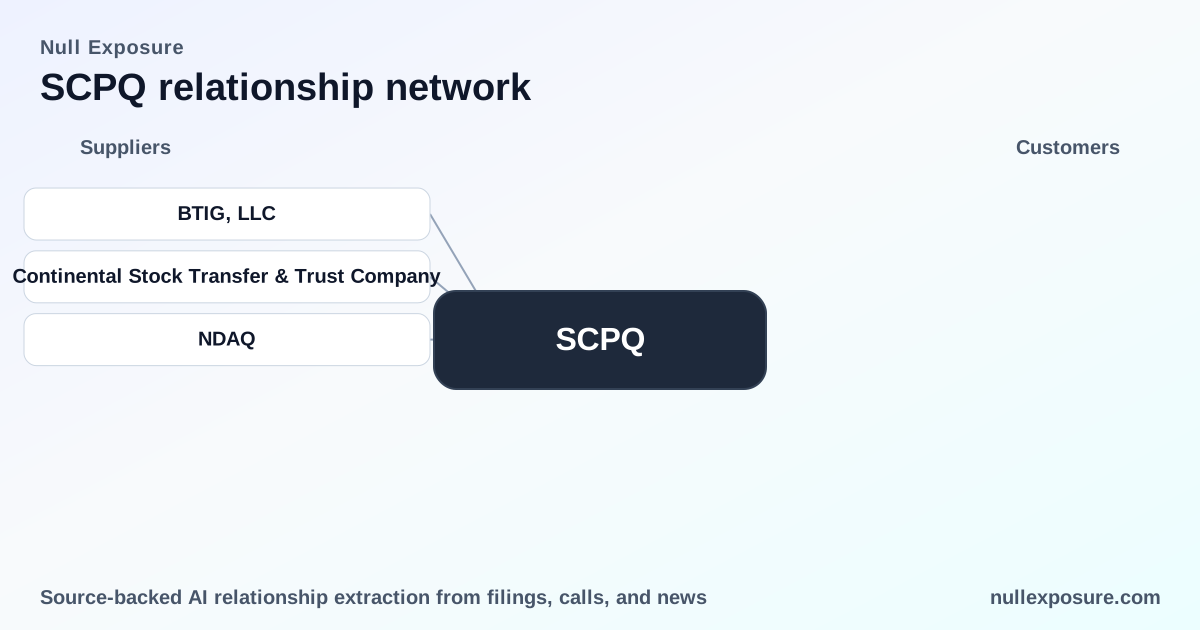
Social Commerce Partners is an enterprise whose early public life is defined by a tight set of capital-markets suppliers: BTIG (underwriter), Continental (transfer agent), and Nasdaq (exchange). For investors, those relationships are the functional backbone of liquidity and shareholder servicing until product revenues scale and broader operational suppliers are disclosed.
- Monitor transfer-agent notices and broker instructions for any unexpected delays in unit separation or post-listing corporate actions.
- Track Nasdaq filings and trading statements for changes to listing status or ticker usage that affect liquidity.
- Review underwriter disclosures in any shelf or secondary offerings for concentration or follow-on issuance plans.
If you want structured supplier intelligence and ongoing monitoring for SCPQ and similar issuers, visit our research center: https://nullexposure.com/
Key takeaway: SCPQ’s supplier risk today is concentrated and actionable—control points are the IPO distribution, transfer-agent operations, and the exchange listing. These are where governance, continuity planning, and investor friction will show up first.