Shoe Carnival (SCVL): Supplier concentration is a central operating risk — and a revenue driver
Shoe Carnival is a U.S. specialty footwear retailer that monetizes foot traffic and assortment through owned stores and e-commerce, buying branded product and reselling it to consumers at scale. The company’s commercial model depends on large national brands for assortment, and those brand relationships directly drive a substantial portion of top-line sales and gross margin. Investors should evaluate SCVL not as a commodity retailer but as a distributor whose P&L and inventory turns are highly sensitive to a handful of supplier partners. For a quick provider-level view, visit https://nullexposure.com/.
What the supplier picture means for revenue and valuation
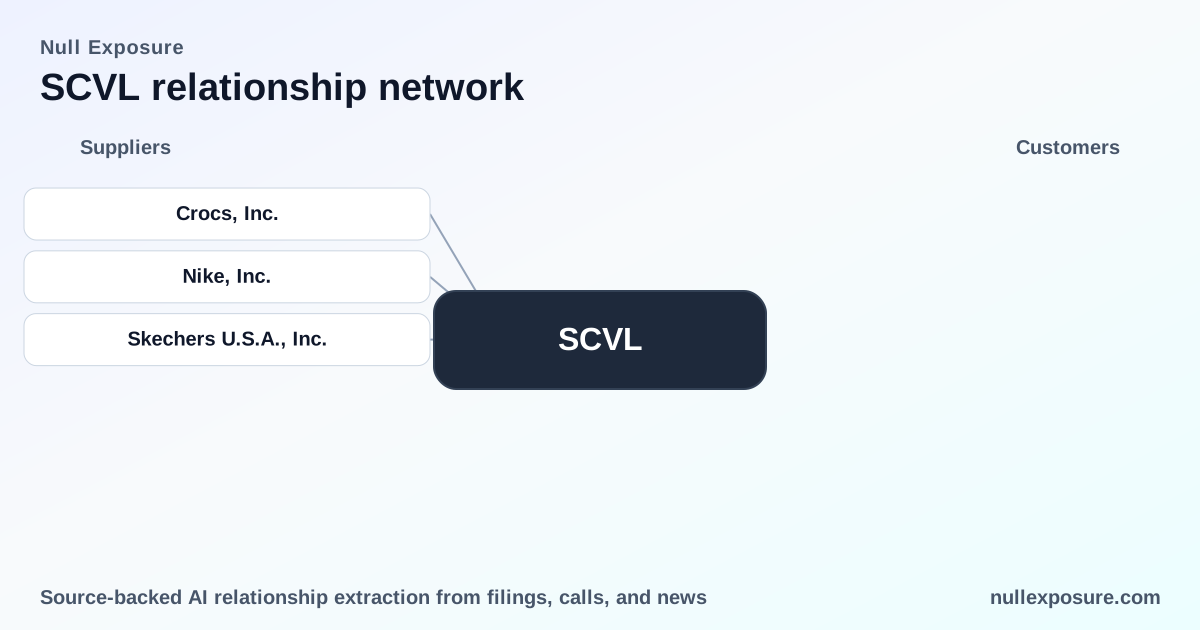
Shoe Carnival’s most important suppliers are national athletic and casual-footwear brands whose products are high-volume, high-turn SKUs for the chain. Collectively, Nike, Skechers and Crocs represented roughly half of SCVL’s Net Sales in Fiscal 2024, a level of concentration that both supports predictable SKU-level demand and creates single-source exposures for the retailer’s gross revenue and in-store traffic economics. This concentration amplifies the impact of assortment decisions, promotional calendars and vendor allocation priorities on SCVL’s profitability and working capital cycle.
The vendor list you need to know: Nike, Skechers, Crocs
Shoe Carnival’s 2025 Form 10‑K discloses the following supplier relationships with explicit sales shares and trends. Below are plain-English summaries of each vendor’s commercial importance.
Nike, Inc.
Nike accounted for approximately 24% of Net Sales in Fiscal 2024, rising from 20% in FY2023 and 14% in FY2022, marking Nike as Shoe Carnival’s largest single-brand revenue contributor. According to Shoe Carnival’s FY2025 10‑K filing (filed February 2025), Nike’s share of sales has grown materially over the three-year window, reflecting heavy consumer demand and likely favorable allocation of core athletic SKUs.
Source: Shoe Carnival FY2025 Form 10‑K (filed 2025‑02‑01), fiscal periods noted in the filing.
Skechers U.S.A., Inc.
Skechers represented roughly 13% of Net Sales in Fiscal 2024, a stable contribution consistent with 14% in FY2023 and 13% in FY2022; Skechers is a steady mid-sized brand partner for SCVL’s assortment. The FY2025 10‑K lists Skechers among the top vendors driving store-level SKU turnover and recurring promotional activity.
Source: Shoe Carnival FY2025 Form 10‑K (filed 2025‑02‑01), fiscal periods noted in the filing.
Crocs, Inc.
Crocs accounted for approximately 11% of Net Sales in Fiscal 2024 and FY2023, making it a substantial, higher-margin casual brand in SCVL’s portfolio. Shoe Carnival’s FY2025 10‑K highlights Crocs as a repeat high-volume supplier that contributes meaningfully to net sales and likely to basket-average metrics.
Source: Shoe Carnival FY2025 Form 10‑K (filed 2025‑02‑01), fiscal periods noted in the filing.
(For a consolidated supplier exposure dashboard and deeper counterparty analytics, see https://nullexposure.com/.)
How contract posture and other constraints shape risk and optionality
Shoe Carnival’s public disclosures include several operational constraints that frame the supplier risk profile. These are company-level signals unless a filing excerpt explicitly identifies a specific partner.
-
Short-term contracting posture: Shoe Carnival states it does not have long-term contracts with suppliers; procurement is executed under typical retail purchasing arrangements. This structure grants the company flexibility to reallocate shelf space and change promotional partners quickly, but it also leaves SCVL vulnerable to vendor allocation decisions and sudden supply constraints when brands prioritize other channels. Evidence in the FY2025 10‑K specifically notes that the company has no long-term contracts and anticipates Nike, Skechers and Crocs will continue as high-volume vendors for FY2025.
-
High counterparty concentration and criticality: The three named suppliers collectively accounted for approximately 48% of Net Sales in Fiscal 2024 (and ~45% in FY2023), a level the filing categorizes as material and critical to the business. For investors, this translates into concentration risk—disruptions or reallocation from any of these brands will have outsized revenue and inventory impacts.
-
Manufacturing and geography posture: Shoe Carnival reports its primary footwear manufacturers are located in China, which signals exposure to APAC supply-chain dynamics, freight costs, lead-time variability and geopolitical trade risk. This is a company-level manufacturing note rather than a vendor-specific contract term.
-
Active, high-volume relationships: The filing indicates Nike, Skechers and Crocs are active and expected to remain high-volume vendors into the next fiscal year, supporting near-term revenue visibility but not providing the legal protections of long-term supplier agreements.
-
Spend scale: Given Shoe Carnival’s Net Sales base (roughly $1.2 billion as described in the filing) and the 48% concentration, implied spend with these partners sits in a high band that is consistent with $100M+ annual revenue flows tied to this small group of vendors.
Together these constraints describe a retailer with operational flexibility but commercially concentrated exposure: short-term supplier relationships reduce lock-in but increase the practical dependency on vendor allocation and manufacturing continuity.
Investment implications — what to watch next
-
Upside levers: If SCVL sustains or grows its Nike share, the top-line and gross-margin profile will improve because Nike is the largest single brand contributor and drives traffic. The company’s P/E (trailing ~8.4) and EV/EBITDA (~6.8) already price in modest growth expectations; supplier-led revenue gains could re-rate multiples on a reacceleration of comps.
-
Key risks: Concentration around three large brand partners and reliance on China-based manufacturing create single-event downside: vendor allocation shifts, factory disruptions, or brand-level retail strategy changes would materially affect inventory turns and promo cadence. Short-term contracts amplify this sensitivity because Shoe Carnival lacks long-term legal protections for supply or exclusive allocations.
-
Operational monitoring: Track brand-level sales cadence in quarterly commentary, vendor allocation language in subsequent 10‑Q/10‑K filings, and any changes in the company’s sourcing geography or inventory-light initiatives. Also watch for updates on promotional funding or marketing partnerships with Nike, Skechers and Crocs that would indicate deeper commercial alignment.
For a concise counterparty exposure brief and supplier risk scoring for buy-side due diligence, visit https://nullexposure.com/.
Bottom line and recommended action
Shoe Carnival’s economics are fundamentally shaped by its supplier mix: heavy reliance on a small number of national brands creates both a revenue engine and a concentration risk. The absence of long-term supplier contracts grants operational agility but reduces downside protection if brand strategies change. Investors evaluating SCVL should treat supplier outcomes as a primary driver of revenue volatility and consider monitoring vendor sales shares and supply-chain signals as part of any investment thesis.
To see an investor-focused supplier map and monitor changes in SCVL’s counterparty exposure over time, go to https://nullexposure.com/.