374Water (SCWO): Supplier Relationships and Operational Signals investors need to know
374Water (ticker SCWO) develops and sells environmental remediation technology focused on pollution control, monetizing through project-based system sales, engineering partnerships, and service contracts with municipal and industrial clients. Revenue is concentrated in early commercial deployments and retrofit projects where the company supplies equipment and coordinates engineering execution with third‑party consultants and manufacturers. For investors evaluating supplier risk, the company’s vendor posture — single-source components, outsourced manufacturing, and explicit project partners — is the core operational variable to watch. Learn more at https://nullexposure.com/.
Why the supplier picture matters for valuation and risk
374Water is a small-cap industrial with market capitalization roughly $42 million and TTM revenue of $1.9 million, while operating with negative EBITDA and a negative EPS profile, which makes execution on a handful of commercial projects mission‑critical to financial performance. High insider ownership (42%) and low institutional ownership (9%) increase governance and liquidity considerations for investors who require clear visibility into supplier continuity and project delivery timelines.
The company’s reported metrics — Price-to-Sales around 22 and EV/Revenue above 22 — price in a premium for future growth and scaling. That premium converts into downside sensitivity if suppliers or manufacturing partners become bottlenecks, given the company’s small revenue base and reliance on discrete large projects for revenue recognition.
What public reports list as supplier relationships
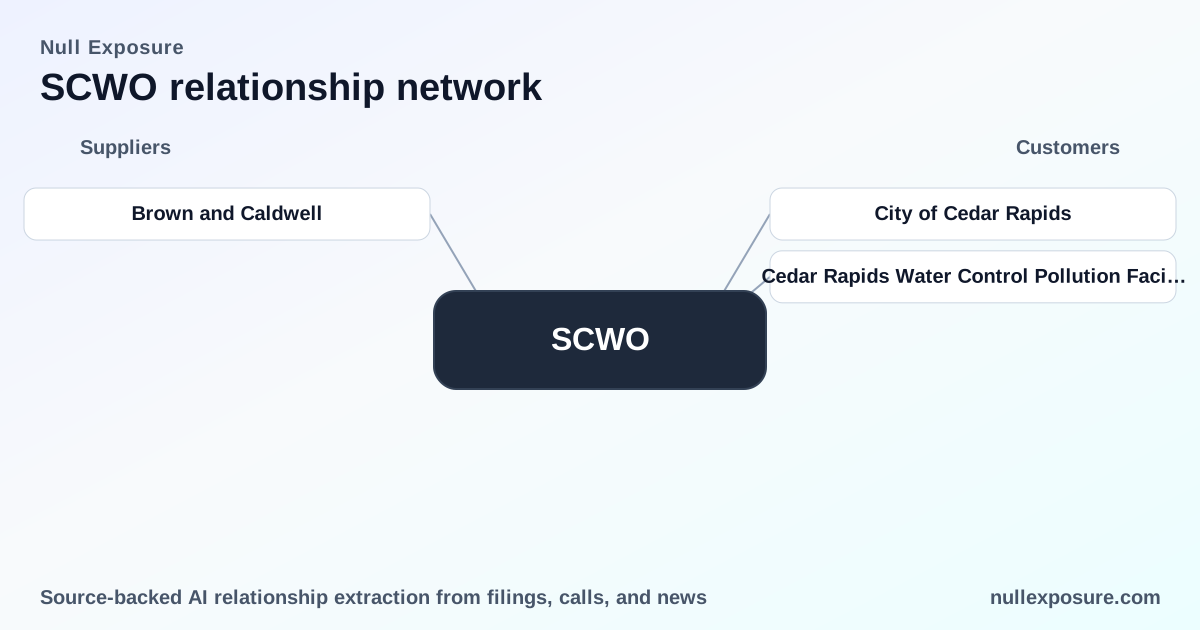
The public relationship data set for SCWO lists a primary engineering consultancy partner, reported across multiple news placements. Each listed relationship below reflects a discrete mention in the results.
- Brown and Caldwell — Proactive Investors reported that 374Water partnered with the Cedar Rapids Water Pollution Control Facility on a PFAS biosolids destruction project and that the engineering consultancy Brown and Caldwell is involved in the project. (Proactive Investors, March 10, 2026; see https://www.proactiveinvestors.com.au/companies/news/1084991/374-water-partners-with-city-of-cedar-rapids-on-pfas-biosolids-destruction-project-announces-board-appointment-1084991.html)
- Brown and Caldwell — An alternate Proactive Investors URL repeats the same project partnership phrasing, confirming the engineering consultancy’s participation in the Cedar Rapids engagement. (Proactive Investors, March 10, 2026; see https://www.proactiveinvestors.com.au/companies/news/1084991)
- Brown and Caldwell — A third listing of the same piece appears on Proactive Investors’ US site and reiterates Brown and Caldwell’s role on the Cedar Rapids PFAS project. (Proactive Investors, March 10, 2026; see https://www.proactiveinvestors.com/companies/news/1084991)
Key takeaway: public reporting identifies Brown and Caldwell as the engineering partner on a named municipal project, and the multiple mentions across Proactive Investors confirm the project-level collaboration as a visible part of 374Water’s go‑to‑market execution.
If you want a consolidated view of supplier and partner signals across filings and press coverage, visit https://nullexposure.com/ for deeper supplier analytics.
Company-level supplier constraints and operational posture
374Water’s public disclosures and supplemental notes convey several company-wide supplier characteristics that shape operational risk and contracting behavior:
- Critical materiality and partial single‑sourcing: The company states that a limited number of suppliers are single source for certain components, and that these suppliers are treated as critical to product quality and development. The disclosure also notes that redundant sources have been qualified for many critical materials, indicating an operational focus on maintaining supply continuity.
- Outsourced manufacturing dependency: The company documented that in 2023 it purchased a substantial portion of manufacturing services from a single third‑party vendor, signaling concentration in manufacturing outsourcing rather than in‑house production.
- Contract lifecycle activity: A Supplemental Manufacturing & Services (M&S) Agreement was formally terminated as of December 31, 2024, indicating contractual churn in manufacturing relationships and suggesting transition or re‑procurement activity.
These constraints translate into four operational signals investors should consider:
- Concentration risk: single-source components and heavy reliance on an external manufacturer create vulnerability to supplier failure, longer lead times, and pricing pressure.
- Contracting posture: 374Water relies on discrete agreements with manufacturing and engineering partners rather than vertically integrating production, which is consistent with a capital-light scaling strategy but increases counterparty risk.
- Criticality: suppliers are labeled critical to product integrity, making supplier performance central to project success and revenue realization.
- Maturity and transition: the termination of an M&S agreement signals active changes in the vendor base, which can either reduce risk (if replaced with robust alternatives) or temporarily constrain throughput.
Operational and investment implications
374Water’s business model is project-driven and partner-dependent. The balance between outsourced manufacturing and engineering partnerships enables faster market entry but places the company’s margin and schedule risk in the hands of suppliers and consultants. With revenue under $2 million TTM and negative operating margins, successful delivery of projects like the Cedar Rapids PFAS biosolids destruction engagement is essential to achieving scale and justifying current valuation multiples.
Key investment considerations:
- Liquidity and runway: limited revenue and negative EBITDA require disciplined cash management and reliable supplier execution to avoid project delays that would strain finances.
- Execution risk: supplier concentration and a terminated M&S agreement are material operational risks that can delay deployments and revenue recognition.
- Partner leverage: securing large engineering consultancies such as Brown and Caldwell for project integration is a positive signal for technical credibility, but does not eliminate manufacturing or supply chain risk.
Risk checklist for active diligence:
- Confirm replacement or redundancy for any terminated manufacturing agreements.
- Verify lead times and single‑source component exposure for upcoming projects.
- Assess contractual protections (liquidated damages, performance bonds) in partner agreements to protect revenue timelines.
If you are modeling project delivery timelines into valuation, full supplier transparency is essential — see more on supplier and counterparty signals at https://nullexposure.com/.
Bottom line — what investors should do next
374Water trades as a high‑beta execution story: valuation assumes successful scaling of a limited number of commercial projects while navigating concentrated supplier relationships. Brown and Caldwell’s role on the Cedar Rapids project is a positive credibility signal, but company-level disclosures about single-source components, significant outsourced manufacturing, and a terminated M&S agreement increase operational risk until redundancy and contract stability are demonstrably restored.
Actionable steps:
- Request contract-level clarity on manufacturing replacement plans and single‑source component inventories.
- Monitor project milestones and public announcements tied to engineering partners for early indicators of revenue recognition.
- Prioritize counterparty diligence (manufacturers and engineering consultancies) before increasing exposure.
For a centralized resource on supplier and partner intelligence to inform these diligence steps, visit https://nullexposure.com/.