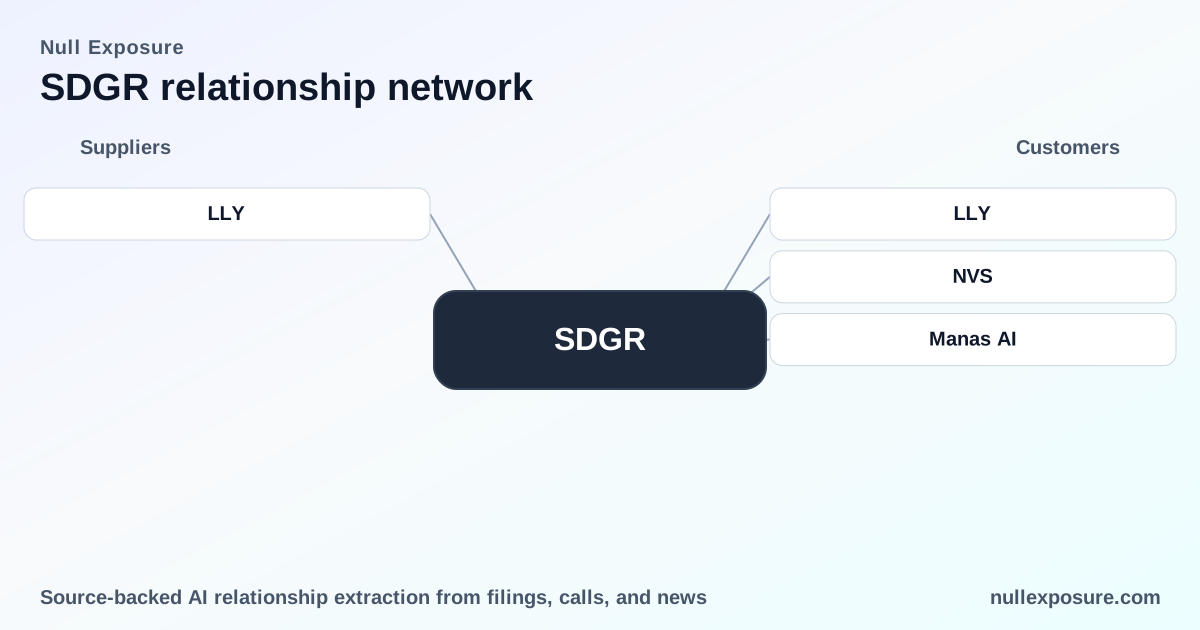
Schrodinger (SDGR) supplier profile — a focused supplier play with enterprise software upside and outsourced operations
Schrodinger operates a physics-based software platform used to discover novel molecules and to support drug development and materials science; it monetizes through enterprise software (LiveDesign), collaboration and partnership revenues with pharmaceutical firms, and services that embed its models into partner workflows. The company's reported Revenue TTM of $255.9M and Gross Profit of $142.6M reflect a business that is already commercial, while negative operating margins and EBITDA indicate investment in growth and R&D rather than short-term profitability. For a quick empirical view and supplier intelligence, visit https://nullexposure.com/.
How Schrodinger runs its business and how that shapes supplier relationships
Schrodinger’s commercial model blends licensed software, hosted enterprise informatics, and collaboration-driven R&D engagements with large pharma. Software licensing and LiveDesign integrations drive recurring and platform-level revenue, while bespoke collaborations and drug-discovery programs produce milestone and services income. The company reports a market capitalization near $937.6M and a Price/Sales of 3.66, indicating market expectations for continued growth rather than near-term profit realization.
Operationally, Schrodinger outsources critical operational functions: the company discloses that it does not operate manufacturing facilities and relies on third-party contract manufacturers for drug substance and finished product, and it outsources substantially all hosted software infrastructure to third-party hosting services. Those disclosures are material to supplier risk and contract design because the company’s uptime, regulatory compliance, and clinical timelines are dependent on external partners. The company also reports long-term occupancy and equipment leases extending through 2037, which signals a long-term contracting posture on the facilities side and a fixed-cost base for operations.
Active supplier relationships on the record
Lilly — enterprise integration with LiveDesign
Schrodinger announced that Lilly’s TuneLab platform will be integrated into LiveDesign, Schrodinger’s enterprise informatics solution, signaling direct product-level adoption by a major pharmaceutical partner. According to a company press summary published March 10, 2026, the integration positions LiveDesign as a place-based hub for partner workflows and demonstrates commercial uptake by a top-tier pharma customer. (Source: Biospace press release, March 10, 2026.)
Constraints and company-level signals that govern supplier risk
Schrodinger’s public disclosures and filings surface a set of constraints that frame how the company contracts and which supplier exposures matter most:
- Long-term contracting posture: The company reported multiple operating leases and a finance lease with expiry dates through 2037 and a remaining weighted average lease term of 11 years as of December 31, 2024, creating fixed occupancy obligations and a degree of operational inflexibility.
- Outsourced manufacturing model: Schrodinger explicitly discloses that it does not own or operate manufacturing facilities and relies on third-party contract manufacturers for all raw materials, drug substance, and finished drug product for preclinical, clinical and potential commercial supply.
- Outsourced services and hosting: The company uses third-party CROs, research collaboratives, and third-party hosting services for its hosted software solutions and clinical development infrastructure.
- Active supplier posture: Filings indicate active outsourcing of hosted infrastructure and continued reliance on CROs, pointing to ongoing supplier engagements rather than legacy or one-off contracts.
- Segments — manufacturing and services: Public statements categorize Schrodinger’s supplier exposure across manufacturing (CROs/CMOs) and services (hosting, clinical services), which are distinct operational risks to monitor.
These constraints are company-level signals and should be treated as the baseline operating model when evaluating any supplier relationship.
What this means for investors and operators — commercial and operational implications
The Lilly-LiveDesign integration is proof of commercial traction with strategic partners and strengthens Schrodinger’s position as an enterprise informatics provider to big pharma. For investors, integrations such as this one translate into higher potential recurring revenue and stickiness, because LiveDesign becomes a workflow hub for partner data and models.
At the same time, the company’s reliance on third-party manufacturing and CROs increases operational risk for clinical-stage programs and any future commercial launches. Outsourced hosting concentrates technology risk into external providers — uptime, SLAs, and data residency protections become investment-relevant items. The long-term lease commitments add a fixed-cost lever that reduces short-term flexibility during revenue fluctuations.
Operationally, procurement and vendor management are strategic functions for Schrodinger. For operators evaluating partnerships with SDGR, the priorities are clear: robust SLAs with hosting providers, multi-sourcing or escalation pathways for CMOs/CROs, and contractual terms that protect revenue recognition tied to collaborative projects.
For context, Schrodinger’s financial profile shows negative operating margin (-19.7% TTM) and negative EBITDA, underscoring that the company is investment-oriented rather than cash-flow generating at scale today; analyst coverage skews positive with consensus target price near $23.67 and most analysts rated Buy or Hold. Institutional ownership is reported at about 108% in company data, an indicator of concentrated professional interest in the story and a potential liquidity consideration for large counterparty moves.
For an operational intelligence briefing or to track additional partner disclosures as they are announced, visit https://nullexposure.com/.
Practical monitoring checklist for SDGR supplier exposure
- Track announced enterprise integrations (like Lilly/LiveDesign) as leading indicators of recurring revenue; require contract-duration and renewal terms when available.
- Assess manufacturing continuity plans: confirm whether Schrodinger’s CMOs have secondary suppliers, regulatory track record, and capacity for scale.
- Validate hosting SLAs and data controls for LiveDesign: uptime guarantees, response times, and breach notification timelines are critical.
- Monitor lease obligations and fixed-cost leverage against quarterly revenue performance to understand flexibility in downturns.
Final assessment and next moves
Schrodinger combines a software-first commercial engine with outsourced operational execution, which creates a hybrid supplier risk profile: commercial upside driven by platform integrations with major pharma (exemplified by Lilly) and operational exposure concentrated in third-party manufacturing and hosting. For investors, the core trade-off is growth and platform stickiness versus external operational dependencies. For operators and procurement teams, the emphasis is on contract terms that mitigate single-vendor risk and secure uptime and supply continuity.
If you need ongoing monitoring of SDGR supplier disclosures, partner integrations, and contract signals, see the full research hub at https://nullexposure.com/. For a tailored briefing or supplier risk scorecard for Schrodinger, start here: https://nullexposure.com/.