Smith Douglas Homes (SDHC): Supplier relationships, underwriting partners, and operational constraints investors should price in
Smith Douglas Homes operates a land-light homebuilding model: it purchases finished lots through short-term lot-option contracts from third-party land developers and focuses capital and operating resources on building and selling production homes across a cluster of Southeastern U.S. metros. The company monetizes primarily through home sales revenue and periodic capital-market access—most recently positioning itself for an IPO—with external underwriting and legal partners supporting the transaction. Operational scalability depends on trade partner networks for construction, and a single licensed ERP platform for workflow and enterprise functions. Learn more about the supplier and partner landscape at https://nullexposure.com/.
Who’s backing the IPO and managing the paperwork
-
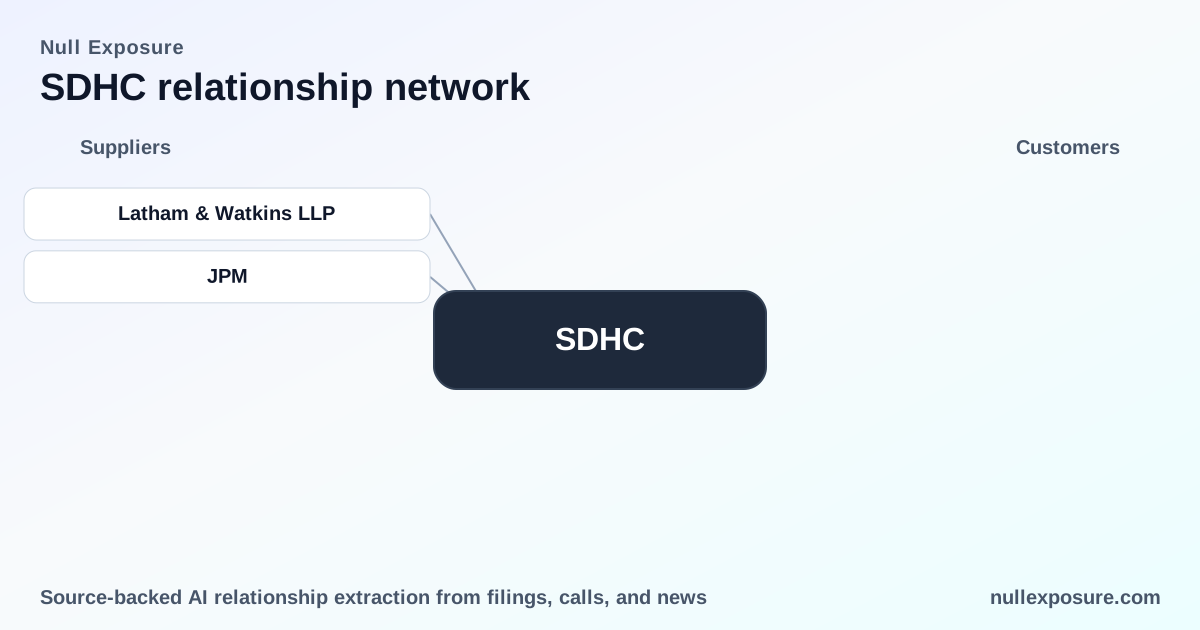
Latham & Watkins LLP represented Smith Douglas in the offering, with a capital markets team leading the equity documentation and deal execution; the representation is documented in firm announcements tied to the offering (FY2024) and reported by Latham’s press note on the transaction. According to the firm’s public note, partners Marc Jaffe, Senet Bischoff, and Benjamin Cohen led the representation (source: Latham & Watkins announcement, FY2024 — https://www.lw.com/en/news/2024/01/latham-watkins-represents-smith-douglas-homes-corp-in-ipo).
-
J.P. Morgan served as the lead underwriter on the IPO and carried responsibility for deal structuring and market distribution; coverage of the IPO noted J.P. Morgan’s role and recent IPO performance trends (reported in a HousingWire piece referencing the IPO effort, FY2023 — https://www.housingwire.com/articles/smith-douglas-goes-big-and-bold-with-a-100-mil-ipo-in-the-works/).
These two relationships cover the public-market execution and legal counsel aspects of SDHC’s capital raise; both are transactional but strategically important to the company’s access to equity markets.
What the supplier constraints reveal about the operating model
Company disclosures surface a compact set of supplier and technology constraints that define how SDHC runs its business:
-
ERP dependency and single-vendor licensing: SDHC exclusively licenses SMART Builder from an entity affiliated with the Founder Fund for sales, purchasing, scheduling, production, accounting, servicing, and other functions; the company states that interruption or failure of this ERP would adversely affect operations, which signals a single-point-of-failure technology dependency (company filing disclosure).
-
Trade partners under short-term contracts: As typical in the homebuilding sector, SDHC generally does not enter long-term commitments with trade partners and suppliers, relying instead on short-term, project-level engagement and lot-option purchasing for finished lots—this reduces capital tied to land but increases operational procurement volatility (company disclosure).
-
Role diversity with suppliers: The firm acts predominantly as a buyer of finished lots and as a licensee of critical software, while also relying on a network of service providers for building trades and cybersecurity functions. The company documents use of external cybersecurity service providers for endpoint monitoring, independent assessment, and regular backups (company disclosure).
-
Mature, long-standing supplier relationships: SDHC reports long-standing, mutually beneficial relationships with many trade partners, which the company leverages for cost savings and consistent practices—this indicates supplier relationship maturity and embedded operational routines rather than ad hoc sourcing (company disclosure).
-
Geographic concentration across Southeastern metros: Operations are concentrated in metropolitan Atlanta, Birmingham, Chattanooga, Central Georgia, Charlotte, Greenville, Huntsville, Nashville, Raleigh and Houston. That footprint creates regional demand exposure and supplier network effects within contiguous markets (company disclosure).
-
Counterparty identification is sometimes opaque: The company purchases finished lots via lot-option contracts from various third-party land developers or land bankers; the disclosures label these counterparties collectively rather than by name, which creates operational opacity around land-supply concentration and counterparty credit (company disclosure).
Collectively, these constraints sketch an operating profile that is land-light and capital-efficient but operationally concentrated on a licensed ERP and on short-term supplier contracting.
Key implications for investors and operators
-
Concentration risk in software licensing is material. The exclusive license of SMART Builder from an entity affiliated with Founder Fund creates a critical dependency: ERP performance and vendor stability directly influence construction throughput and financial reporting processes (company filing). This elevates vendor risk above what a diversified internal platform would present.
-
Short-term contracting lowers balance-sheet land exposure but increases execution risk. Lot-options and transient trade contracts reduce fixed capital tied to land inventory, improving return-on-capital in expansion phases; however, this posture amplifies execution risk during input-cost inflation, labor tightness, or localized supply-chain disruption.
-
Mature trade relationships are a stabilizer, not a cure. Long-standing supplier ties reduce sourcing friction and deliver predictable unit costs, but do not eliminate systemic platform risk created by the ERP dependency and localized geographic exposure.
-
Operational transparency should be monitored. Because lot suppliers and some trade counterparties are not individually disclosed, investors need to monitor backlog disclosures, concentration language, and any footnotes about counterparty credit or supplier disputes for signs of supply constraints.
Concentration, contracting, and risk monitoring in practice
Operational and credit diligence should prioritize these areas:
-
ERP resilience and vendor arrangements: verify the contractual terms of the SMART Builder license and contingency plans for outages or vendor discontinuance. The company’s own disclosures label this as critical.
-
Lot-option counterparties and land concentration: request schedules or disclosure detail around the largest land counterparties and any geographic concentration within the listed metro footprint.
-
Trade partner continuity and cost pass-throughs: examine how the company handles escalating material and labor costs under short-term contractor relationships and whether margin protection measures exist in sales pricing or change orders.
For actionable diligence and updated relationship mapping, visit https://nullexposure.com/ for supplier intelligence and filings aggregation.
Final read: where value and risk intersect
Smith Douglas Homes presents a capital-efficient, land-light growth model supported by mature trade relationships and a clear capital markets playbook; the primary counterweight to that value is single-vendor ERP concentration and the operational volatility inherent in short-term supplier contracting. The underwriting and legal partners—J.P. Morgan and Latham & Watkins—cover access to the public markets, but operational continuity sits largely outside those transactional relationships and squarely with the licensed ERP and the company’s supplier network.
If you are evaluating SDHC for investment or counterparty exposure, prioritize ERP license terms, vendor continuity plans, and lot-option counterparty disclosures. For ongoing supplier and capital-markets intelligence on SDHC and comparable builders, explore analysis and source documents at https://nullexposure.com/.