SDHY — Supplier relationships and what investors should price in
Pgim Short Duration High Yield Opportunities Fund (NASDAQ: SDHY) is an investment vehicle run under the PGIM umbrella that earns through management fees and the net performance of its holdings, with investor returns driven by yield capture in short-duration high-yield credit. For investors and operators assessing third‑party risk, the available reporting identifies a single named relationship and a lack of disclosed supplier constraints — both signals that shape diligence priorities: confirm manager arrangements, clarify operational criticality, and validate disclosures against regulatory filings. For immediate reference and deeper supplier-mapping services, see https://nullexposure.com/.
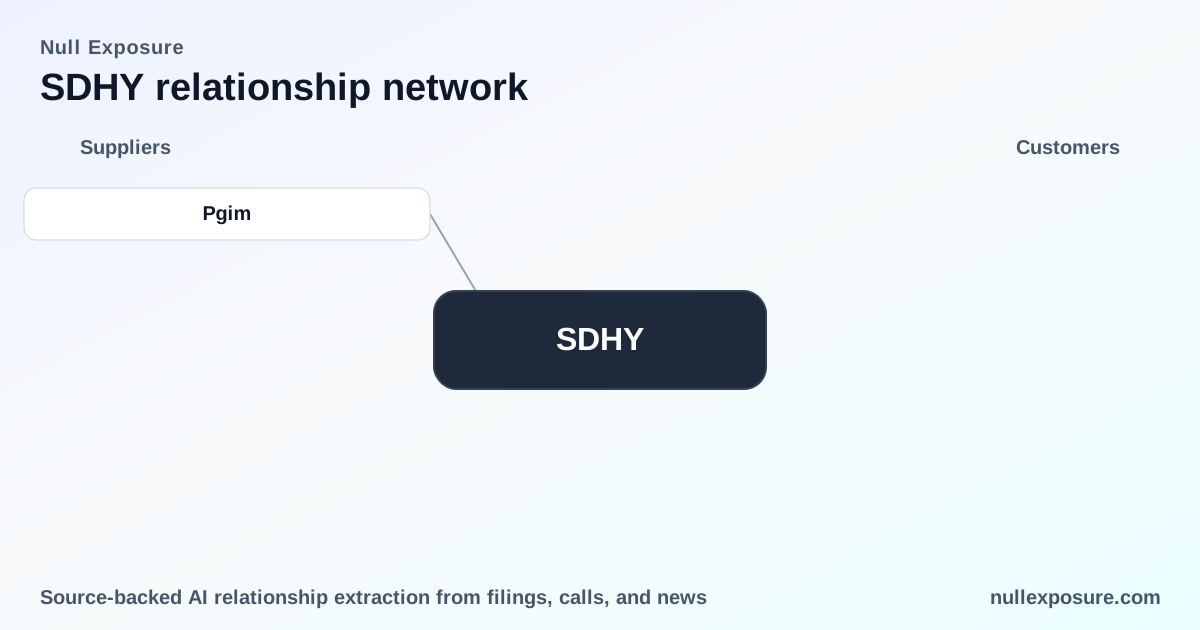
One clear relationship: Pgim is the sponsor/manager cited
Pgim appears as the only named counterparty in the sample of public reporting for SDHY. According to a news release on StockTradersDaily (March 10, 2026), the item summarized key findings for Pgim Short Duration High Yield Opportunities Fund (NASDAQ: SDHY) for FY2025, indicating media and analyst attention on the fund’s performance and positioning. Source: StockTradersDaily news release (2026-03-10) — https://news.stocktradersdaily.com/news_release/139/Responsive_Playbooks_and_the_SDHY_Inflection_102025041202_1760991122.html.
This single relationship entry confirms the fund’s visible operating connection to PGIM-brand management and highlights that investor scrutiny is focused on the manager’s investment playbook and execution rather than a complex web of external suppliers.
What the absence of supplier constraints signals at the company level
The supply-side constraint inventory returned no explicit contractual limitations or vendor-specific caveats. That absence is itself a company-level signal: there are no disclosed supplier constraints in the reviewed sources, which means public reporting does not identify external contractual dependencies that would materially restrict SDHY’s operations in the examined period.
Operational implications of that signal:
- Contracting posture: Public materials do not document restrictive supplier arrangements; investors should treat the fund as operating under standard investment‑management agreements unless confirmed otherwise by prospectus or SEC filings.
- Concentration: No disclosed supplier concentration is reported; however, lack of disclosure is not a substitute for direct confirmation of whether PGIM is the sole critical vendor for portfolio management and operations.
- Criticality and maturity: With no supplier constraints named, the manager relationship is the primary operational linkage visible to the market; maturity of that relationship should be validated by contractual term sheets and service-level commitments found in offering documents.
Investors should rely on regulatory filings and prospectus exhibits to obtain contract-level detail rather than public reporting alone.
How investors and operators should interpret these signals
SDHY’s public footprint on supplier relationships is narrow. That structure produces straightforward risks and benefits:
-
Benefits:
- Operational simplicity reduces counterparty mapping complexity for investors.
- Transparent manager identity (PGIM) allows evaluation against an established firm rather than an opaque vendor network.
-
Risks:
- Single-manager dependency raises operational concentration and execution risk if manager terms or personnel change.
- Disclosure gap on vendor contracts and service levels forces investors to obtain primary documents to assess operational resilience.
Practical steps for investor due diligence:
- Request the fund prospectus and latest SEC filings to confirm management agreements and fee schedules.
- Obtain the investment management agreement or a summary of material sub‑advisory arrangements to confirm termination rights, notice periods, and transition playbooks.
- Validate operational continuity plans and custody arrangements for credit holdings.
For institutional-grade supplier mapping and sharper counterparty visibility, consider commissioning a focused diligence project through https://nullexposure.com/.
Relationship summaries — concise, source-backed notes
- Pgim: A news release on March 10, 2026, highlighted key findings for Pgim Short Duration High Yield Opportunities Fund (NASDAQ: SDHY) for FY2025, signaling market commentary focused on the fund’s strategy and results. Source: StockTradersDaily press release (2026-03-10) — https://news.stocktradersdaily.com/news_release/139/Responsive_Playbooks_and_the_SDHY_Inflection_102025041202_1760991122.html.
These relationship summaries capture every named entity in the available reporting; no other supplier relationships were identified in the reviewed material.
Risk framing and where to push for documents
For investors, the necessary follow-up documents are standard but non-negotiable:
- Fund prospectus and statement of additional information for fee mechanics and management authority.
- Investment management agreement and any sub-advisory contracts for termination and conflict provisions.
- Recent regulatory filings (Form N-PORT, N-CEN, or equivalent) that disclose holdings, risk exposures, and material service providers.
A mid-cycle check of these documents will reveal whether management concentration is an operational risk or purely a disclosure artifact. If you need structured supplier diligence or a verified vendor map, detailed services are available at https://nullexposure.com/.
Final takeaways and next steps for investors
- Primary finding: Public reporting identifies PGIM as the focal manager for SDHY and no other named suppliers; this simplifies initial counterparty analysis but increases the importance of confirming manager terms directly from fund documents.
- Disclosure gap: The absence of supplier constraints in public sources is a company-level signal that requires investors to demand primary contract documentation to evaluate real-world operational risk.
- Actionable move: Retrieve the fund prospectus and investment management agreement, and validate custody and transition mechanisms before assigning material capital.
To convert this analysis into operational assurance, commission targeted supplier diligence or request the fund’s governance exhibits through https://nullexposure.com/.