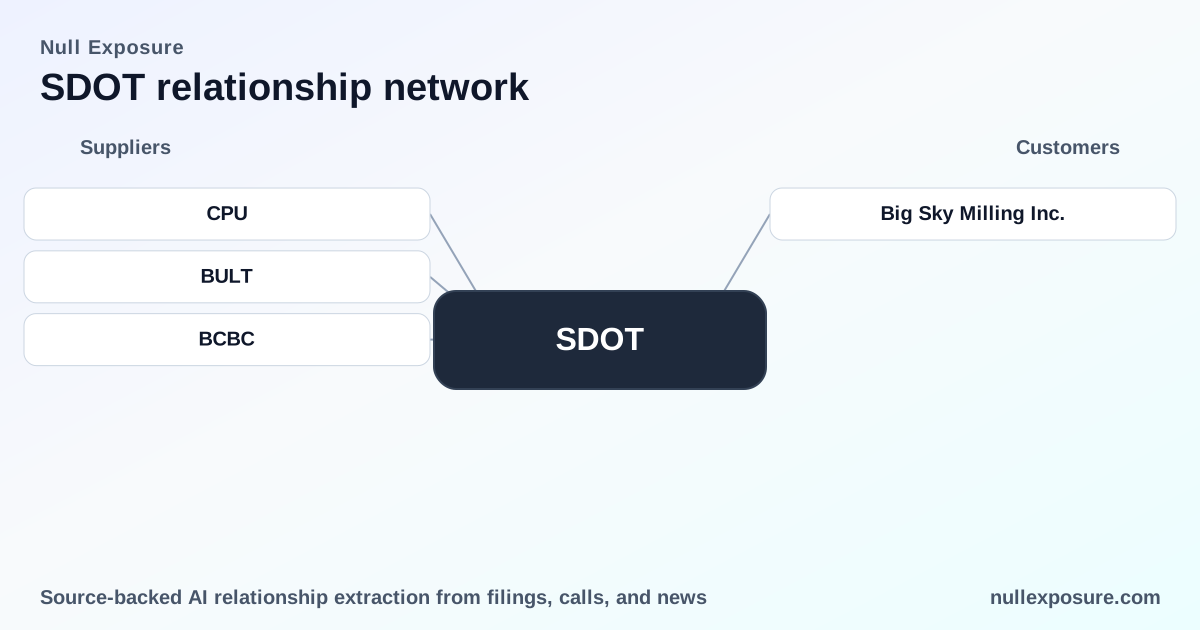
SDOT supplier relationships: what investors need to know
Sadot Group Inc. (NASDAQ: SDOT) operates as a global food supply-chain and agri‑commodities merchant, monetizing through physical commodity procurement, wholesale distribution margins, and value‑added services such as supply‑chain advisory and sustainability offsets. The company funds operations and hedges commodity exposures, contracts service providers for market entry and treasury strategy, and uses standard transfer‑agent infrastructure for corporate actions. Revenue comes from commodity margins and fees tied to logistics and value‑added services; treasury and corporate governance choices shift risk onto the balance sheet.
If you want a consolidated view of SDOT’s supplier and advisor relationships, start here: https://nullexposure.com/
Who shows up in SDOT’s supplier footprint and why it matters
SDOT’s disclosed supplier and advisor relationships are limited in number but strategically diverse: a traditional transfer agent, a digital‑asset advisor for a new treasury strategy, and public filings that show the company acting as both buyer and seller in commodity and offset markets. These touchpoints indicate a hybrid operating posture — core commodity operations augmented with experimental treasury initiatives and formalized outsourcing for market entry.
Detailed relationship-by-relationship breakdown
Computershare, Inc.
Computershare functions as Sadot’s transfer agent and handled shareholder communications for the company’s reverse stock split. According to a CityBiz report covering the reverse split announcement, Computershare will provide post‑split ownership information to stockholders, a routine but necessary corporate‑governance relationship (CityBiz, March 10, 2026: https://www.citybiz.co/article/743529/sadot-group-announces-1-for-10-reverse-stock-split/).
Bitcoin Bancorp — GlobeNewswire engagement
Sadot retained Bitcoin Bancorp to design and implement an institutional Bitcoin treasury strategy, signaling a deliberate move to allocate corporate cash into digital assets under advisory guidance. GlobeNewswire reported the engagement as a formal retention by Sadot to develop a comprehensive Bitcoin treasury approach (GlobeNewswire, Sept 8, 2025: https://www.globenewswire.com/news-release/2025/09/08/3146003/0/en/Bitcoin-Bancorp-OTC-BULT-Retained-by-NASDAQ-Listed-Sadot-Group-NASDAQ-SDOT-to-Develop-Institutional-Bitcoin-Treasury-Strategy.html).
Bitcoin Bancorp — secondary press confirmation
A market write‑up repeated that same advisory hire in the context of short‑term share price moves, noting the Bitcoin Bancorp engagement as part of the company’s public narrative on strategy. The commentary reiterated the retention and was published in a sector outlet discussing SDOT’s market reaction to unrelated news (TS2 Tech, Sept 2025: https://ts2.tech/en/sadot-group-sdot-stock-skyrockets-183-after-trumps-cooking-oil-tweet-whats-next/).
Operating constraints and what they tell investors
Company filings and contractual disclosures supply a set of operational constraints that shape supplier dynamics and internal strategy.
-
A forward purchase agreement disclosed in filings shows Sadot Agri‑Foods committed to buy 180,000 Verified Carbon Units (VCUs) under a Verified Emissions Reduction Purchase Agreement (VERPA), with payment recorded as a prepaid forward on carbon offsets. This is evidence of prepaid procurement and balance‑sheet recognition of environmental credits (company filing, Sept 12, 2023; payment recorded Sept 23, 2023).
-
Sadot’s public disclosures state the company uses hedges to eliminate commodity price exposure between supplier purchase and customer delivery, indicating a buyer’s contracting posture that prioritizes price certainty and margin protection rather than directional commodity bets (company filing language on hedging programs).
-
A services agreement dated November 14, 2022 shows Sadot LLC engaged Aggia LLC FC to provide advisory services for acquiring and managing wholesale food operations in the UAE, classifying Aggia as a named service provider in the company’s expansion playbook. This demonstrates formalized outsourcing for market entry and operational setup (company filing, Nov 14, 2022).
Taken together, these constraints signal a company that: locks in inputs via prepaid contracts, uses hedging to protect margins, and relies on named service providers for geographic expansion. That operating posture lowers exposure to raw price volatility but concentrates execution risk around counterparties and advisory relationships.
What these relationships mean for investors — risks and levers
-
Concentration and criticality: Computershare is a standard transfer‑agent relationship; it is operationally critical for corporate actions but not economically material. Bitcoin Bancorp is strategically material: engagement with a digital‑asset advisor creates a new treasury‑management vector that can materially affect reported cash and volatility of SDOT’s balance sheet.
-
Contract maturity and enforceability: The VERPA prepaid arrangement shows multi‑year commitment and prepayment accounting; this raises counterparty and delivery risk tied to the offset project and can complicate liquidity profiles if credits are delayed or impaired.
-
Contracting posture: The firm’s stated hedging approach shows risk‑avoidant commercial behavior — SDOT locks price exposure between purchase and delivery. This reduces commodity earnings volatility but increases reliance on counterparty execution, margin management, and collateral practices.
-
Governance and transparency: Engagement of external advisors for treasury choices signals a willingness to pursue novel balance‑sheet strategies that require robust governance oversight; investors should weigh management’s track record in executing non‑core financial strategies.
If you want a concise, investor‑grade summary and tracker for these supplier relationships, get the full view here: https://nullexposure.com/
Investor takeaways and recommended actions
-
Monitor treasury allocations closely. The Bitcoin Bancorp engagement is a strategic inflection — any material allocation to Bitcoin will increase reported volatility and require disclosure of custody, counterparty, and valuation policies.
-
Assess counterparty execution risk. The prepaid VERPA and hedging posture shift execution risk to counterparties and service providers; investors should watch for delivery confirmations, impairment disclosures, and margin/collateral terms.
-
Treat corporate actions as operational windows. Transfer‑agent notices around the reverse split handled by Computershare are routine but signal periods when shareholder composition and voting power can shift.
-
Practical next steps for analysts: review the company’s latest SEC filings for treasury policies and offset project confirmations, request counterparty confirmations or disclosures on custody and governance, and track NewsWire updates on any executed Bitcoin purchases.
For a consolidated feed and ongoing coverage of SDOT supplier relationships, visit: https://nullexposure.com/
Bottom line: SDOT runs a disciplined, hedged commodity business while experimenting with treasury diversification and outsourced market‑entry services. Investors should price in lower commodity earnings volatility but higher operational and treasury complexity.