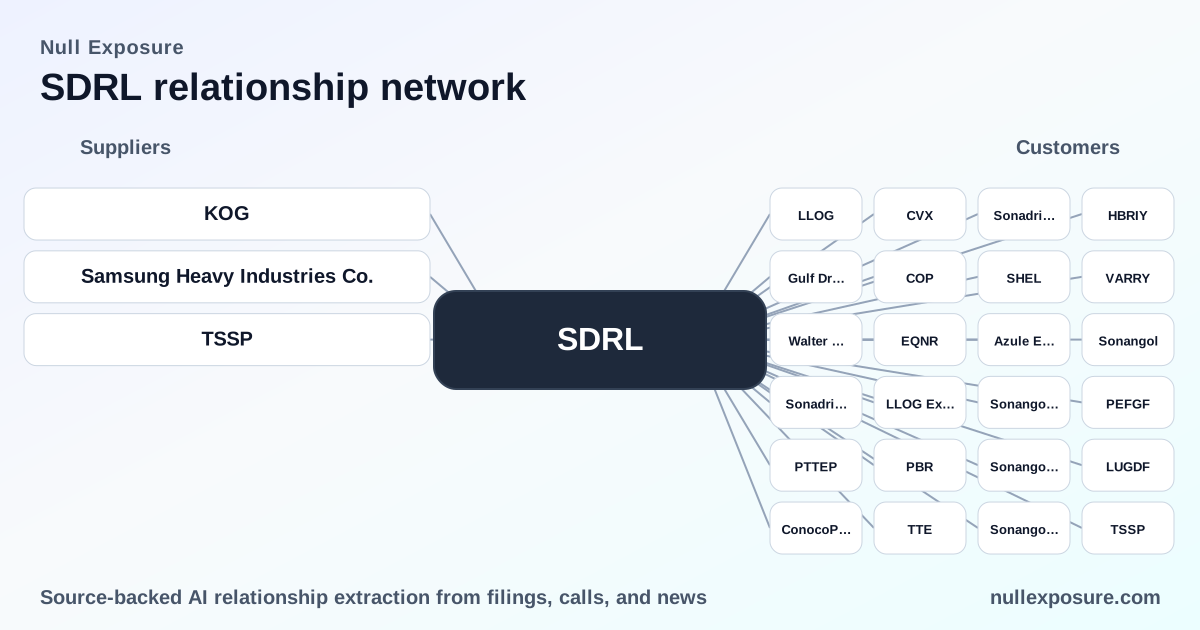
Seadrill (SDRL) — Supplier Map and Strategic Implications for Investors
Seadrill operates and monetizes by leasing and operating offshore drilling units under a mix of long-term charters and short-term arrangements, selling drilling services and dayrates to oil and gas operators while outsourcing significant equipment, manufacturing, and specialist services to third parties. Revenue stability comes from long-term charters and backlog; operational leverage and cost control depend on supplier performance, IP ownership, and targeted technology partnerships. Learn more about supplier intelligence at https://nullexposure.com/.
Quick take for investors: what the supplier relationships reveal
Seadrill’s supplier profile reflects a dual posture: enterprise-grade partnerships to modernize capability combined with reliance on third-party manufacturing and service providers that control key equipment and intellectual property. Company-level signals indicate both long-term contractual revenue visibility and short-term lease exposure, and disclosures emphasize dependence on third-party providers for parts, crew, and equipment. These characteristics create a balanced risk/return profile: predictable cash flows from long-term charters versus operational execution risk tied to suppliers.
How contracting posture and supplier maturity shape risk
- Contracting mix: Evidence of long-term charter agreements delivers revenue certainty and asset utilization visibility, while short-term operating leases create tactical flexibility and episodic volatility. This mix reduces downside in stable markets and preserves upside when dayrates recover.
- Supplier criticality: Seadrill depends on external manufacturers and service providers for both routine operations and advanced technology; suppliers control a large share of IP related to drilling units. Operational continuity and margin expansion hinge on supplier quality and negotiating leverage.
- Maturity and strategic alignment: Partnerships that co-develop automation and digital-control solutions demonstrate a move toward operational efficiency and crew-cost reduction—important drivers of long-term margin improvement.
Supplier relationship: Kongsberg Maritime — technology partnership
According to a March 2026 report on Cyprus Shipping News, Seadrill joined Kongsberg Maritime and Hanwha Drilling in an alliance to pioneer remote dynamic positioning (DP) technology that centralizes automation and reduces cognitive load on rig crews, designed to improve safety, efficiency, and performance at sea (https://cyprusshippingnews.com/2026/03/09/kongsberg-maritime-seadrill-and-hanwha-drilling-forge-alliance-to-pioneer-remote-dynamic-positioning-dp-technology/). This is a strategic, capability-building relationship that targets operational risk reduction and lower crew-related costs.
Supplier relationship: Samsung Heavy Industries Co. — shipbuilding provenance
A Korea Herald article profiling the West Capella notes the rig was built by Samsung Heavy Industries in 2008 and highlights its maximum drilling depth capability, establishing Samsung Heavy as the original shipbuilder behind at least one of Seadrill’s assets (https://www.koreaherald.com/article/10020267). This reflects Seadrill’s reliance on established shipbuilders for core asset construction and the long service life of those assets.
Supplier relationship: Trendsetter (TSSP) — well-intervention equipment deployment
Market coverage in 2025 and 2026 documents the maiden deployment of Trendsetter’s well-intervention equipment on Seadrill units, including first-time regional deployments on rigs like the Sevan Louisiana and contracts tied to Gulf and Angola work (see SimplyWallStreet and TradingView/Zacks reporting, FY2025: https://simplywall.st/stocks/us/energy/nyse-sdrl/seadrill/news/seadrill-sdrl-is-up-79-after-new-gulf-and-angola-contracts-e; https://www.tradingview.com/news/zacks:6d3f8cfb7094b:0-seadrill-expands-backlog-with-new-rig-contracts-in-us-gulf-angola/). Trendsetter supplies specialized intervention equipment that extends Seadrill’s service scope and supports project execution in critical basins.
Constraints and what they mean for valuation and operations
Company-level excerpts provide explicit operational constraints that investors should treat as structural features of Seadrill’s business model:
- Mixed contract terms: The company reports assets under long-term charter agreements alongside short-term operating leases, indicating cash-flow visibility combined with tactical exposure to dayrate swings.
- Service-provider reliance: Management acknowledges dependence on third-party suppliers, manufacturers, and subcontractors for parts, crew, and equipment; operational performance is directly tied to supplier reliability.
- Supplier IP ownership: The majority of IP relating to drilling units and related equipment is held by suppliers, a signal that Seadrill is exposed to supplier bargaining power and potential licensing constraints.
These constraints are company-level signals rather than attributes of any single supplier relationship.
If you want a consolidated supplier risk dashboard for portfolio analysis, visit https://nullexposure.com/ to see how these signals integrate across counterparties.
Investment implications — opportunities and key risks
- Opportunity: Strategic tech alliances (Kongsberg + Hanwha) are a positive signal for long-term cost reduction and improved safety metrics—factors that support premium dayrates for modernized rigs. Upgrading operational tech directly improves operating margins and reduces incident risk.
- Risk: Supplier-held IP and heavy reliance on external manufacturers create concentration and execution risk; failure or pricing pressure from a key supplier would affect uptime and margins.
- Balance: The coexistence of long-term charters and short-term leases provides both stability and optionality; this is a defensive feature in downturns and a lever for upside in recovering markets.
Recommended next steps for investors and operators
- For investors: prioritize tracking changes in charter composition and backlog roll-offs; monitor announcements about supplier IP transfers or long-term supply contracts that could improve Seadrill’s negotiating position.
- For operators and procurement leads: focus on contract design that secures spares, IP access, and service-level commitments from manufacturers; evaluate technology partnerships for measurable efficiency gains before capital allocation.
- For both audiences: integrate supplier-concentration metrics with financial models to stress-test scenarios around equipment downtime or supplier pricing shocks.
Final action: for a deeper supplier risk and relationship briefing tailored to portfolios or asset-level diligence, start with the source hub at https://nullexposure.com/. For analyst-ready reports and ongoing monitoring, see https://nullexposure.com/ for subscription options and contact information.
Bottom line: Seadrill’s commercial footing is strengthened by long-term charters and strategic partnerships, but valuation must account for supplier-controlled IP and third-party operational exposure. Investors who price in both the revenue visibility and execution risk will reach the most resilient conclusions.