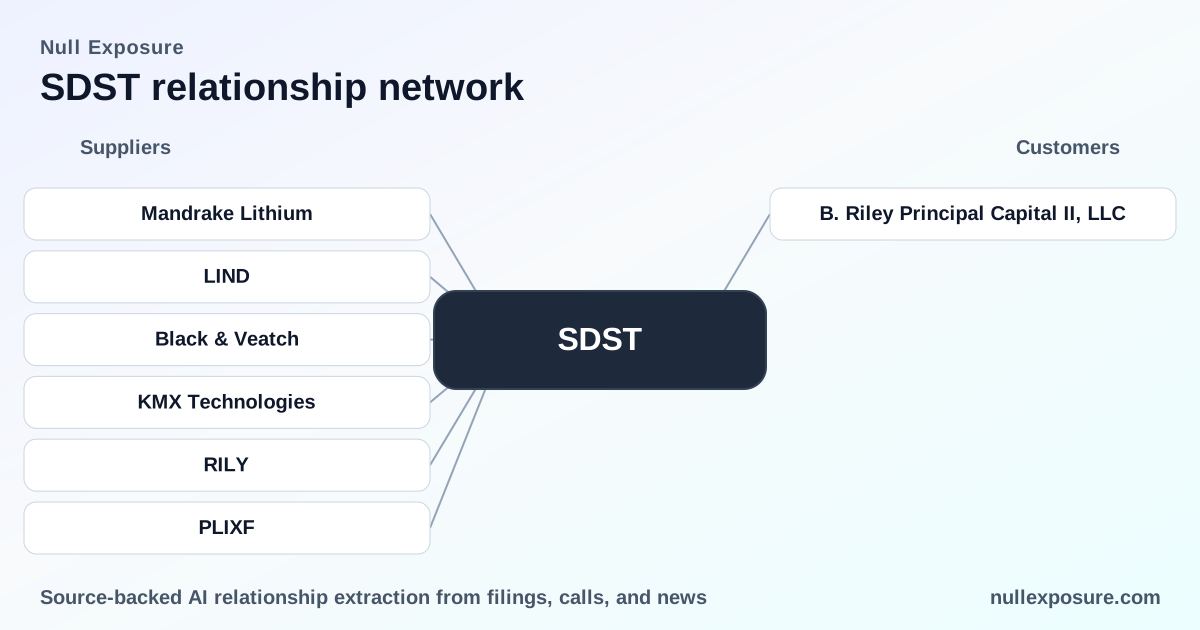
Stardust Power (SDST) — supplier map and what it means for investors
Stardust Power operates as a developer and integrator of downstream lithium refining capacity centered on the Muskogee, Oklahoma refinery project; it monetizes through captive production of battery‑grade lithium carbonate, strategic feedstock supply agreements, licensing of concentration technology, and equity/funding arrangements that underwrite construction and ramp. The company’s commercial model blends long‑term feedstock commitments, an exclusive technology license, and incremental capital raises — a profile that concentrates execution risk around a small set of technical and financing partners. Learn more about supplier risk and relationships at https://nullexposure.com/.
Quick investor thesis
Stardust is executing a build‑to‑own refinery strategy: secure lithium chloride feedstock via supply contracts, deploy licensed concentration technology to convert brine and chloride into battery‑grade carbonate, and fund construction through equity placements and purchase agreements. Value realization depends on successful feedstock delivery, technology deployment under the KMX license, and timely access to growth capital.
For a deeper look at counterparty exposure and procurement posture, visit https://nullexposure.com/.
Who Stardust is working with — concise relationship notes
Below are every supplier/partner relationship surfaced in public reporting and news items for SDST, summarized in plain English with source references.
Mandrake Lithium
Stardust executed a supply agreement with Mandrake Lithium to help secure part of the 13,500 metric tons of lithium carbonate equivalent (LCE) feedstock allocated to the Muskogee refinery project. This is presented as a post‑quarter supply arrangement supporting initial refinery feedstock needs. (GlobeNewswire, Q3 2025 financial release; QuiverQuant summary, November 2025.)
Prairie Lithium
Prairie Lithium is the counterparty to a separate supply agreement that, together with Mandrake, covers the 13,500 mt LCE feedstock position for Muskogee, positioning Stardust to lock initial input volumes for commissioning and early production. (GlobeNewswire, Q3 2025 financial release; QuiverQuant, November 2025.)
Black & Veatch
Stardust retained Black & Veatch to perform an Independent Engineering Red Flag Report for the Muskogee lithium refinery; the report and follow‑up commentary described the technical program as low risk and provided an independent view on constructability and design readiness. (GlobeNewswire press release December 10, 2025; InvestingNews coverage, December 2025; TradingView reporting.)
KMX Technologies
Stardust signed an exclusive licensing agreement with KMX Technologies for vacuum membrane distillation (VMD) and related systems, granting Stardust the right to deploy KMX’s concentration technology and obligating exclusive purchase of KMX VMD Units during the license term. (InvestingNews coverage of the licensing agreement; GlobeNewswire and press statements, February 2025–December 2025.)
Lind (LIND)
Stardust completed a private financing with Lind on December 23, 2025, raising approximately $4.0 million in gross proceeds, providing near‑term liquidity to support project development milestones. (TradingView news release summarizing the private placement, December 2025.)
B. Riley Principal Capital II, LLC (RILY)
Stardust entered a common stock purchase agreement with B. Riley Principal Capital II allowing the company to raise up to $10.0 million over 36 months subject to customary terms, creating a committed—but discretionary—equity‑draw financing source. (Quantis/QuantiSnow summary of the financing facility, early 2026.)
Operating model signals and contractual posture investors should weight
Stardust’s public materials and the relationship set reveal an operating model with specific, investable characteristics:
-
Contracting posture — mixed long‑term plus exclusive technology license. The company pursues long‑term supply agreements for feedstock while holding an exclusive license for KMX’s VMD technology; the KMX license includes an exclusive purchase obligation for VMD units, creating a technology‑vendor lock. (KMX license terms disclosed in company filings and press releases, February–December 2025.)
-
Concentration — supplier and technology focal points. Feedstock volume commitments are concentrated across a small number of suppliers (Prairie, Mandrake) and a single licensed technology partner (KMX), which increases single‑point failure risk if a counterparty underdelivers. This is a company‑level signal drawn from multiple supply and licensing announcements.
-
Criticality — technology and engineering signposts. The Black & Veatch independent engineering review reduces technical uncertainty and acts as a critical gate for capital deployment; engineering validation is a necessary precursor to broad funding and construction, not a nice‑to‑have. (Black & Veatch IE Report coverage, December 2025.)
-
Maturity of relationships — stage varies from active to prospect. Financing relationships with Lind and B. Riley are active funding mechanisms; supply agreements for initial feedstock are executed, but other potential upstream arrangements referenced in filings still read as prospective non‑binding MOUs. The company’s procurement posture blends active contractual commitments with ongoing prospecting for upstream sources.
-
Spend and procurement scale. The company disclosed an engineering agreement in the low‑millions (FEL‑3 contract scale), signaling mid‑single‑digit million dollar vendor spend bands and staged capital outlays ahead of larger construction costs. This constrains near‑term supplier spend and implies incremental contracting as the project scales.
Mid‑article takeaway and action
For investors, the key risk/reward hinge is execution of feedstock delivery and strict adherence to the KMX license purchase path; for operators, ensuring redundancy around feedstock and contingency plans for unit procurement will materially reduce schedule risk. Track the public updates and counterparties at https://nullexposure.com/ for ongoing supplier exposure monitoring.
What this means for portfolio risk and contract diligence
- Capital risk: equity facilities (Lind, B. Riley) provide stop‑gap funding but are not a full construction finance stack; expect additional capital raises or project finance to be required to complete the full 50,000 mtpa ambition.
- Supply risk: initial feedstock secured for commissioning reduces immediate ramp risk but concentration across a small number of suppliers elevates medium‑term supply chain exposure.
- Technology risk: the exclusive KMX license locks Stardust to a single concentrator technology; Black & Veatch’s IE report lowers engineering execution risk but does not eliminate operational or commissioning uncertainty.
- Contract maturity: a mix of executed supply and finance agreements plus non‑binding MOUs suggests staged de‑risking, not a turnkey supply chain.
Final read: operational priorities for the next 12 months
Operators and investors should watch three variables closely: (1) actual feedstock deliveries against contracted volumes, (2) timing and milestones tied to KMX VMD unit deliveries, and (3) successive tranches of financing beyond initial Lind and B. Riley facilities. These will determine whether the Muskogee refinery transitions from de‑risked engineering to revenue‑generating operation.
If you want a consolidated, ongoing view of Stardust’s supplier relationships and counterparty risk, visit https://nullexposure.com/ for monitoring and supplier intelligence.