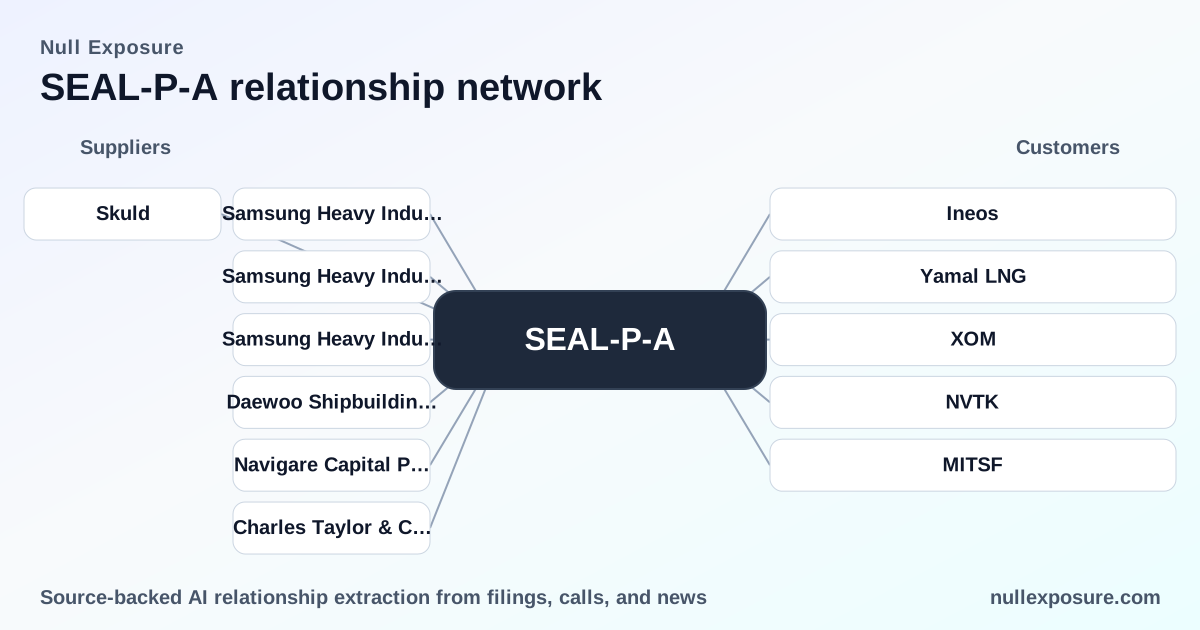
SEAL-P-A: Supplier footprint, counterparty concentration, and operational risk for investors
SEAL-P-A is a preferred security representing an enterprise that positions itself on sustainability and technological advancement and monetizes through a diversified asset portfolio and operational efficiency that generates stakeholder cash flow. For investors evaluating supplier relationships, the critical vectors are capital intensity (newbuild ship orders), counterparty concentration (South Korean shipbuilders and specialist insurers), and operational continuity (charter and insurance dependencies). This note distills public supplier references, highlights concentration and counterparty criticality, and translates them into actionable due-diligence checkpoints for institutional investors.
If you want a holistic supplier-risk view tied to market signals and press evidence, visit https://nullexposure.com/ for the full platform offering.
How the supplier map changes the investment case
Seapeak’s visible supplier footprint is dominated by prime shipyards and specialist marine insurers, which signals a procurement model tied to large, long-lead capital expenditures and to insurance partners who underwrite operational continuity in challenging geographies. Large newbuild contracts and selective P&I coverage are operationally critical for cash generation and for maintaining charter contracts with energy majors. For investors, the risk profile is therefore concentrated in execution risk at shipbuilders and policy continuity with maritime insurers.
Use the supplier inventory below to prioritize due diligence: construction contracts, delivery schedules, charter counterparties tied to specific newbuilds, and P&I cover continuity for Arctic-capable tonnage. If you need tailored counterparty scoring and ongoing monitoring, see https://nullexposure.com/ to get started.
Operating model and supplier risk posture
-
Contracting posture: The public references show a procurement posture that uses large fixed-price or value-specific newbuilding contracts with major South Korean shipbuilders, indicating long-dated capital commitments and scheduled delivery windows that drive financing and revenue recognition timelines. Contracts for specialized tonnage (e.g., LNG carriers, ice-class vessels) are high-dollar, milestone-driven agreements that shape cashflow timing.
-
Concentration: Supplier concentration is material at the shipyard and insurance layers. Multiple entries point to South Korean builders as the primary construction partners, and a narrow set of P&I mutuals providing coverage for Arctic operations. Concentration elevates counterparty execution risk and creates single-point-of-failure scenarios around delivery and insurance continuity.
-
Criticality: These suppliers are mission-critical: shipbuilders enable fleet expansion necessary to secure charters with large energy counterparties; P&I insurers enable legal and operational permission to trade in sensitive regions. Loss or delay of these relationships would directly impair revenue-generating operations.
-
Maturity: The relationships referenced are with established industry incumbents, implying a mature procurement approach rather than opportunistic sourcing; however, maturity of counterparties does not eliminate schedule and underwriting risk, especially for Arctic-capable assets.
Supplier relationships — line-by-line evidence
Below I list every relationship captured in the public results, with a concise investor-oriented sentence and a readable source reference.
-
Samsung Heavy Industries Co., Ltd. — The company placed a fully built-up order of approximately $1.1 billion for five LNG carriers scheduled for 2027 delivery, highlighting a major capital commitment to a South Korean builder. According to MarineLog’s coverage, these vessels are contracted to be constructed by Samsung Heavy Industries (MarineLog, article URL: https://www.marinelog.com/news/seapeak-places-1-1-billion-order-for-5-lng-carriers-at-shi/).
-
Samsung Heavy Industries — Seapeak confirmed a newbuilding order valued at roughly $1.1 billion with Samsung Heavy Industries for five 174,000-cbm LNG carriers, reinforcing the single-shipyard concentration on a high-value fleet expansion. Reported by The Maritime Executive in coverage of Seapeak’s post-acquisition fleet strategy (Maritime Executive, https://maritime-executive.com/article/seapeak-completes-evergas-acquisition-in-continued-growth).
-
Samsung Heavy Industries Co., Ltd — Multiple press feeds repeat that the five LNG carriers will be constructed at a total cost of about US$1.1 billion with scheduled delivery in 2027, underscoring the scale and timing risk attached to those build slots. Covered in LNG Industry reporting on the newbuild program (LNG Industry, https://www.lngindustry.com/lng-shipping/25112022/seapeak-orders-lng-newbuilds-from-samsung-heavy-industries/).
-
Daewoo Shipbuilding & Marine Engineering (DSME) — Several Arctic-capable LNG vessels in the fleet were originally purpose-built by DSME for polar service, indicating prior procurement from a second major South Korean shipyard with niche capability. HighNorthNews documented that Seapeak’s Arctic vessels were constructed by DSME specifically for Arctic conditions (HighNorthNews, https://www.highnorthnews.com/en/britain-ban-transport-russian-lng-uk-linked-vessels).
-
Samsung Heavy Industries — Bermuda-headquartered Seapeak signed a contract with Samsung Heavy Industries for the construction of five LNG carriers, confirming the shipyard as a primary executor for recent fleet orders. Offshore-Energy reported on the signed contract and build plan (Offshore-Energy, https://www.offshore-energy.biz/seapeak-behind-order-for-five-lng-carriers-at-samsung-heavy/).
-
Samsung Heavy Industries — Seapeak ordered five 174,000-cbm LNG carriers at SHI intended for charter to a major energy counterparty, tying newbuild fleet capacity directly to charter revenue opportunities. LNGPrime noted the order and the planned charters with a US energy firm (LNGPrime, https://lngprime.com/contracts-and-tenders/seapeak-wraps-up-evergas-acquisition/69920/).
-
Navigare Capital Partners — Seapeak expanded its fleet through a $213 million purchase from Navigare Capital Partners, showing use of secondary-market acquisitions alongside newbuild strategies to scale capacity. Splash247 reported the transaction in the context of fleet growth (Splash247, https://splash247.com/seapeak-snaps-up-navigare-capitals-lng-carrier/).
-
Charles Taylor & Co. — Four Arctic tankers in Seapeak’s fleet are insured through UK-based P&I mutuals including Charles Taylor & Co., signaling reliance on specific mutual insurers for Arctic operations and coverage continuity. HighNorthNews cited Charles Taylor & Co. as a listed insurer for Seapeak’s Arctic vessels (HighNorthNews, https://en.highnorthnews.com/politics/uk-maritime-services-ban-on-russian-lng-threatens-seapeaks-arctic-yamal-fleet/1090456).
-
Skuld — Additional Arctic vessels rely on Nordic P&I mutuals like Skuld for protection and indemnity coverage, underlining the narrow insurance ecosystem supporting high-latitude trades. HighNorthNews referenced Skuld alongside other P&I providers in coverage of insurance exposure (HighNorthNews, https://en.highnorthnews.com/politics/uk-maritime-services-ban-on-russian-lng-threatens-seapeaks-arctic-yamal-fleet/1090456).
What investors should do next
- Stress-test delivery schedules and financing for the SHI newbuilds and any DSME legacy slots; a delayed delivery calendar changes revenue timelines materially.
- Validate P&I continuity: obtain evidence of multi-year insurance capacity or tested alternatives for Arctic operations given the limited number of mutuals identified.
- Assess charter counterparty alignment: confirm which charters are tied to newbuilds and whether counterparty covenants impose delivery/acceptance conditions that could shift cashflow.
If you want a structured counterparty scorecard and continuous supplier monitoring to quantify these exposures, learn more at https://nullexposure.com/.
Final takeaways
- Supplier concentration is high at the shipbuilding and marine-insurance layers, creating outsized execution and underwriting risk for operations.
- Newbuilds are large and time-bound: the $1.1 billion program with Samsung Heavy Industries is an investment hinge — delivery performance will drive near-term revenue realization.
- Insurance partners are operationally critical for Arctic capability; maintaining P&I continuity is as important as hull construction for revenue extraction in polar trades.
For institutional-grade supplier analysis and to integrate these signals into portfolio risk models, visit https://nullexposure.com/ and request an account-level overview tailored to SEAL-P-A’s public supplier footprint.