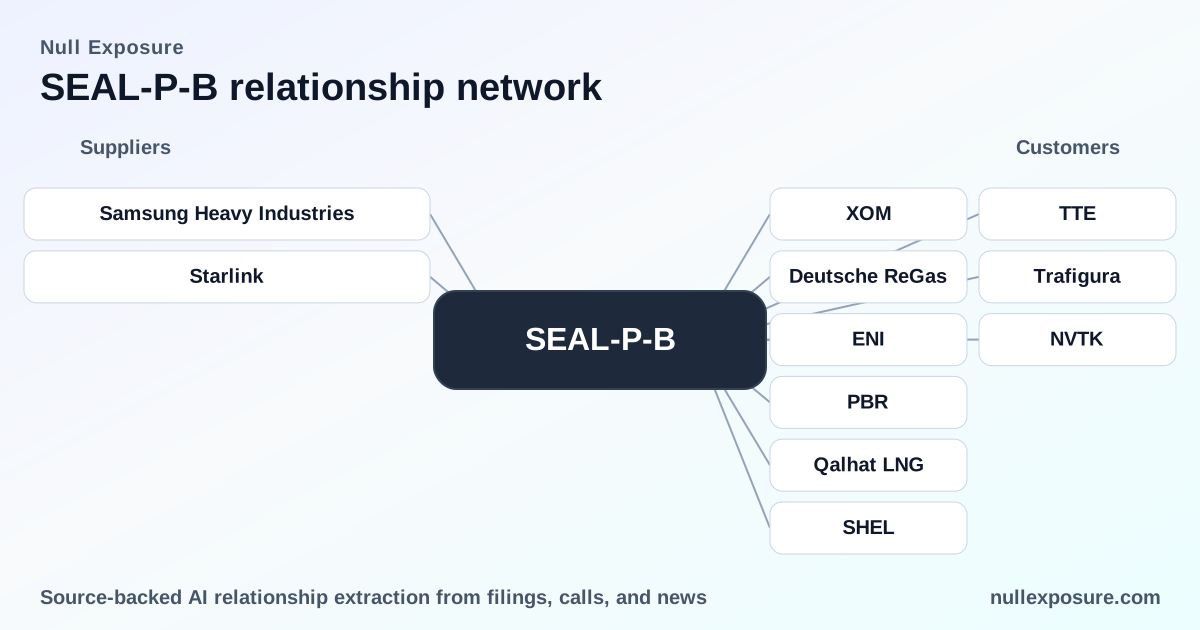
SEAL-P-B: Supplier Map and Strategic Implications for Investors
SEAL-P-B operates as a solutions provider that leverages technology partnerships and commercial contracts to deliver products and services, monetizing through project-based sales and long-term service arrangements. The company's growth thesis rests on strategic supplier relationships and selective capital commitments that expand its operational footprint while keeping fixed-cost intensity controlled through third‑party manufacturing and service providers. For investors, the key question is how supplier concentration and supplier maturity translate into revenue scalability and operational risk.
If you want a quick look at broader supplier exposures and how they shape supplier risk, visit https://nullexposure.com/ for a concise supplier-health dashboard.
What the public supplier signals show about SEAL-P-B
Public records on SEAL-P-B’s suppliers are sparse but focused: recent industry reporting highlights engagements tied to maritime assets and connected services. Two supplier relationships show up repeatedly in market coverage — Samsung Heavy Industries and Starlink — and both point to a business model that outsources capital‑intensive construction and adopts third‑party connectivity solutions. That combination reduces CapEx on SEAL-P-B’s balance sheet while concentrating execution risk with specialized contractors.
Company-level disclosure is limited: the available overview lists numerous financial fields as empty or zero, indicating low public transparency and minimal granular financial disclosure. This is a company-level signal that investors should treat as a governance and information-risk factor rather than a comment on any single supplier.
Supplier relationships you should know about
Samsung Heavy Industries — newbuild LNG carriers and capital outsourcing
SEAL-P-B’s supplier map includes a clear linkage to Samsung Heavy Industries through reported orders for large LNG carriers; market coverage notes that Seapeak ordered five 174,000-cbm LNG carriers at Samsung Heavy Industries tied to charter business with a major energy counterparty. According to reporting in March 2026 by LNG Prime and Tradewinds, these orders are associated with Seapeak’s fleet expansion and contracting strategy (LNG Prime, March 2026; Tradewinds, March 2026).
Starlink — satellite connectivity trials on vessels
The company’s supplier exposure also includes connectivity solutions: Seapeak trialed Starlink satellite internet services on board vessels, including the Seapeak Polar, which signals adoption of consumer-grade, low-latency satellite services for maritime operations. This was reported by LNG Prime in March 2026 and suggests a preference for rapid, off-the-shelf connectivity solutions rather than custom, integrated systems (LNG Prime, March 2026).
How these relationships affect the business model and operating constraints
SEAL-P-B’s supplier profile shows a hybrid posture: capital projects are outsourced to established shipyards, while digital services are sourced from fast-moving, third-party tech vendors. That model delivers flexibility and speed to market, but it carries concentrated execution and integration risk.
- Contracting posture: The reliance on Hyundai-class shipyards like Samsung Heavy Industries indicates a firm contracting posture for large CAPEX items, where performance and delivery timelines are governed by formal shipbuilding contracts and charter commitments.
- Concentration: Use of a small number of specialized suppliers creates concentration risk; failure or delay at a key shipyard or connectivity provider can ripple through operations.
- Criticality: Shipyards and satellite communications providers are critical suppliers — their performance directly affects revenue-generating assets (vessels) and operational continuity (crew communications, telemetry).
- Maturity: Samsung Heavy Industries represents a mature, established supplier, while Starlink represents a rapidly evolving tech supplier with aggressive deployment cycles and evolving service-level expectations.
These are company-level signals derived from the supplier roster and public reporting, not constraints tied to a single excerpt.
If this supplier posture aligns with your risk tolerance, learn more about how supplier concentration shapes investment theses at https://nullexposure.com/.
Investment implications — upside, downside, and what to watch
The supplier pattern creates a mixture of strategic advantages and visible risks:
- Upside: Outsourcing newbuilds to seasoned shipyards and adopting commercial satellite solutions allows SEAL-P-B to scale without proportionate increases in fixed costs, preserving capital for growth initiatives.
- Downside: Operational concentration and limited public disclosure increase the probability of unforeseen delays or cost overruns translating into revenue impacts and investor uncertainty.
- Monitoring points: Watch delivery schedules from shipyards, charter contract backlogs, and operational reports on connectivity uptime and service integration. Because the company’s public financials are not detailed, operational milestones and supplier announcements will be a primary means for investors to assess performance.
Relationship-by-relationship recap (concise)
- Samsung Heavy Industries: Seapeak ordered five 174,000-cbm LNG carriers at Samsung Heavy Industries for charter to ExxonMobil, indicating reliance on established shipyards for fleet expansion (reported March 2026 by LNG Prime and Tradewinds).
- Starlink: Seapeak trialed Starlink satellite internet services on board vessels, including the Seapeak Polar, reflecting adoption of commercial satellite connectivity in operations (reported March 2026 by LNG Prime, March 2026).
Practical next steps for investors and operators
For investors: prioritize supplier disclosure questions in earnings calls and investor materials — ask for delivery timelines, penalties for late delivery, and contingency plans for supplier disruption. For operators: document integration points between shipyard deliverables and connectivity rollouts to avoid handoff-driven delays.
Bold takeaway: SEAL-P-B’s supplier strategy reduces direct capital intensity but concentrates execution risk with a small set of high-impact partners — that trade-off defines the company’s near-term operational profile.
For ongoing supplier intelligence and to compare these exposures across peers, visit https://nullexposure.com/ for analytical tools and supplier-risk scoring.
Final assessment and call to action
SEAL-P-B’s publicly visible supplier relationships point to a pragmatic, outsourced operating model: capital projects through mature shipbuilders and digital operations through agile tech providers. That structure supports rapid scaling if suppliers perform to plan, but the lack of granular financial disclosure and supplier diversification creates material event risk that investors must monitor via supplier announcements and operational milestones.
To track how supplier developments affect valuation and operational risk over time, explore the supplier risk insights available at https://nullexposure.com/.