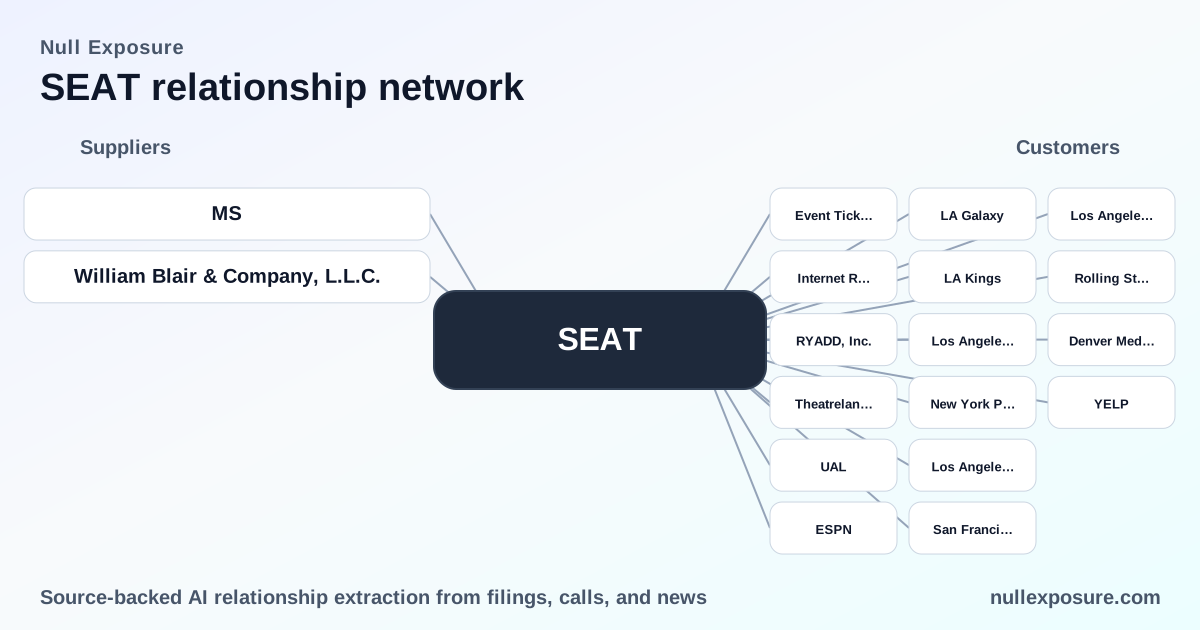
Vivid Seats (SEAT) — supplier relationships and what they signal for investors
Vivid Seats operates an online marketplace that connects buyers and sellers of live-event tickets and monetizes through transaction fees and resale margins in its Resale/distribution segment, supplemented by technology-enabled services. Revenue is generated when tickets change hands on its platform, and the company carries operating leverage from fixed costs (office leases, platform infrastructure) and capital structure commitments that influence supplier and counterparty risk. For investors evaluating supplier relationships, Vivid Seats’ supplier footprint is compact and transactional: advisory firms tie to capital events, while third‑party service providers support security, distribution, and platform operations. Explore supply-side exposure and strategic implications at https://nullexposure.com/.
What the supplier list actually tells you about business risk and control
Vivid Seats’ supplier relationships reflected in public reporting are predominantly transactional and financial‑advisory in nature. The explicit relationships we observe come from a capital-raising transaction where investment banks acted as advisors; those engagements are high‑value but finite. Company filings and constraint evidence show long-term contractual commitments elsewhere — notably office leases and a first-lien credit agreement — which create persistent supplier-like obligations (landlord, lenders, and infrastructure partners) that influence cash flow and negotiating posture.
Key operating-model signals:
- Contracting posture: The company’s disclosures include long-term agreements (an Office Lease dated December 21, 2021 and a First Lien Credit Agreement dated June 30, 2017), indicating ongoing fixed obligations and lender covenants that affect procurement flexibility.
- Role mix: Vivid Seats functions as a seller in its Resale segment (it acquires and resells tickets) and consumes third‑party services for security and platform maintenance, giving suppliers a mix of transactional and operational criticality.
- Concentration & governance: Institutional ownership is high, suggesting sophisticated shareholders who expect cost discipline and effective supplier contracting; this typically reduces supplier slack but raises expectations for performance.
If you are benchmarking counterparty concentration or assessing operational resiliency, start with these contract-level signals and translate them into working capital and covenant stress tests. For more supplier risk intelligence and operational maps, visit https://nullexposure.com/.
Relationship catalog — every supplier relationship in the results
Below are the supplier/relationship entries identified in the available results. Each entry is summarized in plain English and sourced.
-
Morgan Stanley & Co. LLC — Morgan Stanley served as a financial advisor to Vivid Seats in connection with GTCR’s strategic investment in the company. This engagement is advisory and transaction‑specific rather than an ongoing operational supplier contract. Source: PR Newswire announcement on GTCR’s investment (original transaction context: FY2017), reported online via PR Newswire.
-
William Blair & Company, L.L.C. — William Blair acted alongside Morgan Stanley as a financial advisor to Vivid Seats for the GTCR strategic investment; this is a capital-markets advisory relationship tied to the 2017 transaction and does not represent a persistent operational vendor. Source: PR Newswire announcement on GTCR’s investment (FY2017), reported online via PR Newswire.
These advisory relationships confirm that capital transactions were supported by top-tier investment banks, which is a signal of the company’s ability to access strategic advisory services for financing and M&A.
How constraints in filings translate into supplier risk and negotiating posture
Company‑level constraints pulled from public excerpts create a clear operational profile for supplier evaluation:
-
Long-term contractual commitments: The Office Lease (Dec 21, 2021) and First Lien Credit Agreement (June 30, 2017) demonstrate that Vivid Seats carries fixed obligations to landlords and lenders. That structure reduces short-term procurement flexibility and increases the economic value of stable suppliers for core operations (office services, platform hosting, security) because switching costs and termination penalties are more meaningful.
-
Role as a seller and distribution operator: The company explicitly states that in its Resale segment it acquires tickets for resale on secondary marketplaces. This means suppliers involved in inventory acquisition, ticket escrow services, payments processing, and distribution have direct influence on gross margin and working capital.
-
Use of third-party security/service providers: The company engages third parties to assess and test information security controls, indicating technical supplier criticality (security testing, managed detection, hosting). These providers are operationally critical even if contracts are not publicly long-term.
Taken together, these constraints paint a picture of a company with a mixed supplier posture: strategic one-off advisors for capital events, and recurring operational vendors who are critical to platform integrity and distribution economics.
Investment implications: where to focus due diligence
For investors and operators screening supplier risk at Vivid Seats, prioritize the following areas:
-
Covenant and cash-flow sensitivity from long-term obligations. Evaluate lender covenants and lease commitments against seasonal revenue volatility in live events. The First Lien Credit Agreement is a lever on liquidity and refinancing risk.
-
Operational dependency on security and platform vendors. Given explicit reliance on third‑party security testing, vendor outages or provider disputes could produce material operational disruption.
-
Supplier bargaining power on resale inventory and payments. Because Vivid Seats acts as an active buyer and reseller of inventory, counterparties that provide tickets, payment rails, or escrow services exert influence over margins.
-
Capital-advisory relationships are non-recurring but confidence-inspiring. The involvement of Morgan Stanley and William Blair in the GTCR transaction signals the company’s access to premier financial advisory resources when raising capital.
Bold conclusion for investors: operational suppliers are the critical lever for margin recovery; long-term contracts and lender relationships shape negotiating flexibility. A diligence program that combines covenant analysis, vendor SLA reviews, and scenario stress-testing on live-event seasonality will surface the highest-impact supplier risks.
For a supplier risk map and contract-readiness checklist tailored to marketplace businesses like Vivid Seats, see actionable resources at https://nullexposure.com/.
Final assessment and next steps
Vivid Seats’ public supplier footprint in this review is narrow and transaction-focused, but company-level constraints reveal enduring obligations and operational vendor dependencies that drive risk and value. Investors should treat advisory relationships as confirmation of capital-market access, while placing greater emphasis on the recurring service providers that underpin distribution, payments, and security.
If your portfolio or operations team needs a concise supplier exposure report or a vendor-prioritization playbook for marketplace platforms, start with the homepage: https://nullexposure.com/.