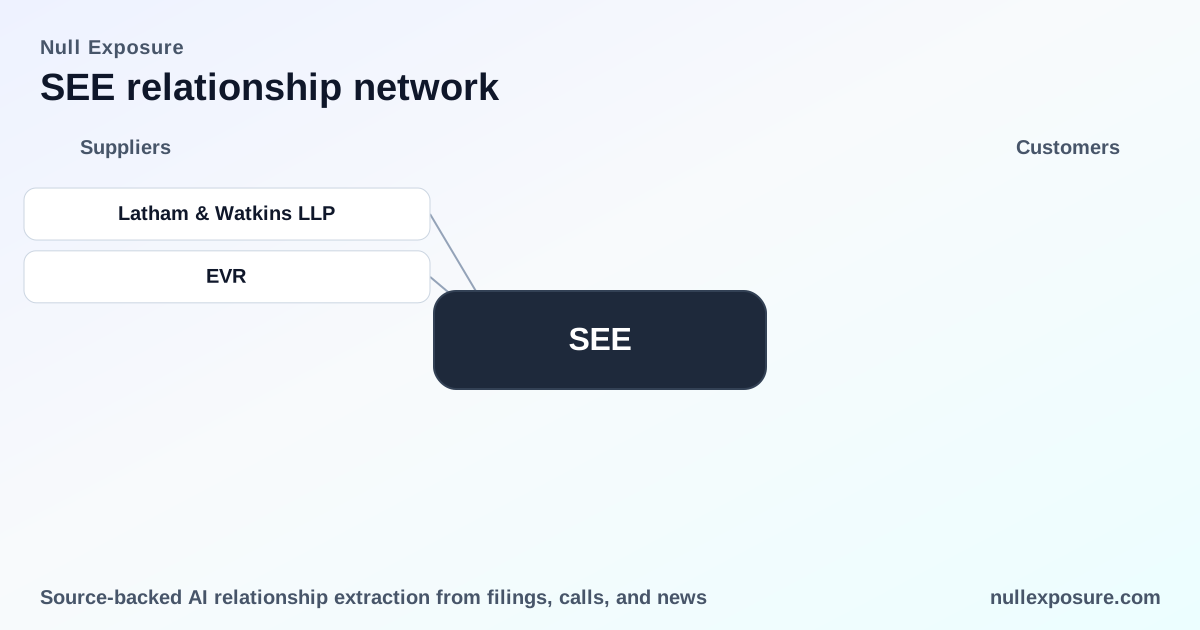
Sealed Air (SEE): Supplier relationships, financing posture, and what the transaction informs investors
Sealed Air operates as a global packaging company that monetizes through sale of differentiated packaging technologies (Cryovac, Bubble Wrap) and upstream procurement of petrochemical and pulp inputs; profitability comes from steady gross margins on packaged food and protective packaging sales plus working-capital financing programs that lower cash conversion cycles. Investors should view SEE as a cash-generative industrial with material raw-material exposure and an active supply‑chain finance footprint that has become a financing lever inside a strategic take‑private process.
If you want a single place to track supplier and financing signals for SEE, start here: NullExposure homepage.
Operational snapshot and investor thesis Sealed Air’s business model combines product differentiation with commodity-sensitive input costs. The company reported roughly $5.36 billion in revenue and $1.03 billion EBITDA (TTM), and raw materials represent about one-third of cost of sales, making input price cycles and supplier arrangements a primary driver of margin volatility. Sealed Air runs a voluntary supply‑chain financing program that lets suppliers sell receivables to financial institutions; outstanding program obligations were reported at approximately $161 million at year‑end 2024, which functions both as a short-term liquidity tool and as an extension of trade payables. These features position SEE as a stable cash-flow business that still carries commodity and working-capital risk that investors should underwrite when valuing the company ahead of the planned acquisition.
What the public relationships tell us Below I cover every supplier/transaction relationship surfaced for SEE in the available results and explain why each matters to investors.
Latham & Watkins LLP — legal counsel on the take‑private
Latham & Watkins is acting as Sealed Air’s legal advisor in the take‑private acquisition, handling the corporate deal work for the transaction. According to a firm news release in November 2025, Latham & Watkins led the corporate deal team representing Sealed Air in the acquisition process. (Latham & Watkins press release, November 2025.)
Evercore — valuation and fairness analysis included in proxy materials
Evercore provided financial analysis referenced in Sealed Air’s proxy supplement, showing implied equity value ranges versus the $42.15 per‑share merger price disclosed in supplemental materials. TradingView republished reporting on Evercore’s analysis and the proxy supplement in March 2026, citing the updated valuation detail after litigation-driven disclosures. (TradingView coverage of Evercore analysis, March 2026.)
How supplier- and finance-related constraints shape the model Sealed Air’s supplier signals form a coherent operating posture that investors can translate into investment risk and opportunity:
-
Contracting posture: The majority of suppliers operate on short-term payment terms, commonly 120 days after month-end, indicating Sealed Air uses extended payables as working-capital management rather than locking suppliers into long fixed-price contracts. At the same time, the company discloses some long-term supply arrangements for critical raw materials, reflecting a hybrid procurement stance—tactical short-term terms for flexibility, selective long-term agreements for continuity. These are company-level policy signals derived from public disclosures for 2024.
-
Concentration and spend: Supplier spending is large in absolute terms—disclosed contractual commitments and program-related payables aggregate in the $100M+ band (e.g., $108.5 million of purchase commitments and $161 million tied to the financing program). That scale makes supplier finance and procurement policies material to cash flow and margin outcomes.
-
Criticality: With polyolefin and other petrochemical‑based resins plus paper pulp representing roughly one-third of cost of sales, supplier performance and commodity pricing are critical to margin stability. This elevates counterparty and market risk for raw-material suppliers into a top-line investment consideration.
-
Maturity and role of relationships: The supply‑chain financing program is active and significant, with outstanding confirmed obligations ($161.1M at year‑end 2024) and suppliers functioning as sellers of receivables in the program. That maturity suggests the program is an operational fixture—not an ad hoc measure—and is being used at scale to optimize cash conversion.
Financial and strategic implications for investors Sealed Air’s supplier profile has direct valuation implications:
-
Working‑capital leverage. The 120‑day vendor terms and active receivable‑sales program give management operational control over payables, effectively substituting short-term financing for bank debt. This reduces near-term cash outflow but increases sensitivity to program continuity and counterparty funding conditions.
-
Commodity pass‑through and margin risk. With raw materials constituting a high share of cost of sales, downside in polyolefin or pulp supply shocks winsorizes margins quickly; long-term supplier arrangements mitigate some risk but do not eliminate cyclical exposure.
-
Transaction overlay. The presence of Latham & Watkins as counsel and Evercore’s valuation work in the proxy shows the take‑private process is supported by experienced advisors and formal fairness analysis—these are governance and valuation signals buyers and lenders rely on. Evercore’s published implied value ranges vs the $42.15 merger price are a key data point for assessing deal premium and potential litigation outcomes. (Evercore analysis cited in TradingView, March 2026; Latham & Watkins representation noted in firm release, November 2025.)
Mid-article action item If you are modeling odious working‑capital risks into SEE’s valuation or benchmarking supplier finance exposure across packaging peers, the detailed supplier-readout on NullExposure is a practical next step: NullExposure homepage.
Risk checklist for investors evaluating SEE supplier relationships
- Counterparty funding risk: The supply‑chain finance program depends on participating financial institutions; a withdrawal or repricing of funding would force SEE to fund more payables directly.
- Commodity price volatility: Input costs form ~33% of cost of sales; sustained price rises compress margins.
- Concentration of spend: $100M+ bands of contractual purchase commitments mean single‑counterparty failures or major disruptions would have measurable P&L and operations impact.
- Deal execution risk: Legal and financial advisers are in place for the take‑private transaction, but proxy supplements and litigation increase near‑term uncertainty around closing mechanics and timing.
Final takeaways and next steps Sealed Air combines steady cash generation with material supplier and commodity exposure, and the company uses supply‑chain finance actively to manage working capital. The public relationships uncovered — Latham & Watkins advising on the transaction and Evercore providing valuation analysis — reinforce that the company’s strategic trajectory is shaped by a formal M&A process with external advisory validation. For investors, the key focus should be on the sustainability of the supply‑chain financing program, the trajectory of petrochemical and pulp costs, and whether the transaction premium adequately compensates for working‑capital execution risk.
If you want to monitor upcoming supplier disclosures, program balances, or advisor filings related to SEE, follow our tracking and signal pages here: NullExposure homepage.
For bespoke diligence on supplier finance programs and counterparty concentration across the packaging sector, start your assessment at NullExposure homepage.