SEER Inc: Supplier relationships that matter for investors
Seer, Inc. designs proteomic instruments and consumables and generates revenue by selling instruments, consumables, and related services to life-science researchers and core labs; the company outsources instrument manufacturing and leverages commercial partnerships to extend sales reach. Seer monetizes through a mix of hardware placements (SP100 instrument), recurring consumables, and co-marketing arrangements that convert product development into commercial channeling. For investors evaluating counterparty risk, concentrate on manufacturing continuity, channel partnerships that accelerate adoption, and the accounting of committed spend. Learn more about how third‑party relationships affect supplier risk at https://nullexposure.com/.
Quick read: the supplier map you need
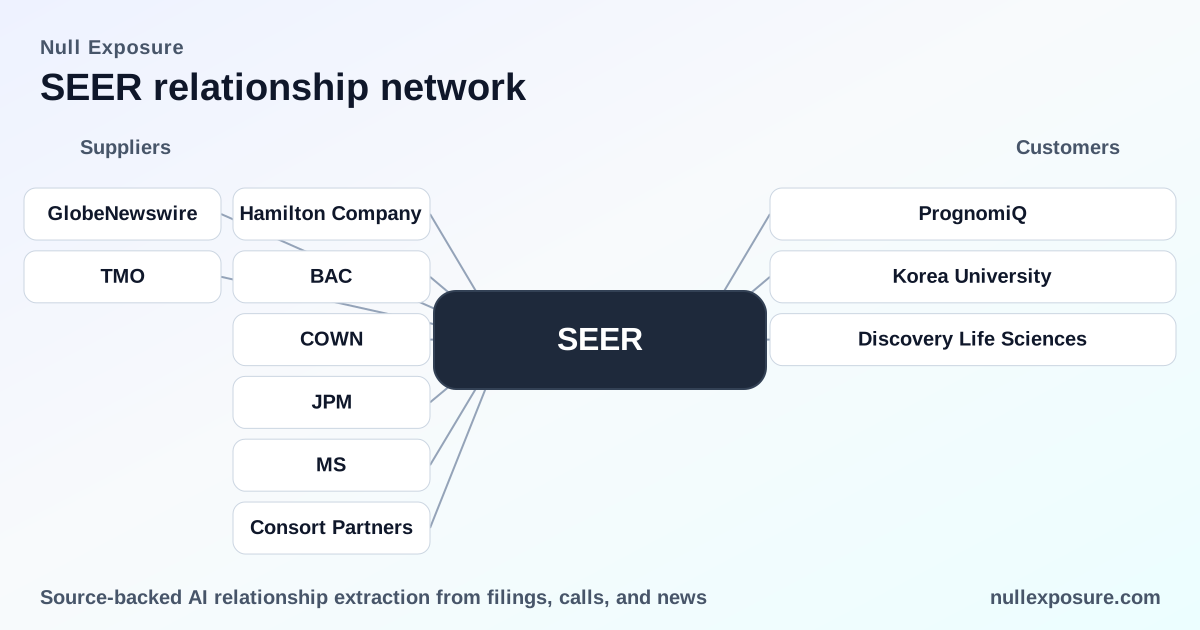
Seer’s supplier and commercial relationships fall into two clear buckets: manufacturing partners who enable instrument and consumable production, and capital/marketing partners that supported the IPO or extend go‑to‑market reach. Below I walk through each named relationship in public filings and press coverage, then distill the operational constraints that determine supply risk and commercial leverage.
Hamilton Company
Seer has an Umbrella Development & Supply Agreement with Hamilton Company to manufacture the SP100 automation instrument; the agreement was executed in 2020 and was renewed with an extended term through December 2027 and automatic one‑year renewals thereafter. This is the primary manufacturing arrangement for the instrument line. According to Seer’s FY2024 Form 10‑K, the SP100 is manufactured by Hamilton under that agreement (FY2024 filing).
BofA Securities
BofA Securities served as one of the lead book‑running managers on Seer’s IPO, supporting the equity placement that funded early commercial expansion; that role is documented in Seer’s IPO closing release. A GlobeNewswire press release dated December 8, 2020, lists BofA Securities among the underwriters for the offering (FY2020 press release).
Cowen
Cowen acted as a lead underwriter on Seer’s initial public offering, facilitating capital markets access at the time of listing and supporting the equity financing that underpins Seer’s go‑to‑market investments. This was disclosed in the December 2020 IPO announcement distributed by GlobeNewswire (FY2020 press release).
J.P. Morgan
J.P. Morgan was a lead book‑running manager on the IPO and played a similar underwriting role to the other syndicate members, helping execute Seer’s public equity issuance. The underwriting roster including J.P. Morgan appears in the company’s IPO closing notice on GlobeNewswire (FY2020 press release).
Morgan Stanley
Morgan Stanley completed the syndicate of lead managers on Seer’s IPO, supporting the capital raise that financed product development and manufacturing scale‑up. The underwriting list including Morgan Stanley is available in the December 8, 2020 GlobeNewswire release (FY2020 press release).
Consort Partners
Consort Partners is listed as Seer’s media contact in investor communications for quarterly reporting; that firm handles investor relations and press coordination for earnings and corporate announcements. The company cited Consort Partners as the media contact in a Q3 2025 results notice published via QuiverQuant (FY2025 press dissemination).
GlobeNewswire
GlobeNewswire is the distribution channel Seer uses for press releases (including the IPO close and earnings announcements); one GlobeNewswire release documents the IPO closing and subsequent investor communications. The December 2020 IPO closing and other press notices were distributed via GlobeNewswire (FY2020 press release).
Thermo Fisher Scientific
Seer has an expanded commercial partnership with Thermo Fisher Scientific to co‑market and sell the Proteograph product suite alongside Thermo’s Orbitrap Astral mass spectrometer, and the partnership produced a first joint sale in 3Q2025. Management referenced the ongoing collaboration and the initial joint sale during recent earnings commentary (InsiderMonkey transcript of the Q3 2025 earnings call and a Q4 2025 earnings transcript reported in The Globe and Mail covering FY2026 commentary).
What the public constraints tell investors about Seer’s operating posture
The public disclosures and constraint excerpts reveal a consistent operating profile with investment implications:
- Contracting posture: mixed term structure. Seer maintains long‑term manufacturing arrangements for key instrument production — explicitly with Hamilton through extended-term purchase order commitments — while also operating routine vendor agreements that are generally cancellable on short notice. This means the company balances supply continuity for flagship hardware against flexibility for non‑critical vendors.
- Manufacturing criticality and concentration. Seer relies on third‑party manufacturers for the SP100 instrument and consumable components; the 10‑K flags manufacturing risks as material and identifies Hamilton as the SP100 manufacturer. Manufacturing is critical to revenue realization, and outsourcing concentrates execution risk with a small set of partners.
- Scale and spend footprint. Outstanding contractual commitments reported were modest — $4.5M at 12/31/2024 and $6.3M at 12/31/2023 — placing most supplier spend in the $1M–$10M band, which indicates meaningful but manageable vendor exposure relative to typical life‑science capital intensity.
- Geographic reach and supply chain diversity. Production spans the U.S. and international facilities for different product classes, which supports market reach but introduces multi‑jurisdictional operational risk (company‑level signal from filings).
- Relationship maturity and activity. Several relationships (Hamilton, Thermo Fisher) are active and operationalized — Hamilton for manufacturing and Thermo for co‑selling — while underwriting and PR partners supported discrete capital and communication milestones. Channel partnerships have progressed to initial joint commercial outcomes, which validates the go‑to‑market strategy.
Put together, these constraints show a supplier model that is operationally mature for core instrument manufacturing but remains commercially nascent in scale, with concentrated manufacturing risk offset by multi‑site consumables production and co‑marketing partnerships.
Find deeper supplier risk scoring and counterparty analytics at https://nullexposure.com/.
Investment implications and actionables
- Manufacturing continuity is a top risk/return lever. Investors should monitor renewals and performance under the Hamilton agreement and any disclosure of alternate manufacturing capacity. The extended-term arrangement through 2027 reduces near‑term execution risk but keeps concentration elevated.
- Commercial partnerships accelerate adoption without heavy capital outlay. The Thermo Fisher co‑sell model produced a first joint sale in 3Q2025, which is a meaningful validation of Seer’s channel strategy and supports recurring consumables revenue growth.
- Capital markets relationships are informational, not operational. The 2020 underwriting syndicate (J.P. Morgan, Morgan Stanley, BofA Securities, Cowen) enabled the IPO but does not create vendor dependency; rather it contextualizes funding history.
For a supplier‑focused investment diligence pack or counterparty monitoring tailored to Seer and peers, visit https://nullexposure.com/ to request a briefing.
Bottom line
Seer’s supplier footprint is concentrated around a small set of critical manufacturing and co‑marketing partners. The company mitigates some concentration through international consumables sourcing and retains flexible short‑term vendor arrangements for non‑critical services; however, manufacturing continuity and successful execution of commercial alliances like Thermo Fisher are decisive to revenue scaling. Track contract renewals, disclosed commitments, and early joint sales to assess operational risk and market traction going forward.