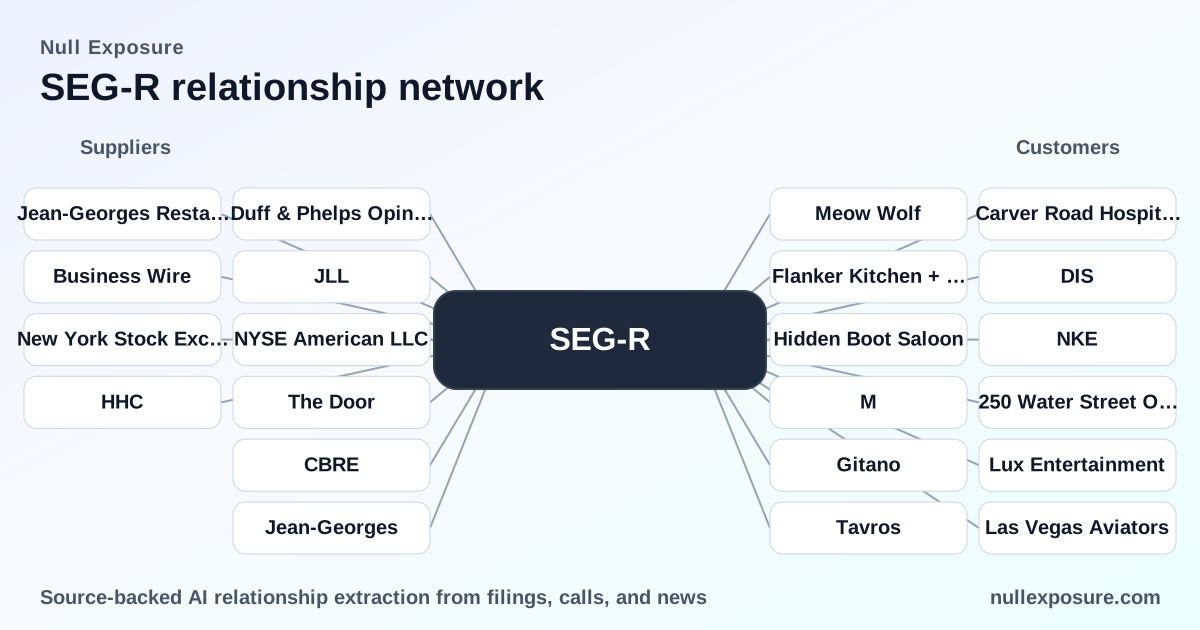
Seaport Entertainment Group (SEG-R): The supplier map that underwrites the Seaport strategy
Seaport Entertainment Group operates as a real estate‑backed entertainment and hospitality operator that monetizes through property development and asset sales, long‑term leasing, in‑house and partner‑run food & beverage, and capital markets access (including an NYSE uplisting). Revenue and value creation flow from unlocking waterfront real estate via tenant placement, restaurant operations, and corporate financing events. For detailed counterparty intelligence and ongoing monitoring of these supplier relationships, visit https://nullexposure.com/.
Executive takeaway: supplier relationships are transactional and strategically aligned
The current supplier footprint reads like a classic developer/operator playbook: trusted capital markets and advisory providers for corporate transactions, large real estate brokerages for disposition and leasing, and specialty hospitality partners for customer‑facing operations. These relationships support near‑term liquidity (uplisting, asset sale), medium‑term tenancy stability (20‑year leases), and operational control (internalizing F&B). The configuration reduces certain outsourcing risks while concentrating strategic dependency on a few large service providers.
Transactional and advisory partners you should know
Duff & Phelps Opinions Practice of Kroll, LLC
Duff & Phelps (Kroll) rendered solvency opinions to the boards of Howard Hughes Holdings and Seaport Entertainment Group in connection with the spinoff transaction, giving formal financial and governance clearance for the restructuring. This advisory role signals rigorous transaction governance during the spin‑out (Kroll transaction page, FY2024).
JLL
A JLL team led by Andrew Scandalios, Ethan Stanton and Nicco Lupo represented Seaport Entertainment Group in the sale of the 250 Water Street development project to Tavros for $1.505 billion, signaling use of top‑tier brokerage for disposition execution and price discovery (The Globe and Mail press release, FY2025).
NYSE American LLC
Seaport Entertainment Group was approved for uplisting from the NYSE American LLC, marking a capital markets step that changes disclosure profile and investor access while reflecting fulfillment of exchange listing criteria (Company uplisting announcement via Business Wire, June 24, 2025).
New York Stock Exchange
The New York Stock Exchange accepted Seaport Entertainment Group for uplisting, a corporate milestone that opens broader institutional visibility and liquidity channels relative to the previous listing venue (Uplisting announcement, June 24, 2025).
Business Wire
Business Wire served as the distribution channel for Seaport Entertainment Group’s June 24, 2025 uplisting announcement, demonstrating the company’s use of established press distribution to meet regulatory and investor communications norms (Business Wire press release, June 24, 2025).
The Door
The Door is identified as media relations contact for Seaport Entertainment Group’s uplisting announcement, indicating a retained or project PR relationship responsible for investor and press engagement during major corporate events (press release contact line, June 24, 2025).
CBRE
CBRE represented both sides in a 20‑year lease at Seaport’s Pier 17 for Meow Wolf’s first East Coast location, a long‑term tenancy that materially shapes foot traffic and experiential programming for the property (ConnectCRE report, FY2025).
Jean‑Georges / Jean‑Georges Restaurants
Jean‑Georges was previously the third‑party manager for Seaport food & beverage operations, and Jean‑Georges Restaurants partnered in a corporate restructuring as Seaport internalized F&B operations at most of its restaurants — a shift from outsourced management to internal management that alters operating margins and counterparty exposure (Globe and Mail earnings transcript, FY2025; TradingView Q3 2025 results).
Howard Hughes Corporation
Howard Hughes Corp. spun off the $850 million 250 Water Street project and other South Street Seaport assets to Seaport Entertainment Group, establishing the company’s asset base and linking historical development pipelines to SEG’s current portfolio (TribecaTrib coverage of the spin‑off, FY2025).
What these relationships reveal about SEG‑R’s operating model
- Contracting posture: The mix of solvency opinions, top brokerage engagement, and long‑dated leases shows a formal, transaction‑oriented contracting posture. SEG contracts deep into capital markets and real estate advisory services to validate corporate actions and execute large asset moves.
- Concentration: Suppliers cluster around a small set of major providers (JLL, CBRE, Kroll) for brokerage and advisory needs, indicating moderate concentration in critical professional services that could raise pricing or availability risk if any one relationship underperforms.
- Criticality: Advisory relationships (Kroll) and exchange interactions (NYSE) are high‑criticality because they directly enable corporate events; long‑term tenants like Meow Wolf are strategically critical for property economics and public perception.
- Maturity: Uplisting and formal solvency opinions signal capital markets maturity and institutional governance standards; long‑term leasing reflects operational maturity in landlord/tenant execution.
There are no expressly captured supplier constraints in the public records assembled here, which is a company‑level signal that no vendor‑specific covenants or limitations were surfaced in the reviewed announcements. This absence should be interpreted as neutral: it does not preclude contractual obligations existing in underlying bilateral agreements, only that they were not disclosed in the cited public filings.
For ongoing tracking of how these counterparties affect valuation, covenant risk, and operational resilience, explore deeper counterparty profiles at https://nullexposure.com/.
Risk and opportunity implications for investors
- Opportunity: The uplisting to the NYSE increases liquidity and institutional interest, creating potential multiple expansion when paired with asset sales (e.g., the 250 Water Street disposition). Using blue‑chip brokers and long‑term experiential tenants supports stabilized cash flow and asset re‑positioning.
- Risk: Reliance on a few large advisors and brokerages creates vendor concentration risk for large transactions; the transition to internal F&B operations reduces counterparty execution risk but increases operational execution risk and cost exposure.
- Operational lever: Internalizing restaurant operations after partnering with Jean‑Georges reallocates margin control to Seaport management — a strategic lever that can improve margin capture if execution is strong but will increase operating complexity.
Conclusion: distilled view for decision‑makers
Seaport Entertainment Group has constructed a supplier ecosystem optimized for large transactions and experiential real estate programming: big‑name brokers and advisors to execute deals, long‑term tenants to stabilize cash flows, and a move toward in‑house hospitality operations to capture operating margin. Investors should value the uplisting and asset monetizations while monitoring supplier concentration and the company’s ability to execute on internalized F&B responsibilities.
To review counterparty risk quantitatively and receive alerts on changes to these supplier relationships, visit https://nullexposure.com/. For bespoke research or to commission a deeper counterparty profile, start your inquiry at https://nullexposure.com/.