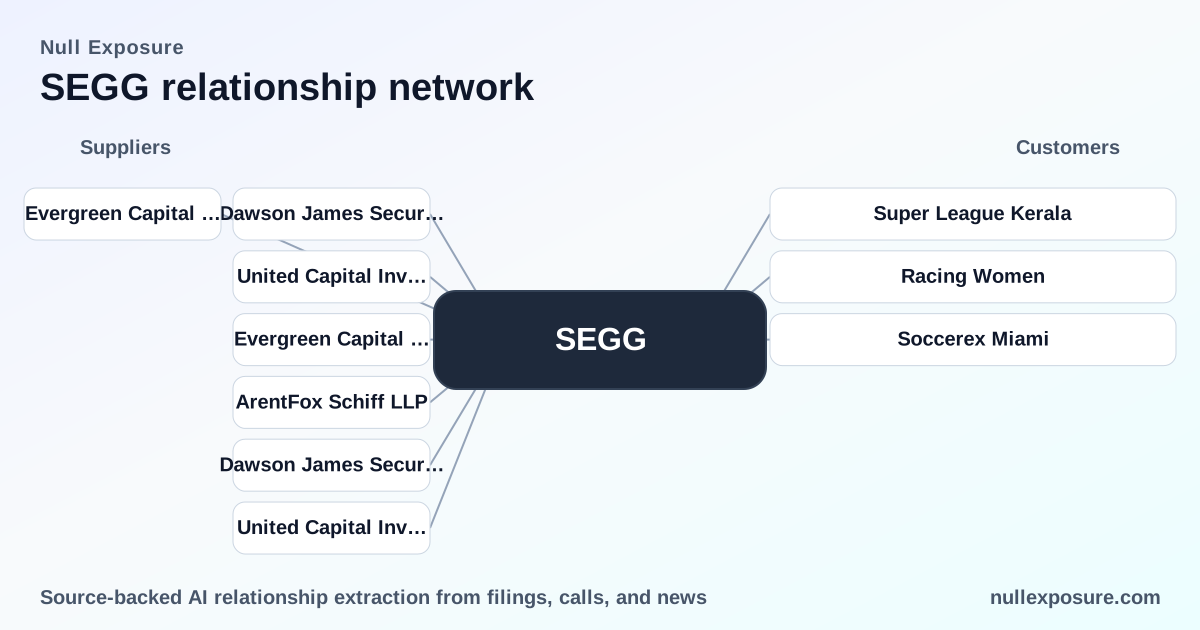
SEGG (Lottery.com Inc.): Counterparty Map and Commercial Signals for Investors
Lottery.com Inc. (SEGG) operates as a digital publisher of lottery results and jackpot data and monetizes its platform through its Data Service offerings, advertising relationships, and sporadic capital markets activity (registered offerings and financing arrangements). Its commercial profile blends content distribution (mobile app stores and web), licensing relationships with lottery organizations for data rights, and intermittent capital-raising via placement agents and debt facilities. For investors and operators evaluating supplier risk, the company’s recent counterparties reveal a shift away from large debt facilities toward equity raises and negotiated terminations of prior financing arrangements. Visit our homepage for broader counterparty intelligence: https://nullexposure.com/
What happened: a short timeline of the recent counterparties
In January 2026 and the weeks that followed, SEGG closed a registered direct public offering, engaged placement and legal advisors, and formally terminated multiple financing agreements that had been on the company’s balance sheet. The public filings and press releases capture these counterparties and the terms that materially affect liquidity and dilution expectations.
-
Dawson James Securities / Dawson James Securities, Inc. — the company used a boutique placement agent structure for the offering and paid placement fees in cash. According to a GlobeNewswire press release dated January 20, 2026, Dawson James Securities, Inc. acted as the sole placement agent for the registered direct offering and the company agreed to pay a cash placement fee; TS2.tech also reported the appointment and a 7% cash fee and expense reimbursement up to $50,000 in connection with the placement agent role (FY2026).
Source: GlobeNewswire press release (Jan 20, 2026); TS2.tech coverage (Mar 10, 2026). -
United Capital Investments London / United Capital Investments London Limited (UCIL) — SEGG formally terminated a previously announced $150 million loan agreement that had been amended and restated in August 2023. The company disclosed the termination in its January 20, 2026 press release and TradingView summarized the termination event on the same timeline.
Source: GlobeNewswire press release (Jan 20, 2026); TradingView report (Mar 10, 2026). -
Evergreen Capital Markets / Evergreen Capital Markets LLC — SEGG reached a tentative agreement to terminate a note and securities purchase agreement entered in December 2025; the company stated it did not intend to access remaining committed amounts under that arrangement. GlobeNewswire and finance outlets noted the agreement in principle to end the note arrangement, which initially provided roughly $500,000 in consideration in December.
Source: GlobeNewswire press release (Jan 20, 2026); Yahoo Finance Singapore coverage (Jan 2026). -
ArentFox Schiff LLP — served as counsel to the company in connection with the registered direct offering that closed in January 2026, as disclosed in the GlobeNewswire announcement. Legal representation for SEGG in the offering was handled from ArentFox Schiff’s Washington, D.C. office.
Source: GlobeNewswire press release (Jan 20, 2026).
(Each of the above relationships is referenced multiple times across the GlobeNewswire announcement, TS2.tech coverage, TradingView and Yahoo Finance reporting through January–March 2026.)
How these counterparties change the commercial picture
The roster of counterparties over Q1 2026 signals a transition in SEGG’s capital stack and supplier posture:
- Shift from large-debt to equity funding: Termination of the $150 million UCIL facility and the decision not to access remaining tranches under Evergreen’s note arrangement indicate an active unwinding of prior credit lines in favor of a registered equity offering executed with a placement agent (Dawson James). That reduces near-term debt covenants but transfers liquidity risk to the equity capital markets and shareholder dilution dynamics.
- Placement-agent economics: The company’s engagement of a placement agent on a best-efforts basis with a 7% cash fee and capped expense reimbursement is an upfront cash cost that directly affects net proceeds from the offering and signals reliance on retail/OTC placement channels rather than anchor institutional commitments. (TS2.tech, GlobeNewswire, Jan–Mar 2026.)
- Legal and advisory continuity: Use of established law firms for the offering (ArentFox Schiff LLP) supports a standard capital markets workflow and mitigates execution risk on documentation and SEC disclosures.
Read our broader coverage for how these moves interact with supplier risk and operational resilience: https://nullexposure.com/
Supplier and operational constraints that matter to counterparties
Company-level disclosures surface several operational constraints that influence supplier negotiations and counterparty risk:
- Material prepaid advertising credit on the balance sheet signals that SEGG has historically compensated third parties with equity in lieu of cash for advertising services; the company recorded a material prepaid asset related to advertising credits issued approximately seven years ago. This influences how new advertising suppliers will price and contract with SEGG—expect negotiated terms that account for prior equity-based settlements.
- Buyer and distributor posture: SEGG’s role as a buyer of advertising services (issuing equity instruments as compensation historically) and its dependence on global distribution platforms (Google Play and Apple App Store) for its app create concentration risk—platform delistings or unfavorable terms would materially affect reach and monetization.
- License dependency: The business relies on contractual rights from lottery organizations for the right to collect and redistribute lottery data; these license relationships are critical to the Data Service revenue stream and influence counterparty diligence around data rights and renewal cadence.
- Service provider concentration and operational continuity: The company relies on a limited number of third-party payment processors, identity/age/geo verification vendors, and accounting/audit firms—changes in any of these providers can produce outsized operational disruption.
- Spend profile: Public filings show trade payables in the ~$8.24 million range and professional fees to auditors in the low six figures (aggregate audit fees of $145,000 for FY2024), placing SEGG squarely in a small-but-material spend band that requires disciplined cash management.
These constraints are company-level signals that will shape how counterparties price risk, demand covenants, and structure fees.
Investment implications and risk checklist
- Liquidity and scale: SEGG reports roughly $0.965M in trailing revenue with negative EBITDA and a market capitalization near $10.8M; these figures position the company as a small, high-volatility equity where counterparties will prioritize upfront cash or protective covenants.
- Concentration risk: Dependence on app stores and a small set of payment and verification providers increases operational risk; license relationships with lottery organizations are mission-critical.
- Counterparty negotiation posture: Given its historical use of equity to pay for advertising and the recent terminations of larger financing facilities, the company’s bargaining power with suppliers is limited—expect counterparties to insist on stronger payment terms or higher fees.
For more detailed counterparty profiles and ongoing monitoring alerts on SEGG counterparties, visit our research hub: https://nullexposure.com/
Bottom line and next steps for investors
SEGG’s recent counterparty activity reflects a deliberate retreat from large-scale debt toward smaller, equity-driven financing and pragmatic contract terminations. That reduces headline debt risk but transfers execution risk to capital markets and heightens the importance of operational continuity with app stores, data licensors, and payment processors. Investors and vendor partners should price for small-cap liquidity constraints, concentrated distribution risk, and a history of equity-based supplier compensation.
If you want ongoing alerts and deeper counterparty dossiers on SEGG and its counterparties, start here: https://nullexposure.com/