Solaris Energy Infrastructure (SEI): Supplier relationships and what they signal for investors
Solaris Energy Infrastructure designs and manufactures specialized equipment for oil and natural gas operators and drives revenue primarily through sales of engineered equipment and related services to upstream and midstream operators. Recent financing activity and disclosed purchase commitments show a company scaling its power generation fleet and funding that expansion through capital markets while maintaining concentrated, contract-backed supplier relationships that are operationally critical to near‑term execution.
For a granular view of counterparties and supplier constraints that matter for underwriters, operators and risk officers, visit https://nullexposure.com/ to explore relationship-level sourcing and contract signals.
How Solaris monetizes growth and why suppliers matter
Solaris’s business is straightforward: it sells and supports engineered equipment that the oilfield requires to operate remotely and reliably. Revenue comes from system sales, long-term service and supply arrangements, and capital programs tied to fleet growth, which is the driver behind large purchase commitments disclosed in recent filings. The company’s capital structure and access to public markets—evidenced by a convertible notes offering—are being used to fund that expansion rather than to finance basic working capital, which elevates the strategic importance of suppliers who enable fleet deployment on schedule.
Key financial context: Solaris reported roughly $622 million in trailing twelve‑month revenue with an EBITDA profile that supports continued capital markets engagement; market participants should balance growth ambitions against supplier concentration and multi‑year purchase commitments when assessing execution risk.
Visit https://nullexposure.com/ for counterparty reports and deeper sourcing detail.
Counterparties and deal roles you should know
Below are the counterparties identified in recent public notices and their roles in Solaris’s financing and legal work. Each item is a concise, plain‑English description with the public source noted.
-
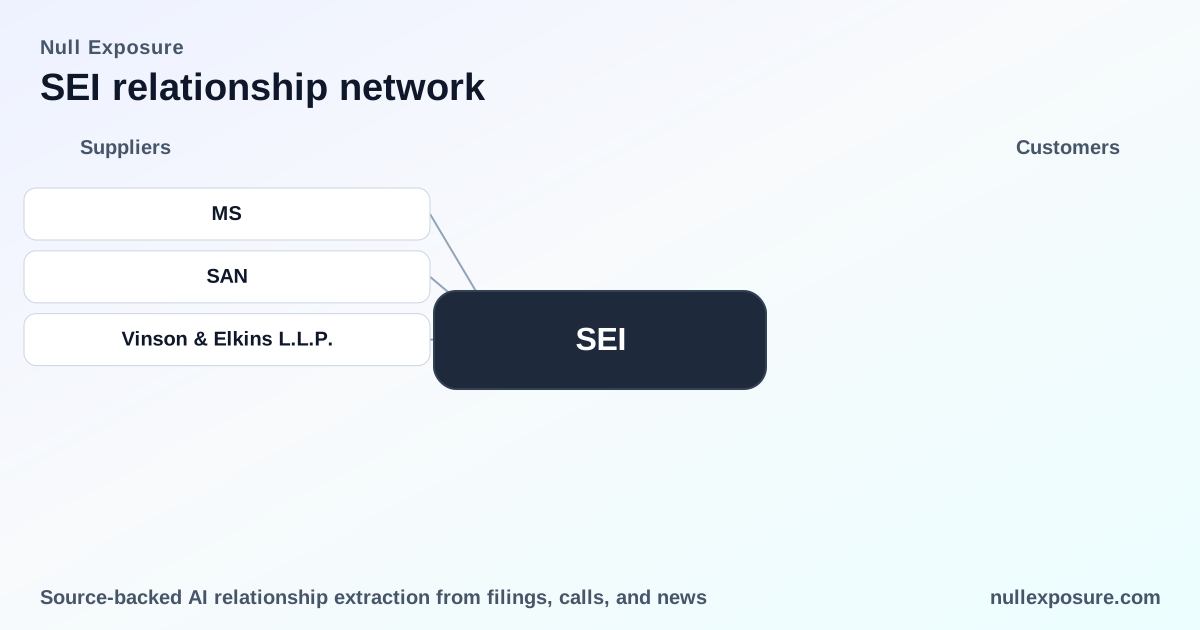
Morgan Stanley & Co. LLC — Morgan Stanley acted as a joint book‑running manager for Solaris’s public offering that was announced in March 2026, handling distribution and investor placement for the transaction. According to a March 10, 2026 press release on Yahoo Finance, Morgan Stanley and Santander US Capital Markets served as joint book‑running managers for the offering. (Yahoo Finance, March 10, 2026)
-
Santander US Capital Markets LLC — Santander partnered as a joint book‑running manager alongside Morgan Stanley, sharing underwriting and placement responsibilities for the convertible notes offering announced in March 2026. The same Yahoo Finance announcement identifies Santander US Capital Markets as the co‑book runner. (Yahoo Finance, March 10, 2026)
-
Vinson & Elkins L.L.P. — Vinson & Elkins provided legal counsel to Solaris on the public offering of convertible senior notes, which priced at $155 million including the exercise of the underwriters’ option; the firm’s client notice confirms the legal advisory role. A Vinson & Elkins news release reported the firm advised Solaris on the upsized $155 million aggregate principal amount offering of 4.75% convertible senior notes due 2030. (Vinson & Elkins news release, March 10, 2026)
What the relationships and disclosures imply about Solaris’s operating posture
The disclosed counterparties tell a clear story: Solaris is actively using capital markets and top-tier underwriters to fund a defined growth program, while relying on established legal counsel to execute complex securities work. Beyond the capital markets players, Solaris’s procurement disclosures show meaningful supplier concentration and staged procurement commitments that will determine whether this growth is durable.
-
Contracting posture: Solaris reports both long‑term and short‑term purchase commitments. The company cites $99.0 million in long‑term purchase commitments (terms extending beyond one year) and $140.7 million in short‑term purchase commitments due within the next 12 months, signaling a mixed contracting strategy that combines multi‑year supplier commitments with near‑term flexibility. These figures are drawn from the company’s public disclosures for FY2025.
-
Spend magnitude and maturity: A specific power generation fleet growth program is a material budget item — Solaris reports total purchase commitments of $788.8 million related to that program, consisting of $239.7 million outstanding as of December 31, 2024 and $549.1 million entered into in 2025. That scale indicates multi‑year procurement dependency and significant capex-driven supplier demand in the near term.
-
Concentration and criticality: The filing notes that, following the MER acquisition, a supplier (unnamed in the disclosure) accounted for 38% of consolidated spending for the period from September 11, 2024 through December 31, 2024, which Solaris classifies as a critical relationship for that interval. At the same time, Solaris also states that during the full years ended December 31, 2024 and 2023, no single supplier accounted for more than 10% of total spending, a contrasting signal that reflects the timing and structure of acquisition-related supplier access.
-
Relationship role and operational exposure: Solaris explicitly describes long‑term third‑party relationships for transportation of equipment and provision of materials used in manufacturing and maintenance, highlighting that suppliers are not only commodity vendors but also service providers tied to equipment logistics and uptime.
Taken together, these disclosures are company‑level signals that Solaris runs a capital‑intensive roll‑out supported by large supplier commitments and that execution risk concentrates around a small number of critical suppliers during transition periods created by acquisitions.
Investor implications and risk checklist
-
Execution risk tied to supplier concentration: The 38% spending episode post‑acquisition is an acute indicator that short windows of supplier dependency can create outsized operational risk even when longer‑term annualized figures look diversified.
-
Funding through convertible debt: The use of a convertible senior notes offering, underwritten by Morgan Stanley and Santander and supported by legal counsel from Vinson & Elkins, shows Solaris’s preference for finance that preserves liquidity while leveraging equity upside — a sensible structure for growth but one that increases scrutiny on cash flow generation and supplier delivery.
-
Procurement cadence matters: The split between near‑term ($140.7 million) and long‑term ($99.0 million) purchase commitments, plus the $788.8 million fleet program, implies a staged procurement schedule that investors should model into capex, working capital and vendor concentration stress tests.
If you want structured scoring of Solaris’s supplier concentration and counterparty risk, Null Exposure curates relationship intelligence that quantifies these exact vectors — explore it at https://nullexposure.com/.
Conclusion: what investors should watch next
Solaris is executing a capital‑intensive growth plan funded in part through a convertible note offering and reliant on a small set of critical suppliers during transition periods. The principal investment thesis hinges on on‑time delivery from those suppliers and the company’s ability to convert fleet investments into recurring revenue and EBITDA expansion. Monitor procurement milestones, supplier diversification actions, and how the company uses proceeds from capital markets to reduce reliance on timing‑sensitive vendors.
For detailed counterparty profiles and contract‑level signals that feed investment theses, visit https://nullexposure.com/ and review the supplier‑level evidence behind these assertions.