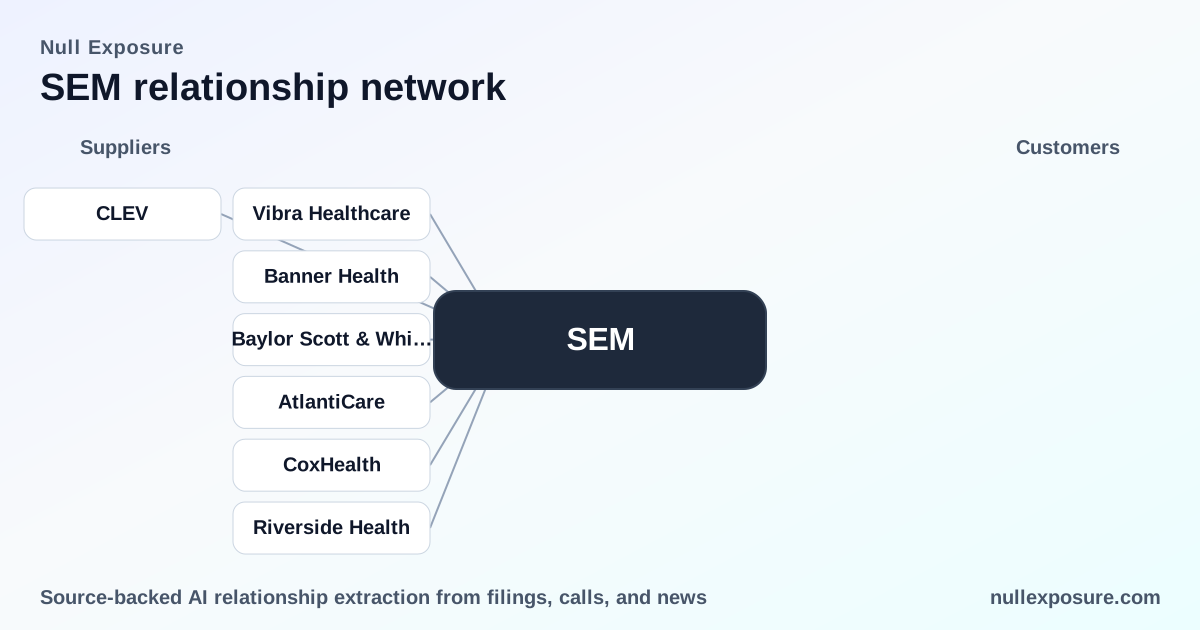
Select Medical Holdings (SEM): Partnering to Scale Rehab and Post-Acute Care
Select Medical operates and monetizes a diversified post-acute care platform that includes critical illness recovery hospitals, inpatient rehabilitation hospitals, outpatient rehabilitation clinics, and occupational health centers. The company grows primarily through joint ventures and leased hospital builds with large health systems, collecting operating revenue from patient care while retaining asset-light elements via leases and partner-operated hospital models. Select Medical’s revenue mix and margin profile are driven by scale in rehabilitation services and contractual arrangements with health systems and payors.
Learn how these partner linkages influence operational risk and capital planning at https://nullexposure.com/.
Why the partner roster matters for investors
Select Medical’s most recent disclosures show a deliberate expansion strategy executed in collaboration with established health systems. These relationships are not simple vendor contracts; they are growth vehicles that deliver new bed capacity, market access, and referral pipelines. For investors, the key implications are: growth visibility through signed projects, capital and leasing commitments tied to partner projects, and operational exposure where Select Medical sometimes functions as operator, lessee, or both.
The company’s financial profile supports this model: 2025 TTM revenue of $5.45 billion and EBITDA of $476 million indicate meaningful scale, while EV/EBITDA of 9.15 and a trailing P/E of 14.0 position SEM as a mid-cycle healthcare services operator with steady cash generation to fund both organic growth and partnerships.
What management disclosed on the 2025 Q4 earnings call
Management enumerated seven partner projects announced or opened in the quarter; each is a discrete local hospital or expansion tied to a health system. Below are concise, plain-English takeaways drawn from the 2025 Q4 earnings call.
-
Vibra Healthcare — 76-bed rehabilitation hospital in Southern Kentucky. Management described the transaction as an acquisition in partnership with Vibra, signaling Select Medical’s continued use of collaborative ownership or operating models to add capacity (2025 Q4 earnings call, discussed March 2026).
-
Banner Health — 58-bed hospital in Tucson, Arizona. Select Medical opened this site with Banner Health, reflecting geographic expansion through marquee regional systems that provide referral stability and market credibility (2025 Q4 earnings call).
-
Baylor Scott & White Health — fifth rehabilitation hospital in Temple, Texas. This represents a repeat partnership with Baylor Scott & White, indicating preferential continuity with large health systems that can move meaningful patient volumes (2025 Q4 earnings call).
-
AtlantiCare — 60-bed hospital in Southern New Jersey. The AtlantiCare project is a new hospital collaboration that extends Select Medical’s reach in the Mid-Atlantic and leverages AtlantiCare’s local market position (2025 Q4 earnings call).
-
CoxHealth — 63-bed hospital in Ozark, Missouri. This development with CoxHealth adds regional capacity in the Midwest and demonstrates the company’s pattern of co-building with health systems rather than standalone Greenfield builds (2025 Q4 earnings call).
-
Riverside Health — 10-bed expansion at an existing rehab hospital in Virginia. This is an incremental expansion rather than a new build, showing management’s use of smaller, targeted investments to densify existing operations (2025 Q4 earnings call).
-
Cleveland Clinic — new 32-bed hospital. Select Medical added a small-format hospital in partnership with Cleveland Clinic, underscoring the strategy of collaborating with nationally recognized systems to capture referral flow and premium clinical alignment (2025 Q4 earnings call).
Each relationship was disclosed during the company’s 2025 Q4 earnings call and represents active projects that contribute to near-term capacity growth and referral network strengthening.
Explore deeper analysis of Select Medical’s partner network at https://nullexposure.com/.
How contract structure and operating constraints shape risk and upside
Select Medical’s filings and disclosures present a nuanced contracting posture that is material to valuation and operational planning:
-
Mixed lease tenors create a hybrid risk profile. The company states that many rehabilitation and critical illness recovery facilities come with long-term leases of 10–20 years (with renewal options), while it also maintains shorter leases of less than ten years for certain critical illness recovery hospitals. This combination gives Select Medical both durable, long-dated occupancy and flexibility to reoptimize footprint where needed.
-
Centralized procurement reduces input cost but concentrates counterparty exposure. Management centralizes sourcing for pharmaceuticals and supplies to extract discounted pricing; this lowers per-unit cost but raises vendor concentration and negotiating leverage risk at the supplier level.
-
Operational staffing is a controllable margin driver and a cost vulnerability. The company acknowledges the use of agency clinical staff in some facilities, which increases operating cost and compresses margins when utilization is high or labor markets tighten.
-
Relationship roles are dual: buyer and service provider. Select Medical acts as a buyer of supplies and as a service provider/operator inside partner hospitals, meaning the company captures operating margins while also carrying procurement and staffing risk.
These constraints are company-level signals drawn from public disclosures; they explain why Select Medical’s growth strategy uses partner-built hospitals to scale referrals while keeping flexibility through selective leasing.
Investment implications and risk checklist
-
Growth through partners is a capital-efficient distribution strategy. Co-development with major health systems supplies predictable referral streams and supports occupancy ramp plans, which is a positive for near-term revenue growth.
-
Asset and lease complexity require active capital management. The mix of long and short leases creates a balancing act between earnings durability and flexibility; investors should watch lease renewal schedules and rent exposure.
-
Labor and procurement are operable margin levers. Agency staffing and centralized purchasing are two practical levers management uses to defend margins; volatility in these inputs will drive short-term margin variability.
-
Counterparty diversification is reasonable but operationally critical. Repeat relationships (e.g., Baylor Scott & White) indicate stable partners, while single-project links broaden geographic reach; both are important for risk allocation.
For focused investor diligence on partner exposure and contract details, visit https://nullexposure.com/.
Bottom line
Select Medical’s partner-first expansion is a deliberate, scalable approach to growing post-acute capacity while sharing development and referral risk with established health systems. The balance of long-term and shorter-term leases, centralized procurement, and intermittent use of agency labor are the core operational constraints that will determine margin volatility and capital needs going forward. Investors should track project execution, lease roll schedules, and labor-cost trends as primary indicators of the company’s earnings trajectory.