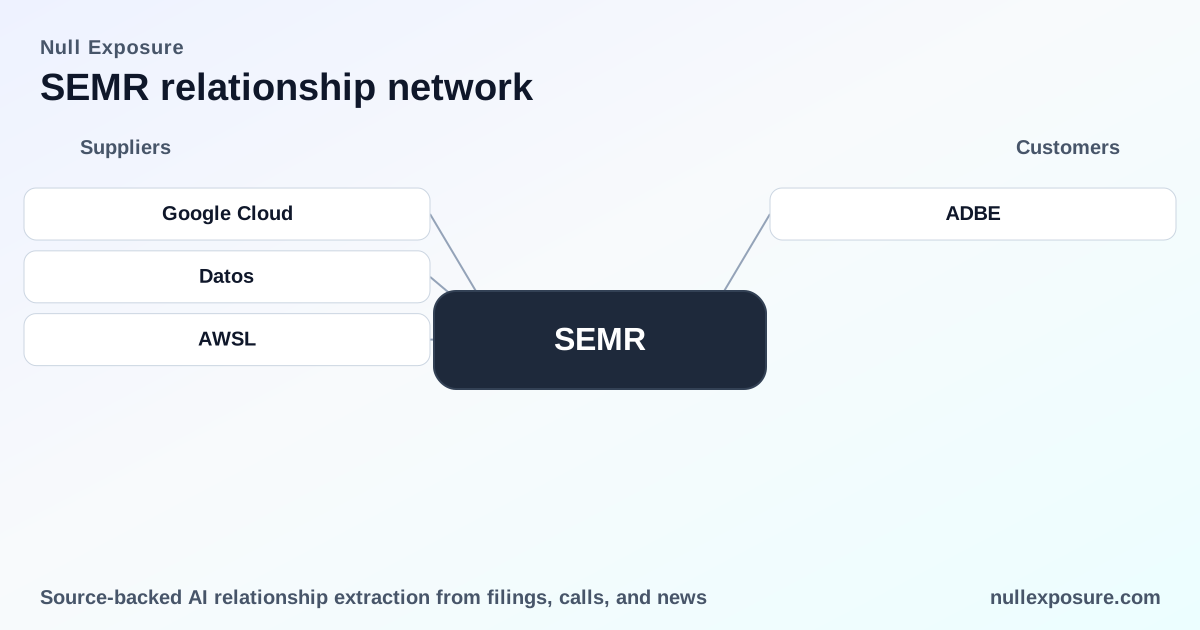
SEMrush Holdings (SEMR) — supplier relationships that matter for visibility and risk
Semrush is a SaaS company that monetizes online visibility and competitive intelligence tools through subscription licenses to marketers and enterprises. The business outsources core infrastructure and augments its enterprise product with third-party data partners, combining owned platforms with cloud-hosted compute and licensed clickstream feeds to deliver scale and product differentiation. For investors evaluating supplier risk and upside, the critical facts are which providers host customer data, which external datasets power higher-margin enterprise offerings, and the contractual profile behind those relationships. Learn how supplier signals affect operational leverage and vendor concentration at https://nullexposure.com/.
How Semrush sources the product: a concise operating thesis
Semrush runs a cloud-first SaaS stack that stores customer data across a mix of company data centers and large public cloud providers. The firm augments that infrastructure with licensed datasets for enterprise analytics, positioning higher-priced product tiers on externally sourced clickstream and behavioral data. This hybrid model reduces capital expenditure but increases operational dependence on a small number of external suppliers, while enabling faster product expansion into enterprise accounts.
Company-level supplier signals investors should treat as fact
The company’s public filings and reporting disclose several clear supplier posture signals that affect contract risk, spend concentration, and maturity:
- Long-term contracted posture: Semrush discloses multi-year commitments with certain data providers running through 2026, indicating contractual stability in its data supply chain. The Form 10‑K for fiscal 2024 explicitly lists multi-year commitments for data providers.
- Active supplier relationships: Those commitments are current and scheduled — the company reports future commitments for data services as of December 31, 2024, showing an active procurement stance.
- Spend concentration and scale: The disclosed future commitments total $13,709 for data services through 2026, signaling modest absolute future data spend relative to the company’s revenue base (Revenue TTM: $443.6M). This indicates the company is not heavily capitalized on high-cost licensed data at scale, an important constraint on vendor power.
These are company-level signals drawn directly from Semrush’s FY2024 disclosures and accompanying reporting; they inform the firm’s contracting posture (multi-year, active), concentration (low absolute future spend), and maturity (established, disclosed commitments).
Supplier ledger — each relationship and why it matters
Google Cloud — cloud hosting for customer data
Semrush states that, for customer data storage, it uses two company data centers in the U.S. and Google Cloud locations in the U.S. This confirms Google Cloud is an active infrastructure provider in Semrush’s hybrid hosting approach, underpinning availability and compliance posture for U.S.-based customer data. (Source: Semrush Form 10‑K, FY2024.)
AWS — a core public cloud footprint
The company’s 2024 Form 10‑K also identifies AWS locations in the U.S. as part of the platform that stores customer data, alongside Google Cloud and the firm’s own data centers. AWS therefore plays a similar infrastructural role to Google Cloud, providing compute and storage capacity that supports product scalability and operational redundancy. (Source: Semrush Form 10‑K, FY2024.)
Datos — enterprise clickstream to accelerate product differentiation
Semrush has integrated Datos, a provider of enterprise-level clickstream data, to strengthen its enterprise offering and data engine capabilities. This partnership is positioned as a product upgrade for enterprise customers, raising the addressable market for higher-tier subscriptions and enabling more sophisticated behavioral insights in Semrush’s analytics. (Source: MarketScreener report, March 10, 2026.)
What these relationships imply for investors
The supplier mix delivers a clear risk/reward profile:
- Operational leverage with limited capex: Relying on Google Cloud and AWS keeps capital intensity low and enables Semrush to scale compute elastically as customer demand grows. That supports gross margin preservation while enabling rapid product rollouts.
- Vendor concentration but low absolute spend for data: The concentration around two major cloud providers increases exposure to pricing or service disruptions at hyperscalers, but the company’s disclosed $13,709 of future data-service commitments through 2026 indicates data licensing is not a large fixed cost today. This trade-off reduces immediate vendor price pressure while leaving operational dependence intact.
- Enterprise upside from data partnerships: The Datos integration is a product-level differentiator that supports higher ARPU from enterprise accounts. If enterprise adoption scales, data licensing economics could shift from modest cost to a meaningful revenue accelerator. (Source: MarketScreener, March 2026.)
- Maturity and contract visibility: The fact that Semrush reports multi-year data commitments transparently in its 10‑K is a positive governance signal; investors can model those scheduled commitments into near-term cost expectations. (Source: Semrush Form 10‑K, FY2024.)
Explore supplier risk models and scenario analysis at https://nullexposure.com/ for tools that translate these relationships into valuation-relevant inputs.
Key risks tied to supplier relationships
- Hyperscaler dependence: Using both Google Cloud and AWS for customer data means Semrush is operationally dependent on third-party cloud SLAs and pricing policies; any meaningful pricing moves or outages at either provider would directly affect service cost and reliability.
- Concentration in data licensing strategy: Current disclosed future commitments are modest, but the business case for enterprise expansion relies on licensed clickstream; scaling that capability could increase vendor spend or require more exclusive terms.
- Contract timing: Multi-year contracts through 2026 concentrate renegotiation events in a narrow window, creating potential lumpiness in future cost trajectories if renewals occur at materially different terms.
Investment implications and next steps for analysts
For investors, supplier disclosures position Semrush as a low-capex, high-variable-cost SaaS operator that leverages hyperscalers and selective data partnerships to pursue enterprise ARPU expansion. The immediate financial exposure to data providers is modest based on disclosed commitments, but strategic dependence on cloud infrastructure and the success of the Datos integration are the two supplier-driven variables most likely to move the company’s margin and growth outlook.
- Track enterprise adoption of the Datos-powered features and any subsequent increases in data licensing commitments.
- Monitor hyperscaler contract notices and any disclosures around multi-cloud redundancy or cost-optimization efforts in future filings.
For a concentrated, enterprise-focused analysis framework and vendor-impact scenarios, see resources and services at https://nullexposure.com/.
Final takeaway
Semrush’s supplier posture is purposeful and predictable: hybrid cloud hosting with Google Cloud and AWS for operational scale, and targeted data partnerships like Datos to drive enterprise product differentiation. The company’s disclosed multi-year commitments and relatively small future data spend provide investors with clear, actionable signals to model vendor cost exposure and enterprise upside into earnings forecasts.