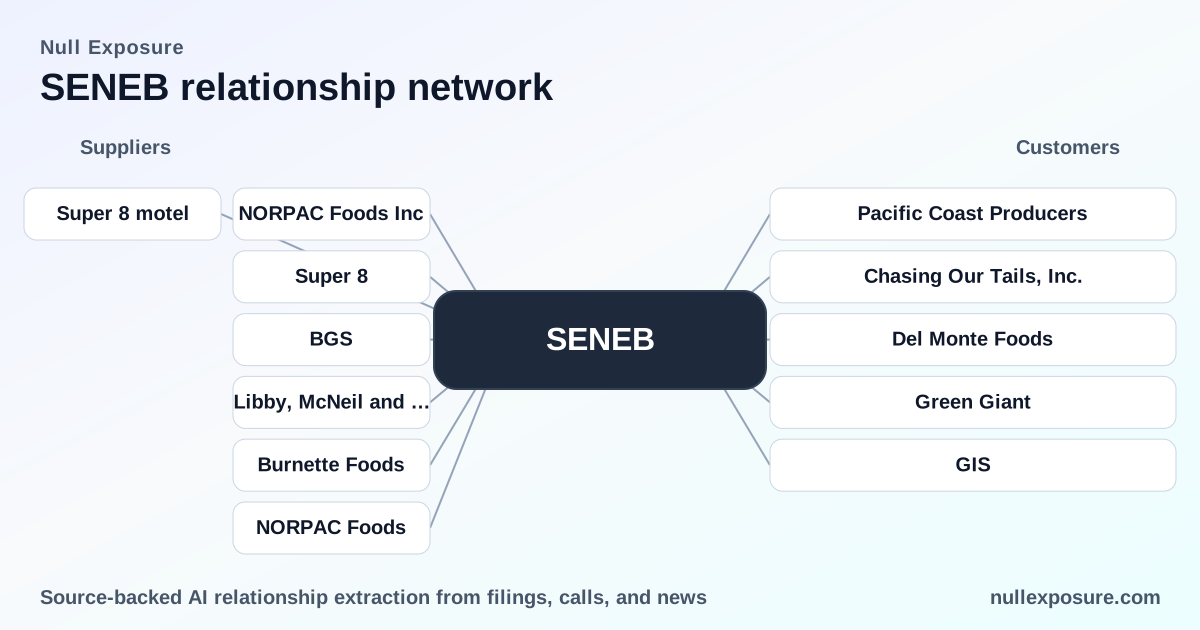
Seneca Foods (SENEB): Supplier relationships that define an old-line packaged foods consolidator
Seneca Foods operates as an integrated manufacturer and packager of branded and private‑label canned and frozen fruits and vegetables, monetizing through scale manufacturing, branded royalties/retail placements and supply agreements for acquired heritage lines. Revenue comes from a mix of owned brands and contract manufacturing for third parties, plus recently consolidated heritage brands such as Green Giant and Le Sueur, which increase gross throughput and give the company leverage over processing capacity. For investors assessing supplier and counterparty risk, Seneca’s model balances high domestic farm sourcing, short-term procurement contracts, and strategic M&A-driven vertical integration. Learn more about supplier intelligence and relationship risk at our homepage: https://nullexposure.com/
Snapshot investors will use right away
Seneca is a mature player in packaged foods with clear operating scale. Key indicators for counterparties and credit reviewers:
- Market capitalization ~ $932 million and Revenue TTM ~$1.61 billion, signaling mid‑market scale.
- EBITDA ~$175 million and EV/EBITDA ~6.4, showing transaction-level leverage potential.
- Trailing P/E 10.6 vs Forward P/E 48.1, reflecting earnings profile shifts after recent deals.
- Heavy insider ownership (~82%) and low institutional ownership (~5%), which affects governance and deal flow dynamics.
These metrics frame supplier negotiations: short-term contracting posture improves price flexibility but increases exposure to commodity swings; scale and acquisitions increase negotiating leverage with growers and co‑packers. If you want a deeper supplier relationship readout, start at https://nullexposure.com/ for vendor mapping services.
How Seneca sources and contracts — the company-level signals that matter
Three constraints in Seneca’s public commentary consistently shape supplier risk and integration strategy:
- Contracting posture: Seneca uses short-term supply contracts and advance grower purchase agreements to manage costs, a posture that delivers procurement flexibility but gives suppliers frequent re‑bidding opportunities (company disclosures).
- Geography: The firm sources primarily from more than 1,100 American farms, anchoring exposure in U.S. agriculture cycles and state-level harvest risk (company disclosures).
- Role: Seneca presents itself as a manufacturer with integrated canning and freezing capacity rather than a simple distributor, meaning supplier relationships are operationally critical and often embedded in logistics and seasonal capacity planning (company disclosures).
These company-level signals indicate high operational criticality for farm relationships, concentrated geography exposure to U.S. weather and labor markets, and a procurement rhythm that favors short-term price resets over long multi‑year guarantees. For a mapped view of counterparties and supplier contracts, visit https://nullexposure.com/ and request a brief.
Relationship inventory — each mention and what it tells investors
NORPAC Foods Inc (FY2019)
NORPAC’s canning division was sold to Seneca in 2017, reflecting Seneca’s ongoing strategy of acquiring regional canning capacity to consolidate supply and seasonal throughput (Statesman Journal, FY2019: https://www.statesmanjournal.com/story/news/2019/08/22/norpac-file-chapter-11-seek-buyer-food-processing-operations-bankruptcy-oregon/2086059001/).
NORPAC Foods (FY2018)
Local reporting also recorded NORPAC’s sale of its canning business to Seneca a year earlier, confirming the transaction’s role in Seneca’s regional capacity buildout and footprint expansion on the U.S. West Coast (Statesman Journal, FY2018: https://www.statesmanjournal.com/story/news/2018/02/02/oregon-fruit-products-buys-165-000-square-foot-plant-salem/301993002/).
Super 8 (FY2021)
During the COVID-19 outbreak at a Seneca green‑bean canning plant, the company used an adjacent Super 8 motel in Shawano to isolate workers, highlighting operational and labor contingency linkages between Seneca and local lodging providers during crises (Milwaukee Journal Sentinel / JSONLINE, FY2021: https://www.jsonline.com/in-depth/news/investigations/reports/2021/05/20/migrant-workers-seneca-foods-green-bean-canning-facility-wisconsin-died-covid-19/3941563001/).
Super 8 motel (FY2021)
A follow-up report noted that Seneca isolated approximately 25 plant workers at the Shawano Super 8 motel as part of its outbreak response, underlining how ancillary local vendors can become de facto crisis suppliers in labor‑intensive processing hubs (JSONLINE, FY2021: https://www.jsonline.com/story/news/2021/06/03/25-wisconsin-seneca-foods-workers-got-covid-company-blamed-community-spread/5258162001/).
B&G Foods (FY2026)
Seneca’s acquisition of Green Giant’s U.S. canned business includes a supply agreement for certain Green Giant frozen SKUs produced in Irapuato, Mexico by B&G Foods, demonstrating that Seneca blends ownership of canned brands with contracted manufacturing abroad for frozen lines (Rochester Business Journal, FY2026: https://rbj.net/2026/03/04/seneca-expands-foods-green-giant-us-frozen-acquisition/).
B&G Foods Inc. (FY2025)
Industry press reported that B&G sold the Green Giant U.S. canned vegetable business to Seneca in November 2023, a precedent transaction that explains why Seneca now carries legacy Green Giant SKU responsibility and the associated supply agreements (Food Business News, FY2025: https://www.foodbusinessnews.net/articles/28783-b-and-g-foods-wraps-up-sale-of-le-sueur-vegetable-brand).
Libby, McNeil and Libby Inc. (FY2018)
Historical notes record that Seneca acquired the Libby business in 1982, reinforcing Seneca’s long-term strategy of preserving legacy packaged‑foods brands and leveraging their retail recognition within its manufacturing footprint (Post Bulletin, FY2018: https://www.postbulletin.com/opinion/our-view-end-of-the-line-for-a-piece-of-rochester-history).
Burnette Foods (FY2018)
Seneca purchased a maraschino cherry business from local peer Burnette Foods as part of its plant consolidation and SKU rationalization strategy, evidencing targeted tuck‑ins that expand product breadth and seasonal fruit sourcing relationships (Just‑Food, FY2018: https://www.just-food.com/news/us-group-seneca-foods-to-close-plant-in-california/).
What these relationships imply for credit and supplier risk
- Acquisition-led growth is strategic and operational: The NORPAC and Burnette tuck‑ins plus the Green Giant deal show Seneca consolidates processing capacity and brand ownership to capture margin and fixed‑cost absorption. That raises integration risk but also capacity control.
- Counterparty complexity is rising: The B&G supply agreement for Mexican‑produced frozen SKUs introduces cross-border manufacturing dependencies alongside Seneca’s heavy U.S. farm sourcing — diversifying operations but adding logistics and FX considerations.
- Labor and local vendor exposure is real: The Super 8 episodes illustrate how labor events convert local service vendors into critical short-term suppliers, increasing operational risk during outbreaks or harvest bottlenecks.
- Procurement posture tilts to flexibility: Short‑term contracts and advance grower agreements give Seneca price agility but expose gross margins to commodity cycles and seasonal harvest disruptions.
- Corporate maturity with concentrated ownership: Seneca’s long history of brand acquisitions, solid EBITDA, and high insider ownership implies executive-driven strategic moves rather than institutionally led moderation.
Bottom line and next steps
Seneca is a mid‑market, manufacturing-led consolidator whose supplier relationships are a mix of acquired capacity, local crisis vendors and targeted third‑party production deals. Key risks for counterparties and investors are short-term contract exposure, U.S. farm concentration, and integration of newly acquired brands and cross-border supply agreements. For business teams running supplier diligence or monitoring counterparty exposure, this profile requires active tracking of seasonal procurement terms, labor contingency plans, and the performance of recent acquisitions.
Explore vendor-level intelligence and relationship monitoring resources at https://nullexposure.com/ to convert these relationship signals into operational action.