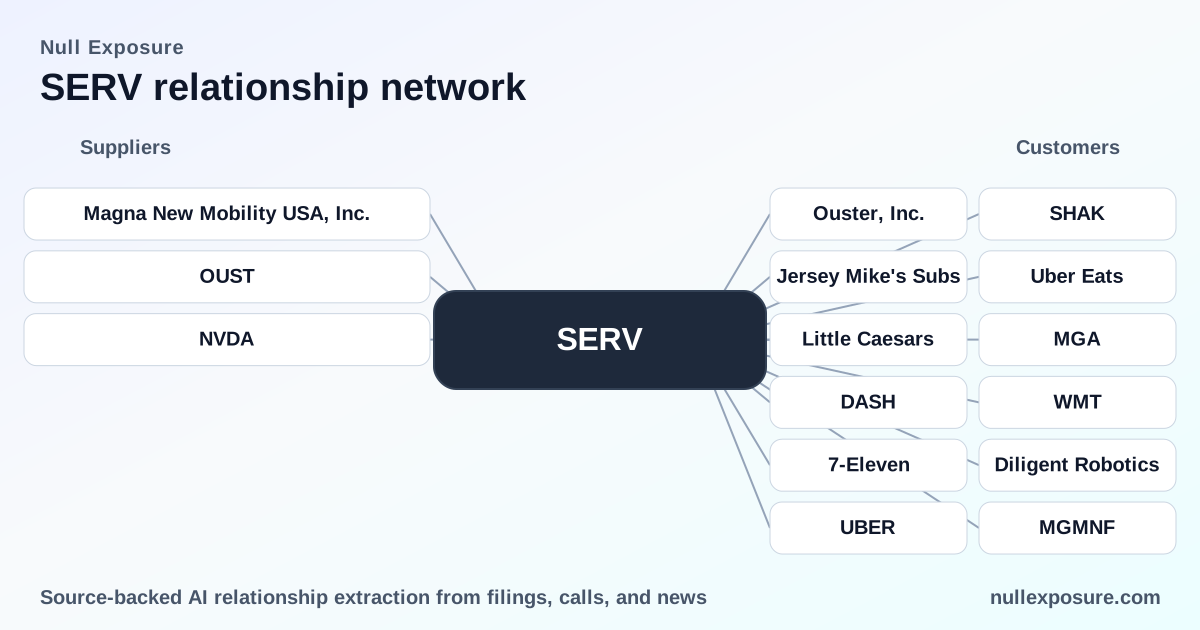
Serve Robotics (SERV): Supplier relationships and contractual constraints that shape the robot delivery economics
Serve Robotics designs, develops and operates low‑emission delivery robots and monetizes through operating its delivery fleet and commercial partnerships that supply critical hardware (LiDAR, compute) and manufacturing services. Investors should value Serve not as a pure hardware vendor but as a capital‑light operator that buys or commits to components and outsources assembly while scaling recurring delivery revenue and platform economics.
For a concise risk map and supplier scoring tailored to institutional diligence, see https://nullexposure.com/.
Where the business stands financially — the short read for investors
Serve is a small‑revenue operator with large losses and a valuation that implies aggressive growth. Market capitalization sits around $745 million against trailing revenue of roughly $2.65 million and an operating margin of -44% (TTM), indicating the market is pricing future scale rather than current cash generation. The stock exhibits high volatility (beta ≈ 3.1) and an analyst consensus target of $18.86, reflecting optionality around fleet rollouts and supply relationships.
The supplier and partner landscape you need to know about
Below I cover every supplier/partner relationship surfaced in filings and market coverage. Each relationship is summarized plainly with source context.
Magna New Mobility USA, Inc.
Serve Operating Co. executed a Master Services Agreement with Magna New Mobility USA, Inc., dated February 1, 2024 and effective January 15, 2024 — a commercial framework that institutionalizes component, assembly or services cooperation between the parties as disclosed in Serve’s FY2024 Form 10‑K. (Source: FY2024 10‑K filing.)
Ouster (OUST)
Serve has a multi‑year LiDAR supply relationship with Ouster; company commentary highlighted Ouster sensors as an example of scalable, market‑ready LiDAR on an earnings call (Q3 2025) and industry coverage noted an expanded LiDAR supply agreement that outfits Serve’s fleet with Ouster REV7 sensors. Ouster is a strategic hardware supplier for Serve’s sensor stack. (Sources: Serve Q3 2025 earnings call; Retail Tech Innovation Hub coverage, June 2024.)
Nvidia (NVDA)
Nvidia was an early investor in Serve and Serve uses Nvidia chips for onboard compute in its robots, giving Serve direct exposure to Nvidia’s AI compute roadmap and supply dynamics. This relationship ties Serve’s operational performance to Nvidia’s hardware availability and pricing. (Source: market coverage reported on March 10, 2026.)
What the contractual constraints tell investors about Serve’s operating model
Serve’s disclosed constraints across filings signal a supplier posture that is a hybrid of long‑term commitments and outsourced execution:
- Long‑term procurement commitments: Company disclosures note an increased total purchase commitment of approximately $6.83 million over a two‑year period ending December 2025, indicating forward‑booked component spend and vendor forward commitments. This reduces near‑term supply risk but locks in cash outlays. (Company disclosure.)
- Outsourced manufacturing model: Serve states that manufacturing and assembly occur through third‑party contract manufacturers after securing component supply, which lowers fixed capital intensity but increases dependence on contract manufacturers’ operational reliability. (Company disclosure.)
- Spend scale: Future minimum payments disclosed (about $3.54 million) place supplier spend in a mid‑range band ($1M–$10M), signaling meaningful but not deeply concentrated single‑vendor spend per contract. (Company disclosure.)
Taken together, these constraints create a contracting profile that favors supply continuity and modularity: Serve reduces in‑house capital intensity via outsourcing, secures essential components through multi‑year commitments, and concentrates risk where critical components (LiDAR, AI chips) are sourced.
The operational and valuation implications investors should weight
- Critical supplier risk: Ouster (LiDAR) and Nvidia (compute) are materially critical to vehicle performance; outages or pricing shocks from these vendors would directly affect unit economics and rollout timelines. The market has priced this dependency as part of high growth expectations rather than current profitability.
- Concentration vs. flexibility: Long‑term purchase commitments reduce execution risk but limit Serve’s ability to renegotiate pricing during rapid component deflation. Outsourced assembly preserves capital flexibility but hands operational control to contract manufacturers.
- Spend scale signals maturity: The $1M–$10M spend band and multi‑year commitments imply Serve is past ad‑hoc procurement and into repeatable commercial sourcing — a positive sign for scaling, but not yet evidence of positive unit economics.
- Valuation disconnect: A Price‑to‑Sales ratio in the hundreds and negative EBITDA require investors to believe in rapid, profitable scale or strategic exit value; supplier relationships that secure LiDAR and compute are central to achieving that outcome. (Company financials, TTM.)
For a structured supplier risk scorecard and to benchmark Serve’s partner exposures against peers, visit https://nullexposure.com/.
Practical takeaways for investor diligence
- Track Ouster and Nvidia supply agreements closely; renewals, pricing resets, or expanded volume commitments are catalysts. The expanded LiDAR deal publicized in industry press is the immediate operational lever.
- Monitor contract manufacturer performance and visibility into minimum purchase obligations; these determine cash outflow timing and response options if customer rollouts slow.
- Valuation is binary: either unit economics prove scalable with stable supplier pricing or the multiple compresses as growth expectations reset.
If you are conducting counterparty diligence or portfolio stress testing, we provide supplier relationship analytics and contract signal extraction that speed decision cycles — learn more at https://nullexposure.com/.
Conclusion: supplier relationships are the wiring behind Serve’s growth story
Serve’s commercial model is a platform operator built on strategic hardware partnerships and outsourced manufacturing, with multi‑year procurement commitments that mitigate some supply risk while introducing locked‑in cost exposure. For investors, the central questions are whether Serve can convert its high valuation into durable margins and whether these supplier relationships remain stable through scale. For a deep dive into supplier exposure, contract durations and spend bands relevant to portfolio construction, explore the resources at https://nullexposure.com/.