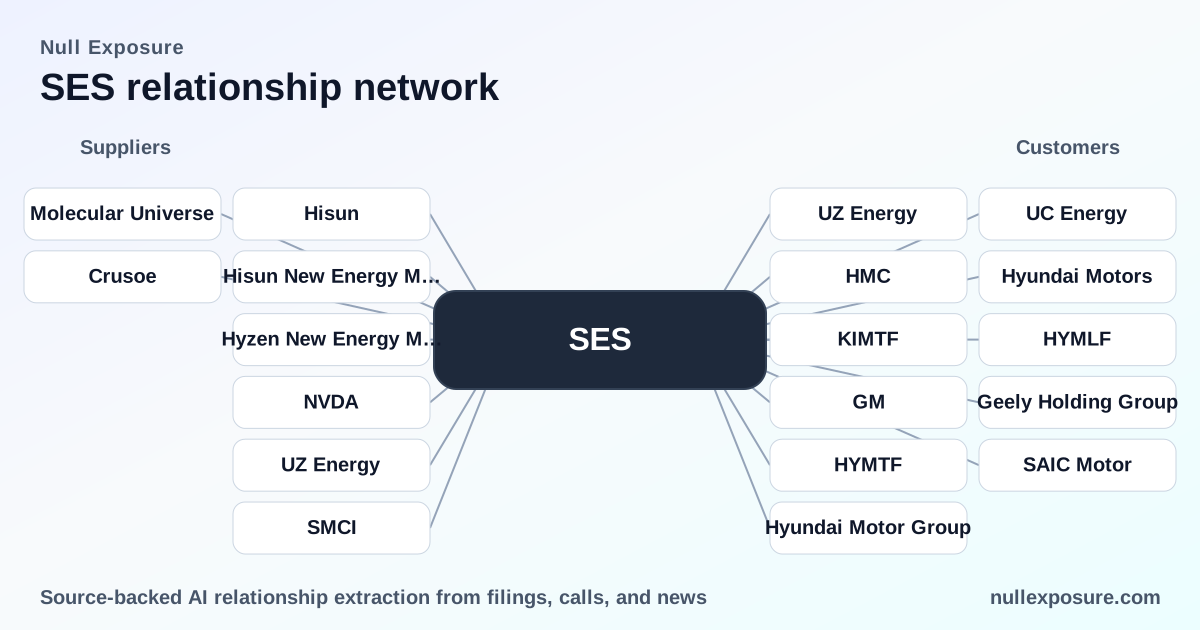
SES AI Corp: supplier relationships that underpin its battery-material commercialization strategy
SES AI Corp develops and commercializes AI-discovered battery materials and then monetizes that intellectual property through licensing, joint ventures and contract manufacturing arrangements that scale discoveries into commercial electrolyte and cell components. The company captures value by pairing computational discovery (Molecular Universe) with third‑party manufacturing capacity and strategic compute partners, generating revenue from commercial supply agreements, joint ventures and licensing of AI‑optimized chemistries. For investors, the critical question is whether these supplier and partner arrangements convert discovery into repeatable, revenue‑generating manufacturing at scale.
Discover how these supplier signals map to execution and risk at the homepage: https://nullexposure.com/
How SES AI’s supplier network fits the business model
SES AI’s economics depend on three linked functions: discovery (AI/ML screening of millions of molecules), scale‑up (contract manufacturing or joint ventures to produce candidate electrolytes), and go‑to‑market (supplying battery manufacturers). The company does not primarily build commodity plants itself; it monetizes IP and secures manufacturing capacity through partners and JVs. That model reduces upfront capital intensity but creates dependency on supplier capacity, technology integration and short‑term contracting dynamics.
The supplier and partner map — every relationship in the record
Hisun / Hisun New Energy Materials Ltd. Co.
SES AI announced a joint venture with Hisun to leverage 150,000 tonnes of annual fabrication capacity to produce materials discovered by SES AI, intended to supply other battery manufacturers for consumer electronics and assets. According to SES’s 2025 Q4 remarks and a Marketscreener term‑sheet release (FY2025), this agreement is positioned to convert Molecular Universe discoveries into commercial product through outsourced capacity.
Hyzen New Energy Materials
SES AI disclosed a joint venture agreement with Hyzen New Energy Materials to contract manufacture materials discovered by Molecular Universe, citing Hyzen’s 150,000‑ton annual capacity as the route to commercial supply. The Globe and Mail coverage of the FY2025 statement documents this production pathway and frames Hyzen as a manufacturing anchor for early commercial volumes.
Molecular Universe
Molecular Universe is the internal name for SES AI’s discovery engine that generates candidate electrolyte chemistries; SES signed a term sheet to establish a JV to supply materials discovered by Molecular Universe. Marketscreener reported the FY2025 term sheet, confirming Molecular Universe is the intellectual core that needs external manufacturing partners to capture commercial value. Molecular Universe is the primary IP asset that SES monetizes through supplier relationships.
NVIDIA
SES AI relies on NVIDIA’s compute platform to search and model over 100 million molecules, accelerating the discovery pipeline through GPU‑accelerated simulations. SES’s collaboration with NVIDIA (FY2024–FY2025 press coverage) positions NVIDIA as a critical compute supplier that materially shortens discovery timelines and supports SES’s product roadmap.
Supermicro
Supermicro provides hardware infrastructure that complements SES’s compute stack for materials modeling; company press releases in FY2024 list Supermicro among SES’s compute partners alongside NVIDIA and others. This relationship supplies the on‑premise server architecture needed for production compute workloads tied to discovery workflows.
Crusoe
Crusoe is listed among SES’s computational and energy‑optimization partners, supplying flexible compute resources and power management that help lower cost and increase throughput for large GPU workloads, as described in SES’s FY2024 corporate communications. Crusoe thus functions as a pragmatic supplier for distributed compute capacity.
UZ Energy
UZ Energy supplies hardware that, when integrated with SES’s software, supports compact energy solutions and prototype system work, according to a FY2025 business note. This relationship supports device and hardware integration experiments rather than large‑scale electrolyte production, positioning UZ as a tactical supplier for near‑term product demonstrations.
Notes on sources: SES’s 2025 Q4 earnings call (March 2026) and FY2025/FY2024 press coverage in Marketscreener, The Globe and Mail and vendor blogs document these partnerships and the role each counterparty plays in production, compute, and prototype workflows.
What the supplier constraints tell investors about operating posture
The contractual and disclosure constraints in SES’s public statements convey three company‑level signals:
-
Short‑term contracting posture. Management states volume demand is limited during product development and long‑term supply arrangements are not yet finalized, implying SES relies on short‑term purchase commitments and JDA‑style arrangements during scale‑up. This operational posture reduces capital commitment but increases execution risk if partners reprioritize capacity.
-
Active development stage. SES explicitly sources third‑party suppliers for raw materials, components and equipment to develop Li‑Metal cells; this is a firm signal that relationships are operational and active but still centered on prototype and early commercial volumes rather than mature, multiyear supply contracts.
-
Mid‑range committed spend. Public filings disclose purchase obligations and committed JDA spend in the $10m–$100m band (total purchase obligations disclosed around $33.6m as of Dec 31, 2024), which indicates meaningful but not large capital commitments tied to scale‑up and development. This level of spending is material to product development but does not represent full plant financing.
These constraints imply a low‑capex, partner‑centric commercialization model with meaningful reliance on supplier continuity and the ability to convert short‑term commitments into predictable, recurring supply agreements.
Investment implications — where the upside and risks live
-
Upside pathway: If SES converts Molecular Universe discoveries into reliable, repeatable chemistries and its JVs (Hisun/Hyzen) deliver commercial supply at scale, revenue growth will accelerate without SES taking full plant construction risk. The pairing of high‑quality compute partners (NVIDIA, Supermicro, Crusoe) with manufacturing partners is an efficient route to scale.
-
Principal risks: Execution risk is concentrated in supplier delivery and contractual continuity. Short‑term contracts and active development stage mean counterparty capacity allocation and integration timelines are the gating factors for revenue realization. Any delay or reprioritization by manufacturing partners could postpone commercialization.
-
Balance sheet and spend signal: Purchase obligations in the tens of millions show management is investing in commercialization infrastructure but not assuming heavy plant capex; this supports a capital‑light growth narrative while exposing SES to external capacity risk.
For more detailed supplier signal analysis and ongoing updates on SES AI’s commercialization progress, visit our research hub: https://nullexposure.com/
Bottom line and recommended next steps for investors
SES AI’s network of manufacturing and compute partners aligns with a capital‑efficient go‑to‑market reliant on outsourced capacity and JV structures. Key diligence for investors: confirm the transition from short‑term development contracts to multi‑year supply agreements, track production ramp metrics from Hisun/Hyzen JVs, and monitor compute partnerships’ capacity commitments. For a deeper supplier‑centric diligence package and ongoing monitoring of partner execution, see our platform: https://nullexposure.com/
Overall, SES’s model can scale commercially without heavy CAPEX, but the company’s path to predictable revenue depends squarely on converting active, short‑term supplier relationships into durable manufacturing throughput.