SEV: Supplier relationships, capital posture, and what investors should track
Sevcon (ticker SEV) designs and sells electric motor controllers and related power electronics across the U.S., U.K., France, South Korea, Japan and China, monetizing through product sales and aftermarket support to vehicle and industrial OEMs. The company’s public profile today is defined more by capital markets activity than by recurring revenue: market capitalization is roughly $83.5 million while reported trailing revenues are listed as $0. For investors and operators evaluating supplier relationships, the priority is to treat SEV as a capital-constrained hardware supplier with limited operating disclosures and direct implications for counterparty risk.
Explore supplier intelligence and monitoring tools
What the company actually sells and how that drives cash flow
Sevcon’s core economic model is straightforward: sell motor controllers and service relationships to vehicle and industrial manufacturers, and capture aftermarket revenue from parts and support. Product sales are transactional and tied to OEM production cycles, which creates lumpy procurement and revenue recognition patterns for suppliers and partners.
Operational facts that shape commercial terms:
- Market capitalization reported at approximately $83.5 million and shares outstanding at 24 million, indicating a small-cap profile with limited market liquidity.
- Reported trailing revenue and profit metrics are listed as zero in the public overview, and conventional profitability metrics (EBITDA, EPS) are not provided.
- Price-to-book ratio is 3.064, while 52-week trading ranged from $1.29 to $22.43, signaling historical price volatility.
These indicators make working capital and financing terms the decisive negotiation point for OEMs and component suppliers: expect shorter payment horizons, collateral requirements, and active monitoring of cash infusions. Suppliers should price for capital risk into long-term supply agreements.
Disclosed relationships: the full list investors should note
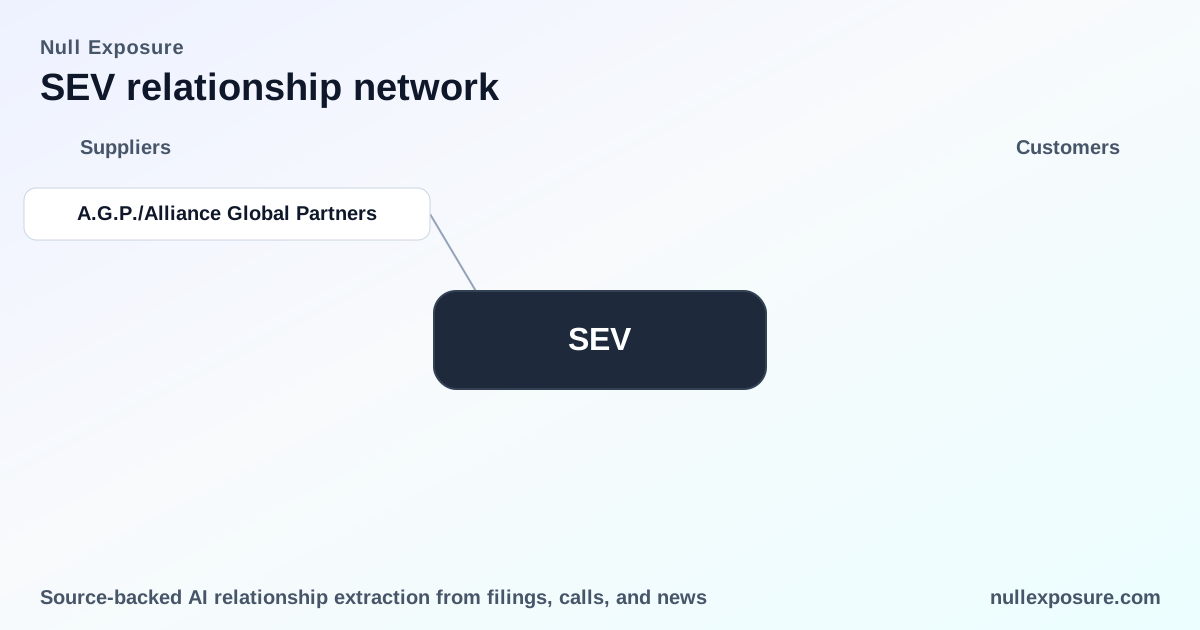
A single relationship is disclosed in the available supplier-scope results:
- A.G.P./Alliance Global Partners acted as sole placement agent for a public offering that priced at $9 million in January 2026. According to a GlobeNewswire release republished by The Manila Times on January 23, 2026, A.G.P./Alliance Global Partners served as the exclusive placement agent on the offering. (Manila Times / GlobeNewswire, Jan 2026)
This is the only relationship surfaced in the provided results set.
Why that placement relationship matters for suppliers and partners
Using an underwriter or placement agent to raise $9 million is a clear operational signal: the company is actively tapping public markets to fund operations rather than relying on operating cash flow. That creates two immediate supplier considerations:
- Financing cadence becomes a driver of procurement: manufacturing volume and payment discipline will be tied to the timing and success of capital raises.
- Counterparty credit risk is elevated during and immediately after offerings; suppliers should build triggers into contracts tied to subsequent capital events or covenant tests.
A placement-agent engagement also demonstrates that management is prepared to accept dilution or transaction fees to secure liquidity, which is material to contract valuation and long-term partnership structures.
Review supplier and counterparty monitoring options
Company-level constraints and what they imply (not tied to any single relationship)
The public data set contains several company-level signals that affect supplier negotiations and operational risk:
- Zero reported trailing revenue and profit metrics. This is a hard operating signal: either sales are not recognized in the period reported, or financial reporting does not capture material operating revenue. For counterparties, this translates into a higher reliance on external capital to sustain production runs.
- No reported institutional or insider shareholdings. The overview lists 0% institutional and 0% insider ownership; this indicates a lack of visible, stable strategic investors that often provide governance and additional capital backstops.
- Small market capitalization with volatile trading range. Market cap of roughly $83.5 million and a wide 52-week price range signal limited liquidity and price sensitivity to news—important when considering long-term supplier credit exposure.
- Public financing posture. The disclosed placement-agent engagement is consistent with a contracting posture oriented to market-based financing rather than internal cash funding; suppliers must treat contractual commitments as contingent on capital access.
These constraints collectively describe a supplier whose criticality to OEMs is product-specific but whose financial maturity and stability are lower than standard-tier suppliers. Contracting should therefore emphasize upfront payments, inventory controls, and milestone-based delivery.
Key risks to underwrite in supplier diligence
- Concentration of cash flow exposure around discrete capital raises and production milestones.
- Absence of transparent recurring revenue increases counterparty credit risk.
- Dilution and capital market dependency can change counterparty bargaining power rapidly.
When structuring agreements, require step-in rights, payment acceleration on capital events, and frequent cadence of financial reporting.
Practical takeaways for investors and procurement officers
- Treat SEV as a capital-dependent hardware supplier. Pricing, payment terms, and inventory commitments must assume further capital activity.
- Monitor financing events closely. The A.G.P./Alliance Global Partners placement agent role is directly relevant to near-term liquidity; subsequent offerings or failed raises will affect supplier exposure.
- Insist on stricter operational protections. Shorter payment cycles, performance milestones, and clear remedies for funding shortfalls are appropriate.
For investors and operators seeking ongoing coverage of SEV and similar supplier relationships, Null Exposure provides curated intelligence and alerting for capital events and counterparty changes. Learn more at Null Exposure
Bottom line: SEV’s engineering value is tangible, but its public disclosures and reliance on market financings make it a higher-risk supplier from a commercial credit perspective. Contracts and investment positions should be structured to protect against funding volatility and limited operating transparency.