Seven Hills Realty Trust (SEVN): Who Runs the Business and Who Gets Paid
Seven Hills Realty Trust is a small, healthcare-focused REIT that originates and acquires first-mortgage loans and other commercial real estate financing and is externally managed; it monetizes through interest income on loan investments and spreads on financing plus fee arrangements tied to externally provided asset-management services. The company’s operating model is built around an external manager that sources, underwrites and services assets on SEVN’s behalf, while capital raises and secured financing supply placement capacity for new loan deployments. For an in-depth supplier-risk view, see the homepage at https://nullexposure.com/.
How SEVN’s operating model shapes supplier risk and returns
Seven Hills uses an externally managed structure in which day-to-day operations and investment origination are run by a manager rather than in-house staff. That contracting posture creates two predictable dynamics: operational concentration (control and execution live with the manager) and contractual short-termism (the management agreement renews annually). The company’s balance-sheet posture amplifies those dynamics—secured financing represents a sizeable share of assets—so vendor performance and access to financing are directly material to portfolio execution and liquidity.
- The management agreement renews on a one-year rolling basis, creating a short-term contracting posture that requires continual governance oversight from the board.
- The manager is a large, established organization with significant scale; that scale reduces single-vendor operational risk but increases counterparty concentration.
- Secured financing is a material component of SEVN’s funding structure, so counterparties that service financing and capital markets work are strategically important for near-term asset deployment and refinancing.
If you want a concise vendor exposure briefing, visit https://nullexposure.com/ to see how suppliers interact with balance-sheet risks.
Supplier relationships that matter — the facts, one by one
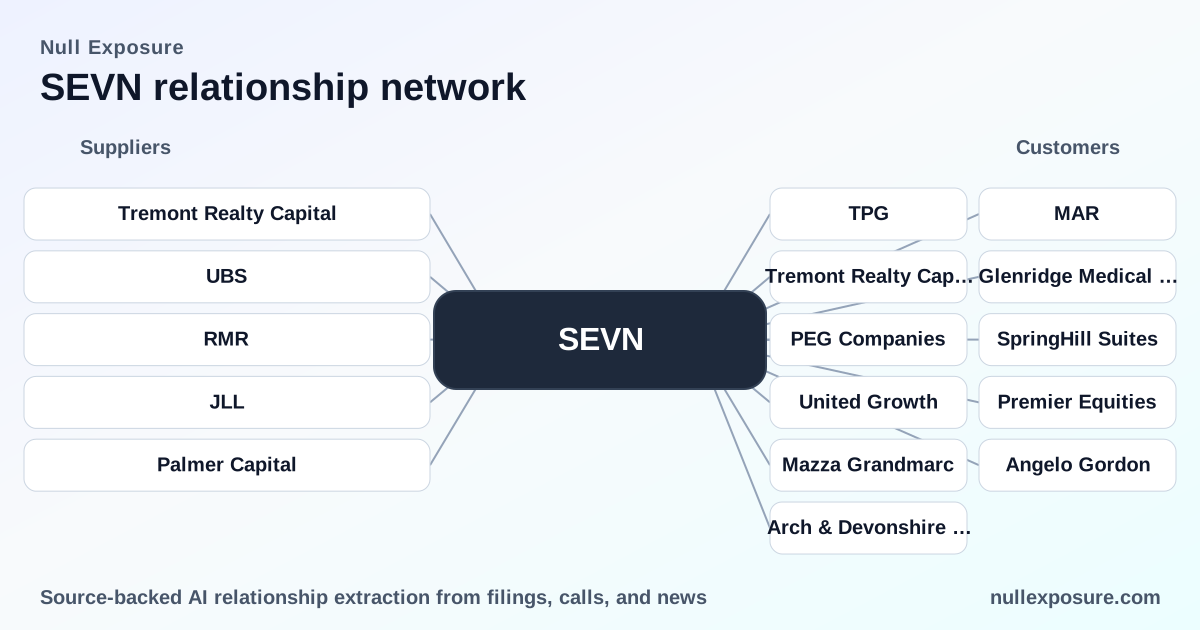
Tremont Realty Capital
Tremont Realty Capital is SEVN’s external manager and handles day-to-day operations, investment origination and asset management; multiple company announcements and press coverage identify Tremont as the manager that sources and administers SEVN’s loan investments (CityBiz, BizWire, Market announcements, FY2025–FY2026). (Examples: CityBiz FY2025; BizWire FY2026 — https://www.citybiz.co/article/776071/seven-hills-realty-trust-deploys-101-3-million-across-three-new-loan-investments/; https://markets.financialcontent.com/stocks/article/bizwire-2026-2-18-seven-hills-realty-trust-announces-fourth-quarter-2025-results)
RMR (The RMR Group / RMR Inc.)
RMR is the parent organization of Tremont’s owner and is cited in SEVN disclosures as the ultimate group with scale; RMR’s balance-sheet activity and asset-management footprint are referenced as part of SEVN’s manager profile and transactional pipeline (RMR is explicitly named in SEVN filings and Q4 commentary, FY2025–FY2026). (Source: Q4 2025 earnings commentary and company filings — https://www.insidermonkey.com/blog/seven-hills-realty-trust-nasdaqsevn-q4-2025-earnings-call-transcript-1699647/)
UBS Investment Bank
UBS Investment Bank acted as the sole dealer manager for SEVN’s rights offering, supporting capital markets execution around SEVN’s equity raise activities (press release covering the rights offering, Dec 2025). (Source: BizWire / FinancialContent, Dec 2025 — https://markets.financialcontent.com/stocks/article/bizwire-2025-12-10-seven-hills-realty-trust-announces-completion-of-rights-offering?Language=english)
JLL
JLL sourced at least one loan transaction to SEVN’s manager, acting in an advisory or broker role on originations that subsequently flowed to Tremont and into SEVN’s portfolio (transaction coverage, FY2025–FY2026). (Source: NEREN/transaction report and Pulse2 FY2026 coverage — https://nerej.com/print/59212?ref=xranks; https://pulse2.com/seven-hills-realty-trust-37-million-invested-in-two-first-mortgage-loans/)
Palmer Capital
Palmer Capital introduced a sponsor to SEVN’s manager for a loan transaction, functioning as an originator or broker in specific financing placements that SEVN acquired (deal announcement, FY2026). (Source: Pulse2 FY2026 — https://pulse2.com/seven-hills-realty-trust-37-million-invested-in-two-first-mortgage-loans/)
What the constraints tell investors about supplier posture and concentration
The documentary evidence in SEVN’s materials establishes several company-level operating characteristics that affect supplier risk:
- Short-term contracting posture: The management agreement renews annually by automatic extension, which gives the board recurring leverage but requires frequent governance decisions and creates execution risk if the relationship were to change suddenly.
- Very large enterprise counterparty: SEVN’s manager is affiliated with RMR, a significant industry operator with billions under management; that scale reduces execution risk in sourcing but increases counterparty concentration and second-order operational coupling.
- Materiality of financing: SEVN reports secured financing representing a large share of total assets, making the facilities and the counterparties that support them material to liquidity and refinancing timelines.
- Service-provider role is central: The manager supplies personnel and essential services for SEVN’s operations, which means vendor performance is a direct driver of underwriting, asset management and compliance outcomes.
- Active relationship stage: The manager and capital markets relationships are active, with ongoing originations and completed offerings in FY2025–FY2026 that show the model is operational and being used to deploy capital.
Together these constraints describe a highly operationally integrated, externally managed REIT: governance and contract vigilance are the primary tools investors use to control vendor risk.
(Where evidence names a relationship explicitly, such as RMR or Tremont, that linkage is reflected in the relationship descriptions above and in the managerial role noted in company filings.)
If you want a structured assessment of supplier concentration and counterparty risk for SEVN’s relationships, start with a focused vendor exposure report at https://nullexposure.com/.
Risk implications and what investors should watch next
- Governance and renewal cadence: Annual auto-renewal of the management agreement requires investors to track board oversight actions and any compensation or performance adjustments tied to those renewal points. Monitor board minutes and proxy disclosures ahead of each January renewal.
- Concentration on a single manager: Because Tremont (and by extension RMR) runs originations and servicing, operational failures or strategic shifts at the manager would have outsized impact on new production and asset performance.
- Capital markets counterparties are transactional but important: UBS played a central role in the rights offering; relationship continuity with capital markets dealers matters for future equity or debt raises.
- Origination pipeline sources matter: Intermediaries like JLL and Palmer Capital funnel deals to the manager; changes in those sourcing relationships would affect deal flow.
Investor actions — practical next steps
- Review SEVN’s management agreement terms and upcoming renewal mechanics in the next proxy/filing cycle and compare compensation and termination provisions to peers.
- Track capital markets activity with UBS and monitor secured financing capacity and covenants that underwrite the portfolio’s leverage.
- Add SEVN manager performance KPIs (origination volumes, servicing metrics, non-performing loans) to regular portfolio monitoring.
For a concise supplier-risk brief and ongoing monitoring setup for SEVN and comparable externally managed REITs, visit https://nullexposure.com/.
Bold closing takeaway: SEVN’s performance is tightly coupled to its external manager and the group infrastructure behind that manager; governance of the management agreement and the health of financing counterparties are the dominant supply-side risks investors must manage.