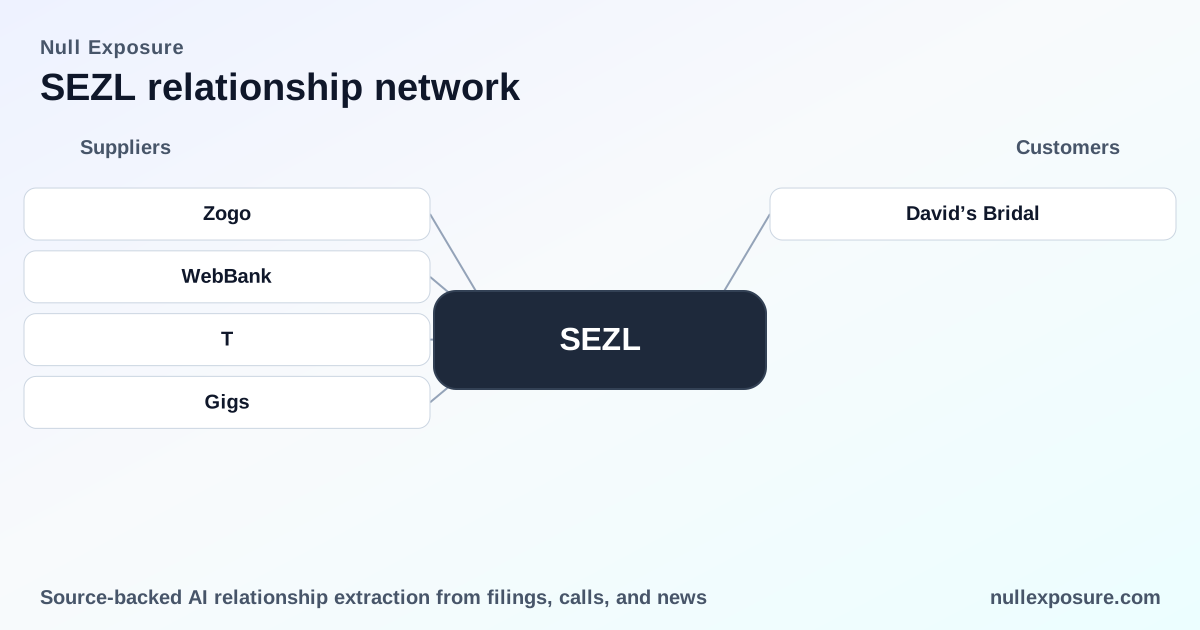
Sezzle Inc. (SEZL) — Supplier Map and Strategic Risk Brief
Sezzle is a technology-enabled payments platform that monetizes through merchant fees and consumer financing spread, plus adjacent services such as virtual card issuance and a newly launched mobile offering. Revenue derives from transaction-driven merchant economics and productized consumer services (e.g., virtual cards and mobile plans), while capital-light partnerships supply banking, connectivity, and content capabilities. For a fast, structured supplier review and connection intelligence, visit https://nullexposure.com/.
How Sezzle makes money and why suppliers matter
Sezzle sells merchants the ability to offer buy-now-pay-later financing and captures fees on processed gross merchandise value (GMV), plus interchange-like economics from a virtual card product. The company also introduced Sezzle Mobile, a subscription product that leverages third-party connectivity and network infrastructure to create an additional recurring-revenue stream. These supplier relationships are not peripheral — they underpin product delivery, regulatory compliance, and unit economics, so assessing partner stability and contractual posture is essential for investors evaluating SEZL exposure.
Direct relationships you need to know about
Zogo — financial wellness content partner
Sezzle integrates financial education for its users through Zogo’s platform; MoneyIQ for Sezzle users is delivered and customized by Zogo. According to a Yahoo Finance piece in March 2026, MoneyIQ is “powered by Zogo,” positioning Zogo as the content and user-education provider for Sezzle’s consumer-facing experience. (Yahoo Finance, March 2026)
WebBank — issuer and on-demand banking collaborator
The Sezzle Virtual Card is issued by WebBank, enabling both integrated and non-integrated merchant acceptance and compatibility with Apple Pay and Google Pay, per Sezzle’s FY2026 disclosures covered by TradingView. A separate investor commentary also references Sezzle’s “On‑Demand” collaboration with WebBank, indicating an active banking partnership used to underwrite and issue card products. (TradingView coverage of Sezzle SEC 10‑K, FY2026; InsiderMonkey commentary, 2026)
AT&T — network partner for Sezzle Mobile
Sezzle Mobile runs on the AT&T network, which provides the core cellular infrastructure for the company’s new mobile service offering starting at $29.99 per month; this was announced in a February 2026 GlobeNewswire release and reiterated in market commentary. The AT&T relationship supplies the physical network anchor for Sezzle’s subscription mobile product. (GlobeNewswire press release, Feb 18, 2026; StockTwits market commentary, 2026)
Gigs — embedded connectivity enabler for mobile
Sezzle Mobile’s embedded connectivity is enabled through Gigs, which operates on the AT&T network to deliver unlimited mobile access as described in Sezzle’s launch communications. Multiple media reports through early 2026 describe Gigs as the embedded connectivity provider powering the mobile service. (GlobeNewswire press release, Feb 18, 2026; InsiderMonkey and Bitget coverage, 2026)
What the supplier map implies about operating constraints and risk
Sezzle’s public supplier disclosures and excerpts signal a company-level reliance on third-party service providers for core functions. The constraints data identifies a “service_provider” role with evidence that Sezzle:
- Relies on third‑party data for consumer credit assessment, which makes credit decision quality dependent on external data feeds and models.
- Engages third‑party providers for information security monitoring and independent audits, embedding outside vendors into its compliance and security posture.
- Maintains contractual relationships that could extend to clients, suppliers, or contractors, suggesting governance oversight of connected-party risk.
These excerpts indicate the following operating-model characteristics:
- Contracting posture: Sezzle operates with an outsourcing posture for non-core operational capabilities, embedding partners into go-to-market features (cards, connectivity, content) rather than building vertically in-house.
- Concentration: A small set of partners appear to enable high-impact products (card issuer, connectivity vendor, education/content provider), so counterparty concentration is meaningful for service continuity and negotiating leverage.
- Criticality: Supplier services are mission-critical; loss or degradation of issuer, network, or connectivity partners would interrupt payment flows and mobile subscriptions, directly harming revenue and customer experience.
- Maturity: Partners cited are established service categories (bank issuer, carrier network, embedded connectivity provider, fintech education partner), which reduces technology risk but preserves counterparty and regulatory risk tied to financial services and telecom.
Key operational takeaway: Sezzle’s business model is capital-light but operationally interdependent — revenue growth and margin sustainability are tightly coupled to the stability and contractual terms of a few external providers.
For a deeper supplier-risk scorecard and vendor concentration analysis, check our platform: https://nullexposure.com/.
Investment implications — what to watch in due diligence
- Revenue sensitivity: Virtual card interchange and mobile subscriptions are incremental revenue drivers; verify contract terms with the card issuer and any revenue-sharing mechanics reported in regulatory filings.
- Counterparty concentration risk: Assess replacement options and termination clauses for WebBank, Gigs, and AT&T equivalents; switching costs and regulatory approvals can be material.
- Regulatory and compliance exposure: Outsourced credit data and security monitoring mean regulatory remediation or vendor incidents can create outsized operational disruption.
- Growth durability: Mobile is a new, brand-adjacent revenue stream — confirm unit economics vs. churn, and test assumptions about cross-sell between BNPL users and mobile subscribers.
Final read and action plan
Sezzle has transitioned from a pure BNPL merchant product to a platform that stitches banking, connectivity, and content to capture adjacent revenue. That expansion increases upside but concentrates operational risk in a few suppliers. Investors should prioritize contract-level disclosure, vendor termination rights, and contingency plans for issuer/network substitution when underwriting SEZL.
For a structured diligence package and supplier impact report tailored to SEZL, visit https://nullexposure.com/ and request a supplier-risk briefing.
Bold thesis close: Sezzle’s monetization is real and diversified across payments and subscriptions, but the company’s performance is tightly coupled to a handful of third‑party suppliers — credit and card issuance, embedded connectivity, and content delivery — which determines both upside and downside.