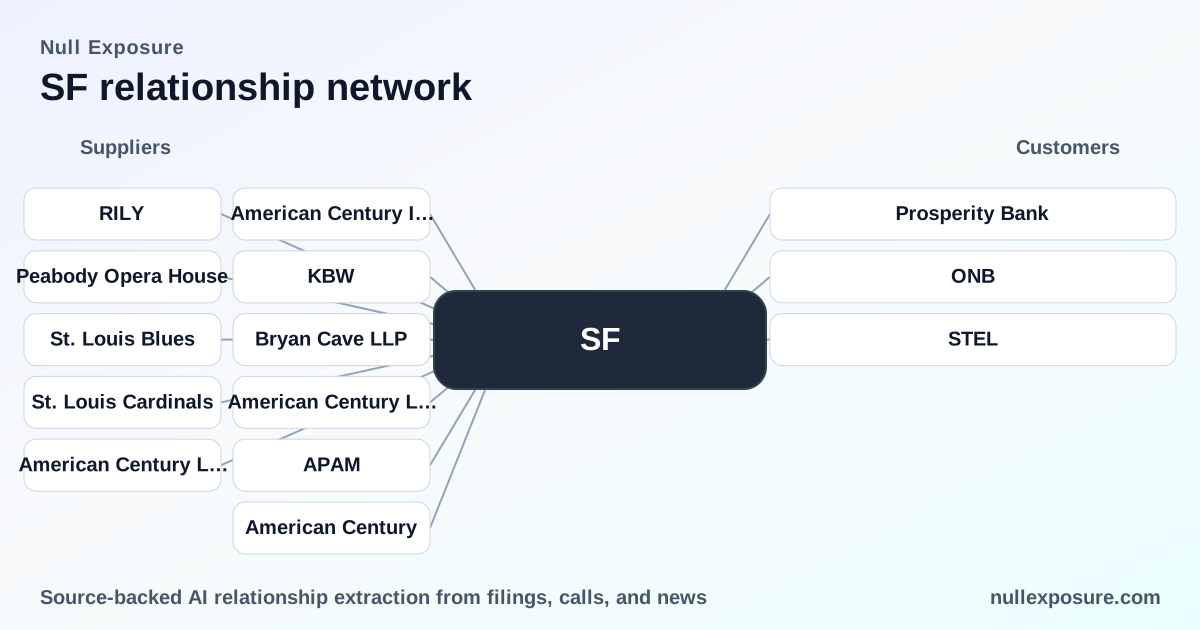
Stifel Financial (SF): Supplier relationships that shape operational risk and brand reach
Stifel Financial Corporation is a diversified capital markets and wealth-management platform that monetizes through advisory and trading fees, asset-management fees, interest spread and client asset commissions, and selective brand partnerships; the company’s scale (roughly $5.5B revenue TTM and a $10.8B market cap) lets it leverage third-party services for valuation, legal counsel, and consumer-facing sponsorships while executing acquisitions to grow fee-bearing assets. For investors, supplier relationships are both an operational dependency (pricing vendors, legal counsel, leased offices) and a reputational vector (401(k) litigation, sports and venue sponsorships) that affect regulatory, cost and brand outcomes.
Explore a supplier-risk profile and relationship map at https://nullexposure.com/.
What investors should watch: the operating implications of Stifel’s supplier mix
Stifel’s supplier map reveals a classic regional-to-national broker-dealer supplier posture: long-duration real-estate commitments, reliance on specialist service providers for valuation and cybersecurity, and a mix of marketing/sponsorship relationships that amplify brand exposure but add reputational surface area. The company's public disclosures show operating leases that stretch into 2039 and an explicit governance framework for third-party procurement and valuation services — signals of measured contracting maturity and formalized vendor risk controls.
- Contracting posture: long-term real-estate leases create fixed-cost leverage but reduce near-term flexibility; leases through 2039 indicate capital and location commitment.
- Service criticality: third-party pricing services are material to fair-value measurement and therefore to financial reporting and risk management.
- Concentration and specialization: use of external legal counsel and advisory firms for transactions and joint ventures indicates a policy of outsourcing complex, episodic capabilities rather than building them exclusively in-house.
- Reputation and litigation: supplier choices tied to retirement-plan investments have produced ERISA litigation that translates supplier selection decisions directly into regulatory and financial risk.
These characteristics shape capital allocation decisions, acquisition integration plans, and stress-test scenarios for operational continuity. If you track counterparty and vendor exposure for SF, prioritize valuation vendors, legal/regulatory advisers, and retirement-plan vendors.
Relationship roll call: each supplier and what it means for investors
American Century Investments
Plaintiffs in a federal ERISA class action allege Stifel’s 401(k) plan sustained losses by continuing to offer actively managed American Century funds, a claim that connects investment-lineup choices to potential participant harm and litigation exposure. According to Bloomberg Law coverage (March 10, 2026), the complaint estimates plan losses tied to retained American Century funds; see https://news.bloomberglaw.com/ip-law/stifel-financial-sued-again-over-handling-of-worker-401k-plan.
KBW (a Stifel Company)
KBW, operating as a Stifel unit, acted in an advisory capacity tied to a leveraged-lending joint initiative, reflecting intra-group advisory capability and how Stifel leverages subsidiary expertise for strategic transactions. This relationship is described in a Lord Abbett press release about the joint venture (FY2024); see https://www.lordabbett.com/en-us/financial-advisor/about-us/media-relations/press-release/stifel---lord-abbett-form-leveraged-lending-joint-venture.html.
Bryan Cave LLP
Bryan Cave LLP provided legal and regulatory counsel in the Lord Abbett joint-venture formation, illustrating Stifel’s use of external legal counsel for regulatory structuring and transaction support. The engagement is noted in the same Lord Abbett press release (FY2024); see https://www.lordabbett.com/en-us/financial-advisor/about-us/media-relations/press-release/stifel---lord-abbett-form-leveraged-lending-joint-venture.html.
American Century Large Cap Growth Fund (pooled account)
The pooled account is one of two funds named in ERISA litigation alleging fiduciary negligence for retaining underperforming active managers in the company 401(k) plan, a reputational and potential financial liability channel. The claim and fund identification are reported by PlanAdviser and GlobeNewswire (Feb–Mar 2026); see https://www.globenewswire.com/news-release/2026/02/20/3242021/0/en/Sanford-Heisler-Sharp-McKnight-Files-134-Million-ERISA-Class-Action-Case-Against-Stifel-Financial-Corp-on-Behalf-of-More-Than-10-000-Retirement-Plan-Participants.html and https://www.planadviser.com/complaint-accuses-stifel-of-401k-investment-mismanagement/.
Artisan Mid-Cap Growth Pooled Account (APAM)
The Artisan pooled account is the second fund cited in the ERISA complaint; retention of this actively managed option since 2014 is central to the plaintiff’s contention that fiduciaries failed to act prudently. Industry press and PlanSponsor documented the complaint in March 2026; see https://www.plansponsor.com/stifel-hit-with-401k-investment-mismanagement-complaint/.
American Century (entity mention)
Media outlets covering the litigation note that American Century-branded products were retained in the plan despite long-term underperformance, reinforcing that vendor selection for retirement offerings has direct investor-facing consequences. USA Herald and related coverage reported on these allegations in March 2026; see https://usaherald.com/stifel-accused-in-federal-class-action-of-costing-workers-up-to-134-million-by-keeping-poorly-performing-funds-in-401k-plan/.
Artisan (entity mention, APAM)
Artisan’s name appears in multiple filings and press accounts tied to the ERISA suit; the company is implicated only as a fund retained in the plan rather than a defendant, but the association amplifies litigation visibility. See USA Herald and PlanSponsor coverage (March 2026) for details: https://usaherald.com/stifel-accused-in-federal-class-action-of-costing-workers-up-to-134-million-by-keeping-poorly-performing-funds-in-401k-plan/ and https://www.plansponsor.com/stifel-hit-with-401k-investment-mismanagement-complaint/.
B. Riley (RILY)
Stifel’s Q4 2025 earnings commentary explains that acquired businesses from B. Riley (the employee-wealth business) and the acquisition of Brian Garnier were part of capital deployment that expanded adviser-led client platforms and wealth capabilities. Management noted these strategic acquisitions on the 2025Q4 earnings call; see the SF 2025Q4 earnings call transcript.
Peabody Opera House (Stifel Theatre naming rights)
Stifel holds long-dated naming-rights and venue sponsorships, including the transformation of the Peabody Opera House into Stifel Theatre under a multi-year agreement, demonstrating a deliberate brand investment in its hometown. MLB and related press describe the 10-year renaming agreement that began in 2018; see https://www.mlb.com/press-release/press-release-cardinals-announce-stifel-as-club-s-first-jersey-patch-sponsor.
St. Louis Blues (official jersey sponsor)
Stifel serves as the official jersey sponsor for the St. Louis Blues, a sponsorship that raises local brand familiarity and supports retail and community engagement strategies; coverage notes the arrangement initiated in the 2022–23 season. See the MLB press release and associated local reporting (FY2023); https://www.mlb.com/press-release/press-release-cardinals-announce-stifel-as-club-s-first-jersey-patch-sponsor.
St. Louis Cardinals (jersey patch partner)
Stifel is the St. Louis Cardinals’ first-ever official jersey patch partner, reflecting a targeted marketing approach that monetizes civic brand equity and increases national visibility among consumers. The announcement is recorded in the Cardinals/MLB press release; see https://www.mlb.com/press-release/press-release-cardinals-announce-stifel-as-club-s-first-jersey-patch-sponsor.
American Century Large Cap Growth Pooled Account (PlanAdviser duplicate entry)
PlanAdviser’s coverage reiterates the pooled account’s role in the ERISA complaint, underlining that multiple industry outlets are tracking fund-level allegations linked to the plan’s fiduciary conduct. See PlanAdviser’s reporting (March 2026) for the filing details: https://www.planadviser.com/complaint-accuses-stifel-of-401k-investment-mismanagement/.
Artisan Mid-cap Growth Fund (APAM duplicate entry)
GlobeNewswire and other releases name the Artisan mid-cap fund in the same complaint narrative, reinforcing that the litigation is fund-specific and could influence future 401(k) lineup governance. See the GlobeNewswire release (Feb 20, 2026): https://www.globenewswire.com/news-release/2026/02/20/3242021/0/en/Sanford-Heisler-Sharp-McKnight-Files-134-Million-ERISA-Class-Action-Case-Against-Stifel-Financial-Corp-on-Behalf-of-More-Than-10-000-Retirement-Plan-Participants.html.
(For a consolidated supplier-risk dashboard and historical relationship evidence, visit https://nullexposure.com/.)
Constraints and how they inform valuation and risk modeling
Stifel’s published vendor and property disclosures generate three actionable company-level signals for analysts: (1) long-term lease commitments (leases extending through 2039) increase fixed operating leverage and should be modeled into steady-state SG&A and cash-flow sensitivity; (2) third-party pricing and valuation services are embedded in financial-reporting controls, making vendor integrity and availability material to mark-to-market risk; (3) an explicit third-party acquisition and cyber-risk policy indicates institutionalized vendor governance, reducing idiosyncratic integration risk but not eliminating litigation exposure. These are company-level characteristics and are independent of any single supplier relationship unless publicly stated otherwise.
Final assessment and investor actions
Stifel’s supplier profile mixes strategic acquisitions and marketing partnerships with routine reliance on specialist vendors; the immediate investor priority is operational and legal risk stemming from the 401(k) ERISA complaint, while medium-term focus should be on vendor resilience for valuation services and the financial implications of long-term lease commitments. For near-term monitoring, track case developments, filings around the retirement-plan suit, and any regulatory commentary about fiduciary governance.
For deeper supplier evidence and tailored exposure analysis, review our research hub at https://nullexposure.com/. If you are modeling counterparty and vendor concentration into your SF thesis, start with the ERISA suit, valuation-service dependencies, and the long-term lease schedule — and contact us for a bespoke supplier risk report at https://nullexposure.com/.