SF‑P‑D: How this preferred tranche functions for income investors and capital markets partners
SF‑P‑D is a series of perpetual preferred shares issued by a reputable financial institution that monetizes through fixed dividend obligations to holders while providing the issuer durable regulatory capital and balance‑sheet flexibility. The instrument generates predictable cash returns for income‑focused investors, and the issuer leverages a syndicate of underwriters and exchange listing to distribute and maintain liquidity in the security. For investors and operators evaluating supplier relationships around SF‑P‑D, the strategic question is how underwriting partners, market makers, and the exchange infrastructure affect pricing, access, and ongoing tradeability. Learn more at https://nullexposure.com/.
The business model in plain English: issuance, yield, and capital utility
SF‑P‑D is designed to deliver a steady income stream to investors through fixed dividend payments while sitting above common equity in the capital stack. Issuance proceeds are used by the parent for balance‑sheet purposes—reducing funding costs and shoring regulatory capital—so the issuer effectively monetizes the preferred by converting investor cash into durable capital. The economics are simple: investors accept capped upside and limited governance in exchange for higher, senior cash yield; the issuer accepts fixed periodic payouts to preserve common equity and raise lower‑cost capital.
Distribution depends on the capital markets ecosystem: underwriters bring scale and placement capabilities, and the New York Stock Exchange listing sustains visibility and secondary liquidity. These relationships materially influence initial pricing, the investor base composition, and post‑issuance trading. For immediate context and more relationship detail, visit https://nullexposure.com/.
Who the issuer relied on to place and trade SF‑P‑D
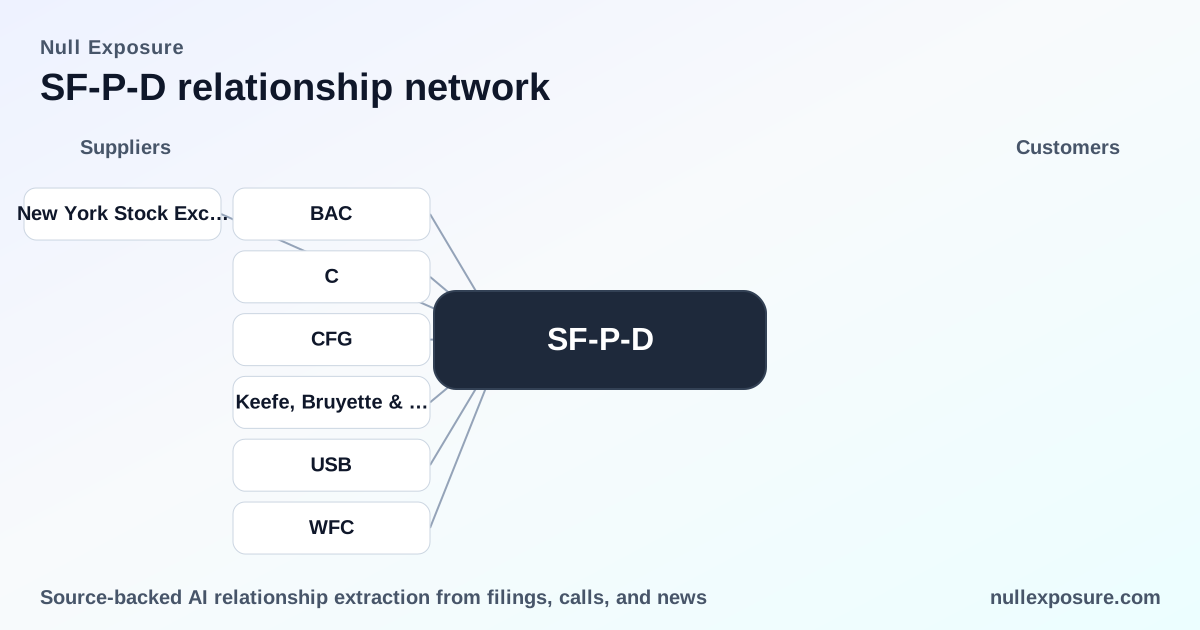
Below are every supplier relationship we have on record for SF‑P‑D, summarized in plain English with source attribution.
-
BofA Securities, Inc. — BofA acted as a joint book‑running manager on the offering, providing distribution muscle and institutional placement capability that helped the issuer access a broad investor base. Source: GlobeNewswire press release, July 15, 2021 (https://www.globenewswire.com/de/news-release/2021/07/15/2263997/0/en/Stifel-Announces-Pricing-of-300-Million-of-Non-Cumulative-Perpetual-Preferred-Stock.html).
-
Citigroup Global Markets Inc. — Citigroup served as a lead manager on the deal, contributing underwriting capacity and syndicate coordination to secure demand from buy‑side clients. Source: GlobeNewswire press release, July 15, 2021 (https://www.globenewswire.com/de/news-release/2021/07/15/2263997/0/en/Stifel-Announces-Pricing-of-300-Million-of-Non-Cumulative-Perpetual-Preferred-Stock.html).
-
Citizens Capital Markets, Inc. — Listed as a lead manager, Citizens Capital Markets played a supporting underwriting role that broadened distribution channels to regional and institutional investors. Source: GlobeNewswire press release, July 15, 2021 (https://www.globenewswire.com/de/news-release/2021/07/15/2263997/0/en/Stifel-Announces-Pricing-of-300-Million-of-Non-Cumulative-Perpetual-Preferred-Stock.html).
-
Keefe, Bruyette & Woods, A Stifel Company — Keefe Bruyette acted as a joint book‑running manager and provided sector expertise and deal structuring for the offering, reflecting direct internal capabilities of the issuer group. Source: GlobeNewswire press release, July 15, 2021 (https://www.globenewswire.com/de/news-release/2021/07/15/2263997/0/en/Stifel-Announces-Pricing-of-300-Million-of-Non-Cumulative-Perpetual-Preferred-Stock.html).
-
U.S. Bancorp Investments, Inc. — As a lead manager, U.S. Bancorp Investments contributed placement resources and buy‑side network access that helped syndicate the issuance across wealth and institutional channels. Source: GlobeNewswire press release, July 15, 2021 (https://www.globenewswire.com/de/news-release/2021/07/15/2263997/0/en/Stifel-Announces-Pricing-of-300-Million-of-Non-Cumulative-Perpetual-Preferred-Stock.html).
-
Wells Fargo Securities, LLC — Wells Fargo acted as a joint book‑running manager, adding scale to the underwriting group and enabling wider primary distribution for the preferred series. Source: GlobeNewswire press release, July 15, 2021 (https://www.globenewswire.com/de/news-release/2021/07/15/2263997/0/en/Stifel-Announces-Pricing-of-300-Million-of-Non-Cumulative-Perpetual-Preferred-Stock.html).
-
New York Stock Exchange — The Series D preferred trades on the New York Stock Exchange under the symbol “SF PrD,” providing an on‑exchange venue and the visibility that supports secondary market liquidity and reference pricing. Source: GlobeNewswire press release, January 27, 2026 (https://www.globenewswire.com/news-release/2026/01/27/3227118/0/en/stifel-announces-a-three-for-two-stock-split-11-increase-to-its-common-stock-dividend-declares-preferred-stock-cash-dividend.html).
What these relationships imply for investors and operators
Underwriting and exchange partners are not incidental: they shape initial coupon levels, who holds the security, and how easily positions can be adjusted in secondary markets. The syndicate for SF‑P‑D includes major global banks and regional specialists, which signals broad distribution and a diversified placement strategy at issuance. The NYSE listing confirms exchange liquidity is in scope for the issuer.
Operationally, this means:
- Underwriters control initial supply and pricing discipline; their reputations influence investor acceptance.
- A diversified syndicate reduces execution concentration risk and widens the investor network.
- Exchange listing sustains tradability, which is critical for institutional portfolio management and mark‑to‑market valuations.
For more on supplier exposure and issuer profiles, visit https://nullexposure.com/.
Company‑level constraints and operating signals
There are no explicit constraint excerpts tied to specific supplier relationships in the available record. At the company level, the following operational characteristics emerge as material signals:
-
Contracting posture: standard capital markets issuance model — the issuer uses established underwriting agreements and syndicate distribution to place preferred shares, indicating reliance on traditional contractual engagement with lead managers.
-
Concentration: moderate to low single‑counterparty concentration — the presence of multiple lead managers and joint book‑runners spreads execution risk and investor access across several institutions.
-
Criticality: high to the extent that preferred funding supports balance‑sheet and regulatory objectives — preferred stock is a critical instrument for capital management and investor access. Disruption in underwriting or exchange services would materially affect issuance cadence and liquidity.
-
Maturity: perpetual issuance profile — the 2021 press release identifies the issue as non‑cumulative perpetual preferred stock, which implies indefinite duration from the issuer’s perspective and sustained dividend obligations from its cash flow planning.
These signals are company‑level and not assigned to a specific supplier unless explicitly stated in source text.
Practical takeaways and a short risk checklist
- Underwriting diversity is a strength: a multi‑bank syndicate reduces placement concentration and improves market reach.
- Exchange listing underpins liquidity: NYSE trading status supports a price discovery mechanism that benefits both holders and corporate treasury functions.
- Perpetual structure changes duration risk: investors must price the security for long‑term interest rate exposure and issuer credit trajectory.
- Operational risk centers on capital markets partners: underwriter execution and exchange connectivity will materially affect secondary market liquidity.
Final action: if you are evaluating counterparty risk, underwriting terms, or secondary market planning for SF‑P‑D, begin with a targeted review of the offering documents and syndicate agreements and then map execution exposure to your portfolio liquidity needs. For an integrated supplier analysis and bespoke risk mapping, visit https://nullexposure.com/ for vendor profiles and relationship tools.
Concluding recommendation: treat SF‑P‑D as a yield instrument whose value is tightly linked to the issuer’s capital strategy and the syndicate/exchange channels that sustain its market. For deeper supplier intelligence and ongoing monitoring, return to https://nullexposure.com/.