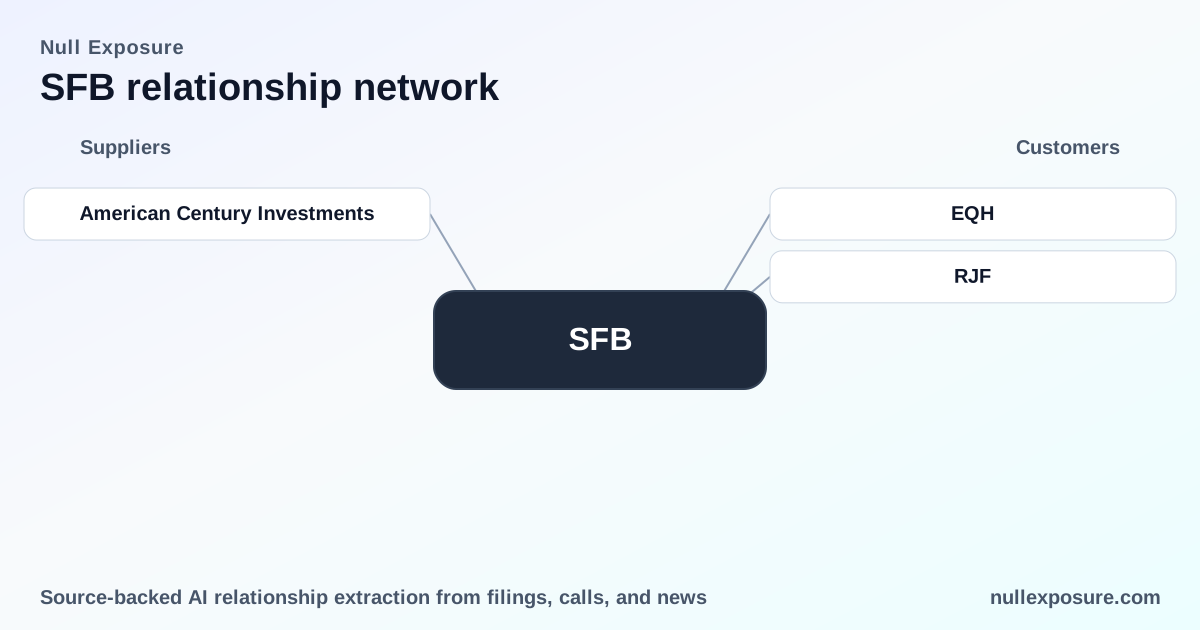
Stifel Financial (SFB): Supplier posture, contract signal, and the one public supplier link investors should track
Stifel Financial operates as a full-service investment firm—wealth management, institutional sales and trading, and investment banking—and monetizes through recurring advisory and asset-management fees, trading and underwriting spreads, and interest-bearing balance-sheet activities. The company’s 5.20% Senior Notes due 2047 are a deliberate capital-structure tool that locks in long-duration funding while preserving liquidity and operational flexibility for client-facing growth. For investors and vendors evaluating Stifel as a partner or counterparty, the mix of long-term leases, committed and uncommitted credit lines, and reliance on third-party pricing services defines a hybrid contracting posture: stable fixed-cost relationships layered with day-to-day financing dependencies. Learn more about supplier risk and exposure at https://nullexposure.com/.
The single supplier relationship in the public record — what it is and why it matters
American Century Investments: litigation touchpoint with plan offerings
A March 10, 2026 Bloomberg Law report documents a lawsuit alleging Stifel’s retirement plan lost between $42 million and $134 million by continuing to offer two actively managed funds from American Century Investments; American Century is not named as a defendant in the complaint. This item is a reputational and fiduciary exposure linked to product selection for employee benefit plans and is material from an operational risk perspective. (Bloomberg Law, March 10, 2026)
What the company filings and signal constraints reveal about supplier strategy
Stifel’s public disclosures and compiled constraints paint a clear operating profile for vendor relationships and counterparty management:
-
Long-term contractual footprint: Stifel recognizes right-of-use assets for leases longer than one year and reports executive offices it owns and leases through staggered expirations, with many leases extending through 2039. This establishes a durable facilities and real-estate vendor base and implies predictable long-term service and maintenance obligations. (Company filings, leases disclosures)
-
Material committed credit capacity: The company maintains a Credit Agreement that provides a committed unsecured facility up to $750 million with a maturity of September 27, 2028, reflecting sizable contracted access to liquidity and deep, multi-year bank relationships that underpin operations. (Credit Agreement disclosure)
-
Short-term, bank-dependent liquidity lines: As of December 31, 2024, Stifel reported uncommitted secured lines totaling $880 million with four banks, drawn on a day-to-day basis and dependent on collateral and lender approval, indicating an operational reliance on short-term counterparty willingness for fixed-income financing. (December 31, 2024 disclosures)
-
Vendor reliance for valuation and controls: Stifel discloses the use of third-party pricing services to value Level 1 and Level 2 securities and certain hedging derivatives, signaling critical dependence on external pricing vendors for financial reporting, risk management, and regulatory compliance. (Valuation services disclosure)
-
Large spend/credit signal: The presence of multi-hundred-million-dollar credit facilities and committed borrowing capacity places Stifel in a $100m-plus spend band for financing vendors and banking relationships, reflecting the scale at which counterparties transact with the company.
Taken together, these signals show a dual-mode supplier posture: long-term, fixed contractual commitments (real estate and select bank facilities) coexisting with high-frequency dependence on short-term bank counterparts and external pricing vendors. This mix elevates the importance of counterparty uptime, collateral arrangements, and vendor governance.
How those characteristics translate into counterparty risks and negotiation leverage
-
Contracting posture: The long-term leases and committed credit facility provide stability and bargaining leverage with landlords and key banks, enabling Stifel to negotiate standard commercial terms and predictable service SLAs. By contrast, uncommitted lines force the company into operational dependence on bank discretion and collateral haircuts, shifting leverage toward prime banking counterparties for day-to-day funding.
-
Concentration and criticality: Having uncommitted lines spread across four banks reduces single-counterparty concentration but does not eliminate funding concentration risk if market stress reduces willingness across institutions simultaneously. Third-party pricing vendors are critical single points for valuation and compliance; any disruption would affect NAVs, margining, and reporting timelines.
-
Maturity and tenor risk: The Credit Agreement’s 2028 maturity and notes due in 2047 create a laddered maturity profile that mitigates short-term refinancing pressure for long-term capital, while leases through 2039 lock in occupancy costs. This structure is favorable for long-horizon investors but requires active liquidity management in the intermediate term.
Practical takeaways for investors and prospective suppliers
-
Monitor litigation and fiduciary exposures. The American Century-linked lawsuit centers on plan product selection and alleged quantifiable loss; vendors and investors should track legal developments for both reputational and potential financial remediation impacts. (Bloomberg Law, March 10, 2026)
-
Assess bank counterparties and collateral terms. Suppliers and partners should request clarity on whether Stifel uses uncommitted lines to finance specific product cohorts and the collateralization mechanics that could affect counterparty credit during stressed markets. Company filings detail $880 million of uncommitted secured lines as of year-end 2024.
-
Validate vendor SLAs for pricing services. Given the reliance on external pricing for Level 1/2 securities, counterparties that supply valuations, market data, or model support should negotiate formal SLAs and redundancy plans to limit operational concentration. (Valuation services disclosure)
-
Factor in long-term occupancy costs. Tenants and vendors engaged on-site should expect continuity but also long-duration cost commitments tied to leases through 2039; this raises the importance of fixed-cost pass-throughs in long-term supplier contracts.
If you need a deeper counterparty report or supplier exposure map for Stifel, start here: https://nullexposure.com/.
Bottom line and next steps
Stifel’s public signals show a large, institutional-grade firm with a hybrid supplier posture—stable, long-term commitments in real estate and committed credit, paired with reliance on uncommitted short-term liquidity and external pricing vendors. The primary public supplier touchpoint in the record today is the American Century matter documented by Bloomberg Law (March 10, 2026), which is a fiduciary/plan-product issue that investors should monitor alongside liquidity and vendor-concentration indicators.
For practitioner-level due diligence or to track evolving supplier relationships at scale, visit https://nullexposure.com/ for structured exposure reports and updates.