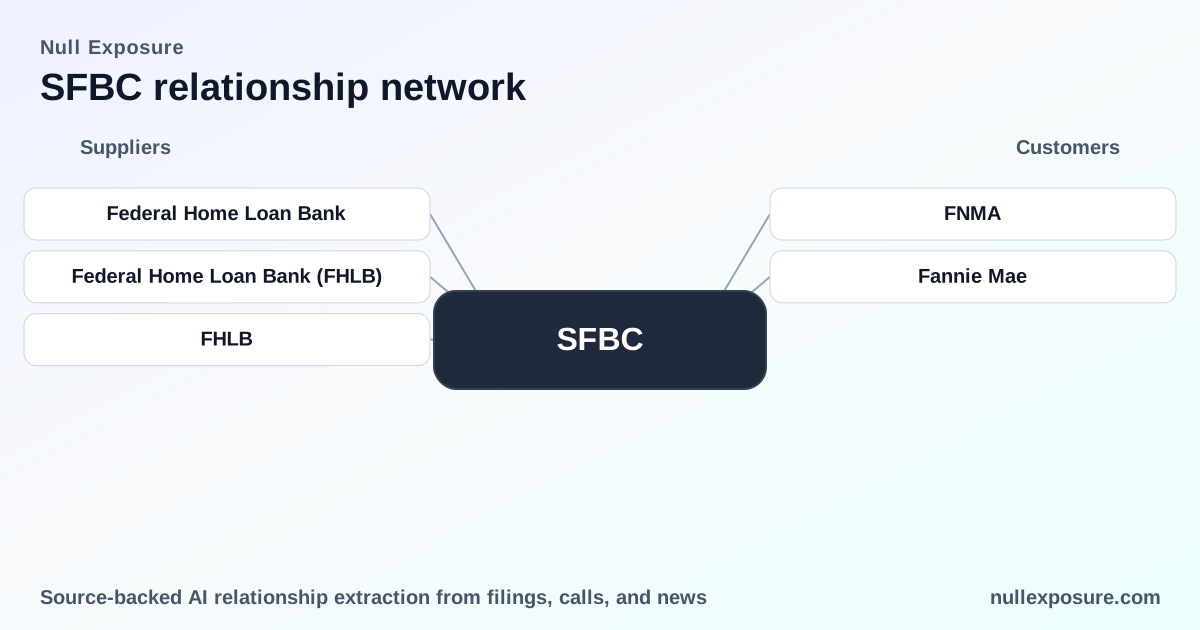
Sound Financial Bancorp (SFBC): How a regional bank manages its FHLB financing and what it signals to investors
Sound Financial Bancorp (SFBC) operates as the holding company for Sound Community Bank, monetizing through net interest margin, fee income from commercial and consumer banking, and periodic capital returns to shareholders. The company runs a conservative balance sheet relative to peers: modest borrowings, positive profitability metrics (trailing P/E ~13.7, return on equity ~6.7%), and a material dividend yield (~1.85%), while managing a mix of long-term obligations and short-term funding lines. For investors and counterparties evaluating SFBC supplier and lender relationships, the most consequential counterparty activity in public filings through 2025 centers on Federal Home Loan Bank (FHLB) advances and targeted paydowns of subordinated debt. Learn more about our coverage at https://nullexposure.com/.
The headline: shrinking FHLB reliance, active liability management
Across earnings releases in late 2025, Sound Financial Bancorp reduced its outstanding FHLB advances from $40.0 million a year earlier to $10.0 million at December 31, 2025, driven in part by scheduled repayments and a deliberate paydown program. The company also accelerated reduction of subordinated debt during the fourth quarter of 2025, reflecting an active liability management posture that reduces short- to medium-term funding risk. These moves lower borrowing concentration and improve flexibility for new lending or capital deployment.
Every disclosed FHLB-related mention (plain-English, source-cited)
- In the Q3 2025 earnings release, Sound reported FHLB advances of $25.0 million at September 30, 2025 and June 30, 2025, versus $40.0 million at September 30, 2024, signaling a multi-quarter reduction in usage. (GlobeNewswire press release, Q3 2025 — Oct 28, 2025: https://www.globenewswire.com/news-release/2025/10/28/3176002/0/en/Sound-Financial-Bancorp-Inc-Q3-2025-Results.html)
- In the Q4 2025 results, the company reported FHLB advances of $10.0 million at December 31, 2025, down from $25.0 million at September 30, 2025 and $25.0 million at December 31, 2024, reflecting further paydown late in the year. (GlobeNewswire press release, Q4 2025 — Jan 27, 2026: https://www.globenewswire.com/news-release/2026/01/27/3227143/0/en/Sound-Financial-Bancorp-Inc-Q4-2025-Results.html)
- The same Q4 2025 disclosure is mirrored in a second GlobeNewswire posting of the release, reiterating the $10.0 million outstanding FHLB advances at year-end 2025 versus $25.0 million in the prior quarter, confirming consistency across filings. (GlobeNewswire re-posting, Q4 2025 — Jan 27, 2026: https://www.globenewswire.com/news-release/2026/01/27/3227143/20398/en/Sound-Financial-Bancorp-Inc-Q4-2025-Results.html)
- A Manila Times re-publication of the Q4 2025 release noted that the bank repaid $15.0 million of FHLB borrowings that had maturity in January 2026, indicating specific maturities were resolved before year-end. (The Manila Times, reprint of GlobeNewswire Q4 2025 results — Jan 28, 2026: https://www.manilatimes.net/2026/01/28/tmt-newswire/globenewswire/sound-financial-bancorp-inc-q4-2025-results/2266547/amp)
- An independent financial outlet restated the Q4 2025 numbers, again noting FHLB advances of $10.0 million at Dec 31, 2025 versus $25.0 million at Sep 30, 2025 and Dec 31, 2024, corroborating the paydown narrative. (SAHM Capital distribution of Q4 2025 results — Jan 28, 2026: https://www.sahmcapital.com/news/content/sound-financial-bancorp-inc-q4-2025-results-2026-01-28)
What the relationship set and corporate constraints reveal about SFBC's operating model
The company-level disclosures include several operating constraints that define SFBC’s business model and contracting posture:
- Long-term contractual posture: Sound’s real estate leases typically carry initial terms of three to ten years with renewal options, and the bank issued $12.0 million of subordinated notes in September 2020 that mature in 2030. These features impose multi-year fixed obligations and influence funding needs over the next several years. (Company disclosures cited in constraints)
- Service-provider reliance: The filings explicitly recognize reliance on external vendors for essential day-to-day services, indicating that operational continuity depends on a small network of third-party service providers rather than fully in-house capabilities.
- Mid-sized counterparty spend and concentration signal: The disclosed FHLB advance levels and subordinated note sizes place major funding relationships in the $10m–$100m spend band, large enough to be material for operations but not so large as to create single-counterparty dominance given the bank’s total asset and capital scale.
These company-level constraints combine into a coherent operating model: SFBC runs a conservative, credit-focused regional bank with a manageable but meaningful dependence on a handful of external capital and service relationships, with contractual tails that stretch into the next decade.
Investor implications and risk/reward framing
- Positive: Lower near-term refinancing risk. Active paydown of $15.0 million in FHLB borrowings due in Jan 2026 and a reduction to $10.0 million outstanding at year-end indicate improved liquidity flexibility entering 2026. (GlobeNewswire Q4 2025 / Manila Times reprint)
- Watch: Long-dated subordinated liabilities. The $12.0 million subordinated notes maturing in 2030 represent a fixed capital obligation that constrains capital-return flexibility and could require refinancing at materially different market terms later in the decade.
- Balance-sheet scale: With market capitalization around $98.5 million and book value near $42.89 per share, SFBC is a small regional player where event-driven moves in borrowing or asset quality can have outsized effects on capital ratios and valuation.
For a deeper view of counterparty exposures and to benchmark SFBC against peers, visit https://nullexposure.com/.
Tactical takeaways for operators and counterparties
- FHLB is a meaningful but shrinking source of wholesale funding for SFBC; counterparties should expect continued conservative liability management and potential re-use of secured advances when originations accelerate.
- Service providers should price for continuity and scale: the bank outsources critical functions and will value vendors that can guarantee uptime and regulatory compliance.
- Credit providers and investors should monitor subordinated note maturities and dividend policy for signs of capital strain or aggressive growth initiatives.
Conclude with a final actionable step: for institutional investors and procurement teams assessing SFBC supplier relationships and capital counterparties, use the consolidated reporting and trend lines presented here as the basis for due diligence — and track quarterly filings for any deviation from the current deleveraging trajectory. Explore ongoing coverage and relationship analytics at https://nullexposure.com/.