ServisFirst Bancshares (SFBS): Ratings, funding posture, and supplier relationships that matter to investors
ServisFirst Bancshares operates as the holding company for ServisFirst Bank, monetizing through traditional regional banking activities—interest margin on loans and securities, fee income, and deposit gathering—while financing growth via both long-term subordinated notes and short-term credit lines. The company's balance of recurring core banking revenue and deliberate capital structure decisions (subordinated debt plus available lines) creates predictable cash flow, but also concentrates exposure around funding and third-party service continuity. For a concise supplier-risk profile and relationship map, visit https://nullexposure.com/.
What investors need up front: the business model and why suppliers matter
ServisFirst’s core economics are straightforward: net interest margin and fee income drive profitability, supported by conservative capital ratios and an investment-grade rating trajectory. The company funds itself with a mix of deposit liabilities, short-term committed lines, and long-dated subordinated notes that underpin regulatory capital treatment and investor confidence. Because the bank both borrows from and relies on third parties for software and transaction processing, supplier relationships directly affect liquidity flexibility, operations, and compliance continuity.
Key financial context: market capitalization roughly $4.0 billion, trailing P/E around 14.5, return on equity near 16%, and institutional ownership north of 77%—a profile of a mature regional bank with strong investor interest and visible governance. For more on supplier mapping and exposure analysis, see https://nullexposure.com/.
How ServisFirst contracts and where risk concentrates
ServisFirst exhibits a mixed contracting posture that balances maturity and optionality:
- Long-term contractual commitments exist via subordinated notes issued in 2017 and 2020 that extend capital stability into the late 2020s and 2030. These instruments are typical for banks seeking regulatory capital treatment and investor predictable yields.
- Short-term liquidity flexibility comes from committed lines of credit with various financial institutions; available capacity declined from $880 million at year-end 2023 to ~$537 million at year-end 2024, with $80 million drawn at that date.
- Operational criticality is elevated because the company explicitly relies on third-party software vendors for transaction processing, and the company asserts that a security disruption could have a material adverse effect on business results.
Taken together, these signals show a mature supplier ecosystem with critical service providers and significant funding partners, where disruptions or increased cost of capital would have meaningful business impact.
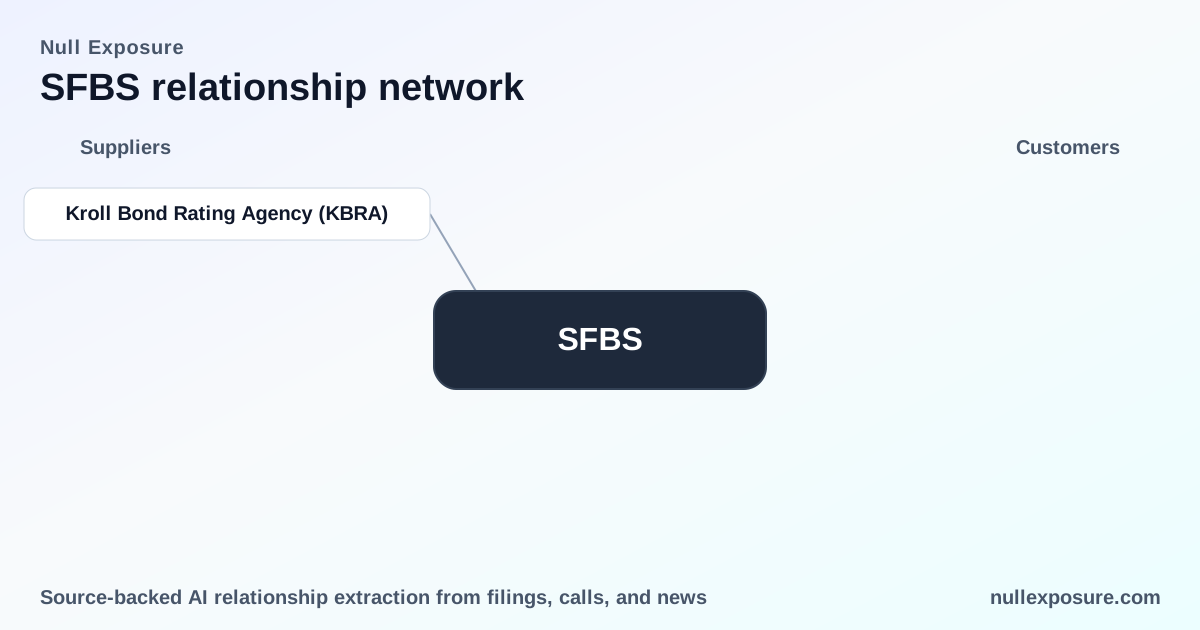
Relationship map: Kroll Bond Rating Agency (KBRA) — three press releases
ServisFirst’s supplier-scope relationships returned three press notices that cite the same external counterparty, Kroll Bond Rating Agency (KBRA). Each press release references KBRA’s long-running investment-grade assessment. Below are plain-English summaries for each item identified in the results.
-
The GlobeNewswire release about ServisFirst Bank Huntsville’s new regional CEO mentions that KBRA has assigned ServisFirst investment-grade ratings with a stable outlook annually since April 2015, underscoring external credit validation as the bank expands regional leadership. Source: GlobeNewswire press release, December 15, 2025.
-
A companywide leadership announcement issued via GlobeNewswire repeats that KBRA affirmed investment-grade ratings and a stable outlook on an annual basis since April 2015, a signal used by management to support strategic hires and governance messaging. Source: GlobeNewswire press release, December 15, 2025.
-
The GlobeNewswire release on ServisFirst’s expansion into Texas again notes KBRA’s consistent investment-grade rating and stable outlook dating back to April 2015, reinforcing the rating agency’s role in validating the bank’s regional growth and funding profile. Source: GlobeNewswire press release, December 15, 2025.
Collectively, these items make KBRA an important external validation partner in public communications; while KBRA is not a supplier in the operational sense, the agency’s ongoing rating coverage materially affects funding costs and investor perception.
Operational constraints and what they mean for supplier strategy
The constraints extracted from company disclosures translate into actionable signals for investors evaluating supplier relationships:
- Contracting maturity: Long-term subordinated notes (2017 and 2020 issues) indicate multi-year capital commitments that reduce refinancing frequency but limit early-call flexibility for one tranche until 2025; this underlines deliberate capital planning rather than opportunistic short-dated borrowing.
- Liquidity posture: Short-term committed lines totaling hundreds of millions show active bilateral funding relationships; a decline in available lines between 2023 and 2024 signals either strategic drawdown or evolving counterparty capacity—investors must monitor this metric for liquidity resilience.
- Role exposure: The company is both a buyer (borrower) from financial counterparties and a service consumer for third-party software providers that process transactions; these dual roles increase the criticality of maintaining diversified counterparties and tested continuity plans.
- Materiality of third-party risk: The company’s explicit statement that a security breach could have a material adverse effect elevates vendor cyber resilience and contractual indemnities into primary diligence items for investors.
Taken together, these constraints describe a supplier landscape that is mature, materially important to operations, and concentrated around funding and software services—not a scattershot set of low-value vendors.
Investment implications and what to watch next
- Funding stability is a core risk/return driver. Long-term subordinated debt reduces short-term refinancing risk but leaves the company exposed to market moves in credit spreads at the next call/reset windows; monitor subordinated note call dates and the availability of backup lines.
- Operational vendor risk is consequential. Third-party software providers are critical service providers; focus due diligence on vendor contracts, SLAs, and security attestations that protect against a material breach.
- Ratings continuity supports capital access. KBRA’s repeated investment-grade assessments are not just PR—they influence term funding costs and institutional demand; tracking subsequent KBRA actions should be part of an investment surveillance program.
If you evaluate counterparties, supplier concentration, or the practical risk of vendor disruption, we maintain detailed supplier profiles and exposure analytics. Explore our platform for a deeper map: https://nullexposure.com/.
Final takeaways and immediate actions
- ServisFirst runs a balanced but concentrated supplier posture: long-term subordinated capital, active short-term credit lines, and critical third-party software dependencies. These are strategic choices that produce stability but carry clear vendor and funding concentration risks.
- External ratings (KBRA) matter materially to funding and investor sentiment; their long-term stable outlook supports the bank’s strategic expansion narrative.
- For investors and operators, the priority actions are: validate vendor continuity and security, monitor committed line availability, and watch subordinated note call/reset timelines.
For an actionable supplier-risk briefing tailored to SFBS and peer comparisons, visit https://nullexposure.com/ and request the ServisFirst supplier dossier.