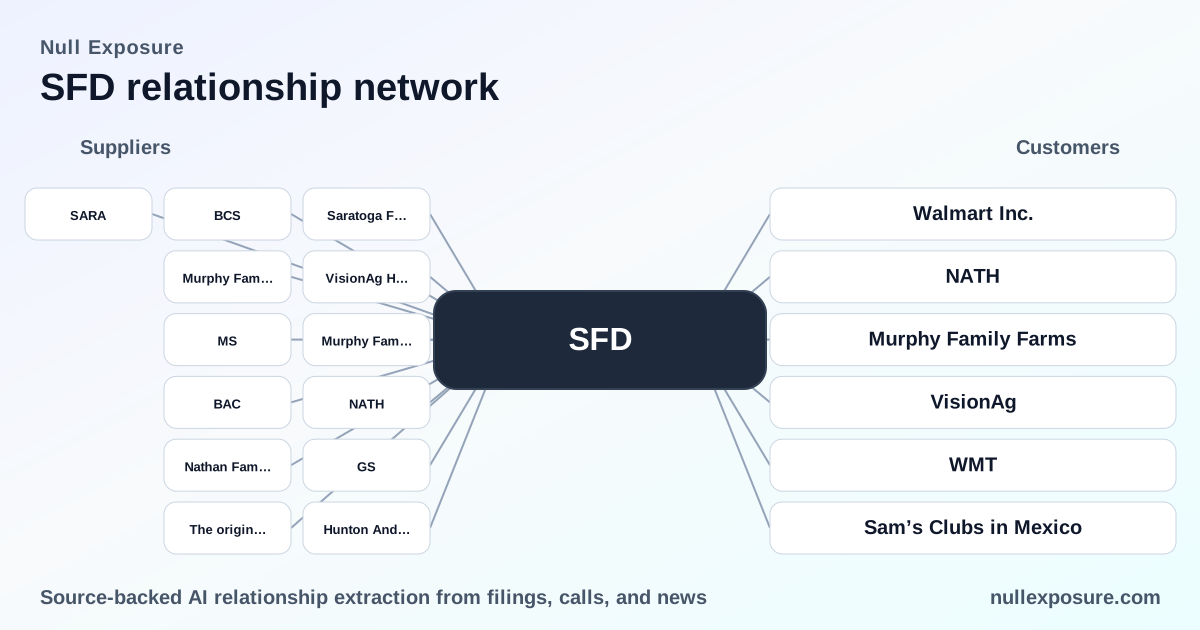
Smithfield Foods (SFD): Supplier Relationships and Strategic Constraints Investors Should Track
Smithfield Foods operates as an integrated pork producer and packaged‑meats marketer, monetizing through fresh‑pork production, value‑added packaged meats, brand licensing, and recurring retail and foodservice distribution. The firm captures margin by vertically integrating hog procurement and processing while outsourcing key inputs and services under a mix of long‑term and usage‑based contracts; recent M&A and capital‑markets activity also signal an active approach to securing branded growth. For investors evaluating supplier risk and operational resilience, the supplier map shows a blend of concentration (single‑source seasonings), scale suppliers for livestock, and market partners for financing and M&A execution.
Explore a unified view of counterparties and constraints at https://nullexposure.com/ to align supplier risk with portfolio analysis.
What the counterparty list reveals about Smithfield’s operating posture
Smithfield runs a manufacturing‑centric model: its Packaged Meats business sources most raw materials internally from its Fresh Pork segment, while selected inputs and services are delegated to external suppliers under contractual arrangements. The mix of exclusive sourcing for seasonings, multi‑year contract farming, pay‑for‑use logistics contracts, and targeted third‑party advisory relationships creates a profile that balances control over primary input flows with select external dependencies that are material to operations.
Relationship-by-relationship: what investors need to know
-
Saratoga Food Specialties, LLC (Saratoga) — Smithfield purchases most seasonings for its Packaged Meats segment from Saratoga under an exclusivity arrangement; that sourcing agreement and exclusivity are disclosed in Smithfield’s FY2024 Form 10‑K and were active as of the filing. (Source: Smithfield FY2024 10‑K)
-
Saratoga (SARA) — The company’s 10‑K reiterates that most seasonings for Packaged Meats come from a single company, Saratoga, and notes an exclusivity sourcing agreement that historically governed this supply arrangement. (Source: Smithfield FY2024 10‑K)
-
VisionAg Hog Production, LLC — VisionAg is contracted as a hog supplier and is expected to supply roughly 600,000 hogs annually, signaling Smithfield’s continued reliance on third‑party producers to meet slaughter and processing volumes. (Source: Smithfield FY2024 10‑K)
-
Murphy Family Farms LLC — Under a new supplier arrangement, Murphy Family Farms will supply approximately 3.2 million hogs annually, reflecting a substantial outsourced supply relationship supporting Smithfield’s pork operations. (Source: Smithfield FY2024 10‑K)
-
Murphy Family Ventures — Public reporting documents Smithfield’s December announcement that Murphy Family Ventures will reestablish Murphy‑owned farming capacity to produce roughly 3.2 million hogs annually for Smithfield, formalizing a strategic supplier relationship. (Source: Smithfield Times, Dec. 2025)
-
The original Murphy farms — Local reporting highlights that the original Murphy family farms have a long history as contract growers for Smithfield and are returning to independent pork production while continuing to supply Smithfield under new arrangements. (Source: Smithfield Times coverage, FY2025)
-
Nathan’s Famous / Nathan’s Famous, Inc. / Nathan Famous, Inc. / Nathan’s Famous Inc. (NATH) — Smithfield has held an exclusive license since 2014 to manufacture and sell Nathan’s Famous‑branded hot dogs and related products in North America; multiple outlets reported Smithfield’s proposed acquisition of Nathan’s for $450 million in an all‑cash deal that converts that licensing relationship into ownership. (Sources: PerishableNews; FoodEngineering; GlobeNewswire; RestaurantBusinessOnline; MeatPoultry; MeatingPlace; QSR Magazine — all FY2026 reporting)
-
Goldman Sachs (GS) — Goldman Sachs acted as Smithfield’s financial advisor on the Nathan’s Famous acquisition, reflecting the use of top‑tier M&A advisory for strategic brand purchases. (Source: PerishableNews FY2026)
-
Hunton Andrews Kurth LLP — Hunton Andrews Kurth served as legal counsel to Smithfield on the Nathan’s Famous transaction, indicating external legal support for the acquisition. (Source: PerishableNews FY2026)
-
Morgan Stanley (MS) — Morgan Stanley is one of the joint lead book‑running managers on Smithfield’s proposed secondary offering of common stock, signaling active capital‑markets engagement in FY2025. (Source: GlobeNewswire; ProvisionerOnline FY2025)
-
BofA Securities (BAC) — BofA Securities serves as a joint lead book‑running manager on the same secondary offering, supporting Smithfield’s equity capital activity. (Source: ProvisionerOnline; GlobeNewswire FY2025)
-
Barclays (BCS) — Barclays is also a joint lead book‑running manager for Smithfield’s proposed offering, completing the syndicate supporting the company’s capital raise. (Source: ProvisionerOnline; GlobeNewswire FY2025)
Constraints and the operating model — how contracts and concentration shape risk
Smithfield’s supplier constraints reveal an operational posture that is highly integrated but selectively dependent:
-
The company uses multi‑year contracts with contract farmers where farmers provide facility investment and labor in exchange for performance‑based service fees — a long‑term contracting posture that secures scale but transfers upfront capital and operational execution to third‑party growers. (Evidence: FY2024 10‑K excerpt on multi‑year farmer contracts)
-
Cold storage and logistics are governed by pay‑for‑use or committed‑volume contracts across over 45 locations, indicating a usage‑based cost structure that scales with throughput and can flex with volume variability. (Evidence: FY2024 10‑K excerpt on cold storage contractual arrangements)
-
Materiality: hog procurement volumes are a material line item for Smithfield’s cost base and supply chain; disclosed procurement metrics underscore that livestock supply is central to gross margins and production continuity. (Evidence: FY2024 10‑K procurement figures)
-
Concentration: Seasonings for Packaged Meats are single‑sourced from Saratoga under an exclusivity agreement (documented in the 10‑K), representing a supplier concentration risk with a defined contract expiry window. (Evidence: FY2024 10‑K sourcing agreement with Saratoga)
-
Role profile: Smithfield functions simultaneously as a manufacturer (processing its own hogs into packaged goods) and a contract counterpart (relying on third‑party farms and specialized service providers), which creates operational redundancy in some areas and concentrated dependencies in others. (Evidence: multiple FY2024 10‑K excerpts)
Midway check: for comprehensive supplier profiling and contract analytics visit https://nullexposure.com/ to map counterparties against contract types and materiality.
Investment implications: risk, optionality, and operational priorities
-
Concentration risk in seasonings is tangible and contract‑bound. The exclusivity with Saratoga centralizes a narrow but critical input; investors should treat this as a supplier concentration with defined renewal timing and potential bargaining leverage implications. (Source: Smithfield FY2024 10‑K)
-
Livestock supply is both strategic and outsourced. Multi‑year farming contracts and new large suppliers (Murphy entities, VisionAg) reduce spot exposure but create operational dependence on third‑party husbandry and biosecurity performance. (Sources: Smithfield FY2024 10‑K; Smithfield Times FY2025)
-
Acquisition of Nathan’s Famous converts a longstanding licensing relationship into ownership, de‑risking brand‑license expiry and providing higher capture of retail and foodservice margins; advisory and financing partners (Goldman Sachs; Morgan Stanley; BofA; Barclays; Hunton Andrews Kurth) demonstrate capital‑markets readiness to execute on strategic moves. (Sources: PerishableNews; FoodEngineering; GlobeNewswire; ProvisionerOnline FY2025–FY2026)
-
Operational flexibility through usage‑based logistics contracts cushions throughput volatility but links cost to utilization—beneficial in growth phases and a headwind in volume downturns. (Source: Smithfield FY2024 10‑K)
Key takeaways for investors and operators
-
High‑impact suppliers are identifiable and contract‑documented: seasonings (Saratoga) and large contracted hog suppliers (Murphy family entities, VisionAg) represent the most operationally critical external relationships. (Source: Smithfield FY2024 10‑K; Smithfield Times FY2025)
-
Strategic M&A reduces brand licensing friction: acquiring Nathan’s Famous is a defensive and value‑accretive move that removes future licensing renewal risk and increases direct control of branded margin. (Sources: FoodEngineering; PerishableNews FY2026)
-
Capital markets relationships matter: underwriters and advisors in the Morgan Stanley / BofA / Barclays / Goldman Sachs ecosystem signal that Smithfield has access to execution capability for both financing and M&A. (Sources: GlobeNewswire; ProvisionerOnline; PerishableNews FY2025–FY2026)
For a deeper counterparty breakdown and to integrate these supplier signals into investment models, visit https://nullexposure.com/ — align counterparties to cash‑flow and operational sensitivity analyses.
Conclusion: Smithfield’s supplier network is strategically constructed to protect core processing economics while outsourcing scale inputs and specialized services; the critical dependencies (seasonings and hog supply) and recent brand consolidation are the two leverage points that will determine execution risk and near‑term upside for investors. For ongoing monitoring and supplier concentration alerts, see https://nullexposure.com/.