Samfine Creation Holdings Group (SFHG): Supply-role snapshot and what investors should know
Samfine Creation Holdings Group operates as a commercial printer across Hong Kong, Mainland China, the United States and Europe and monetizes through contract printing services, project-based production and recurring print service agreements. The company generated roughly $153.7 million in trailing revenue with a gross profit of $31.6 million and is loss-making on an operating basis (operating margin -15.9% and net margin -7.77%) as of the latest reported quarter (2025-09-30). For investors and operators evaluating SFHG as a supplier or counterparty, the core commercial reality is straightforward: SFHG sells manufacturing capacity and print execution across multiple jurisdictions, and its market value is small and sensitive to liquidity and margin pressure. Learn more at https://nullexposure.com/.
How Samfine makes money and why that matters to buyer/supplier strategy
Samfine’s revenue stream is driven by volume-based printing contracts and one-off commercial projects, executed from production facilities headquartered in Kwun Tong, Hong Kong, with operations that touch major import/export markets. The company’s low price-to-sales ratio (0.067) and small market capitalization (approximately $10.27 million) highlight that capital markets currently assign limited premium to growth prospects; operationally the business converts top-line into gross profit but not into stable operating profits.
Key financial signals:
- Revenue TTM: $153.7M; Gross profit: $31.6M — gross margin ~20.6%.
- Negative operating and net margins, with EBITDA in negative territory (EBITDA: -$12.74M).
- Small public float (1.22M shares) and limited institutional ownership concentration (about 76.6% of shares held by institutions).
These indicators shape supplier dynamics: contracting will prioritize price, on-time delivery and capacity reliability, while counterparties that demand scale or integration will press on margins. For operators sourcing printing services, Samfine’s reach across regions is an advantage, but financial fragility increases operational risk for longer-term, capital-intensive contracts. For investors tracking supplier risk, see more context at https://nullexposure.com/.
The visible supplier/partner relationships and what they imply
Below I list every relationship surfaced in public results and provide a concise, plain-English take on each.
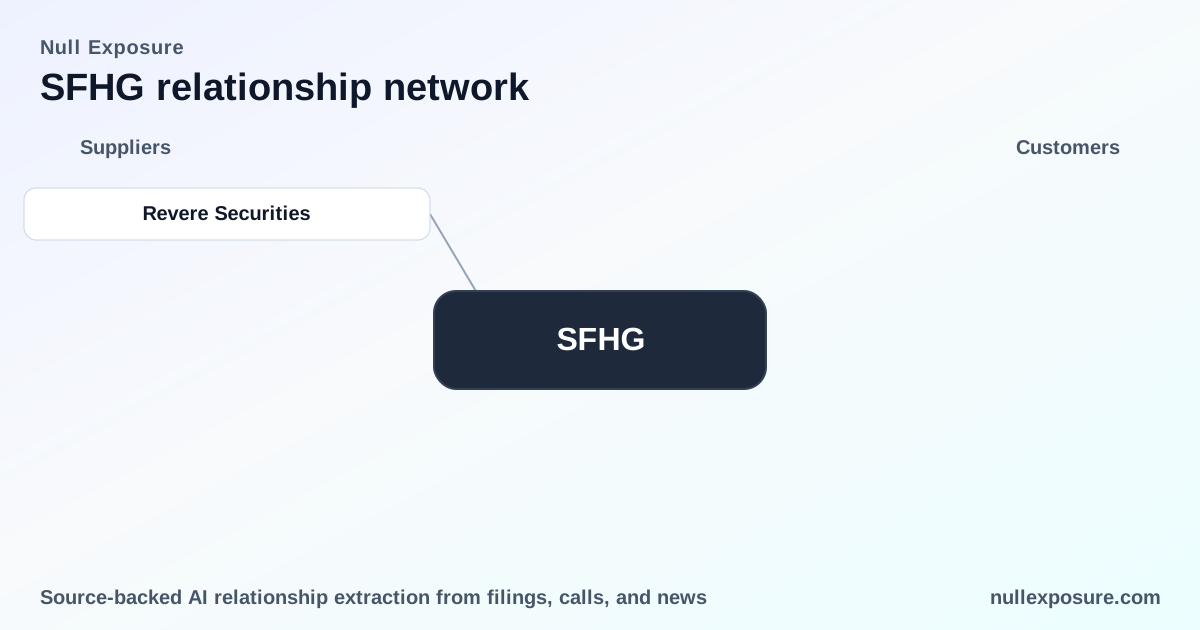
Revere Securities — sole bookrunner on a capital-markets deal
According to a Renaissance Capital report dated March 10, 2026, Revere Securities is the sole bookrunner on Samfine’s offering, signaling an active capital-marketing engagement to underwrite or arrange financing. This is a direct commercial linkage between Samfine and an investment bank for capital formation activity (Renaissance Capital, March 10, 2026).
- Why this matters: A sole bookrunner appointment concentrates execution risk and positions Revere as the primary conduit for any equity or debt placement tied to Samfine’s public profile and balance sheet.
Operating-model constraints and company-level signals
There are no supplier-specific constraint excerpts reported in the public results for SFHG; that absence is itself informative. Company-level signals drawn from filings and market data describe the operating posture you should evaluate when assessing SFHG as a supplier or counterparty:
- Contracting posture: Transactional, price-and-volume driven. The business model is oriented to discrete commercial printing orders and recurring service agreements rather than deeply embedded systems integration.
- Concentration: Revenue base and market capitalization indicate moderate operational scale; counterparty concentration risk should be assessed case-by-case because public disclosures do not show large strategic anchor customers.
- Criticality: For buyers requiring multi-region manufacturing footprint, Samfine is useful for geographic coverage, but financial leverage and negative operating margins reduce the company’s standing as a strategic long-term partner.
- Maturity: The company operates across established markets (HK, PRC, US, Europe) but retains small-cap characteristics: low enterprise value relative to revenue (EV/Revenue ~0.696) and thin public float, suggesting limited capital-market flexibility.
These characteristics imply that counterparties should prioritize contract terms that protect against execution risk, such as short payment cycles, performance guarantees and staged commitments.
Risks that matter to counterparties and investors
- Financial fragility: Negative EBITDA and operating losses require counterparties to account for counterparty credit and business continuity risk.
- Liquidity and market risk: Small market cap and thin float can amplify balance-sheet pressure if Samfine pursues additional capital raises; the appointment of a sole bookrunner underscores that pathway.
- Operational exposure: Multi-jurisdiction operations reduce single-market risk but increase logistics and compliance complexity; counterparties should quantify this operational overhead in contracting.
Practical next steps for investors and procurement teams
For investors assessing SFHG’s supplier relationships or for procurement teams considering contracting with Samfine, recommended actions are:
- Require contractual protections (payment terms, performance milestones, indemnities) for multi-month or capital-intensive engagements.
- Monitor capital-market activity closely; an active bookrunner relationship signals potential dilution or refinancing events that affect counterparty continuity.
- Stress-test vendor supply continuity against Samfine’s operating cashflow and order backlog.
If you want deeper relationship mapping or a tailored supplier-risk brief, start here: https://nullexposure.com/.
Final read: what to take away
Samfine Creation Holdings Group operates a geographically diversified commercial printing business with meaningful gross margins but negative operating profitability and small public-market capitalization. The public record shows a recent capital-marketing engagement with Revere Securities acting as sole bookrunner (Renaissance Capital, March 10, 2026), which is material for investors and counterparties because it directly impacts financing and liquidity posture. For procurement, the key actions are to structure contracts to limit execution and credit exposure; for investors, monitor capital raises and margin recovery as leading indicators of value creation.
To review SFHG’s public filing history, counterparties and supplier analysis tools, visit https://nullexposure.com/ for curated relationship intelligence and structured briefings.