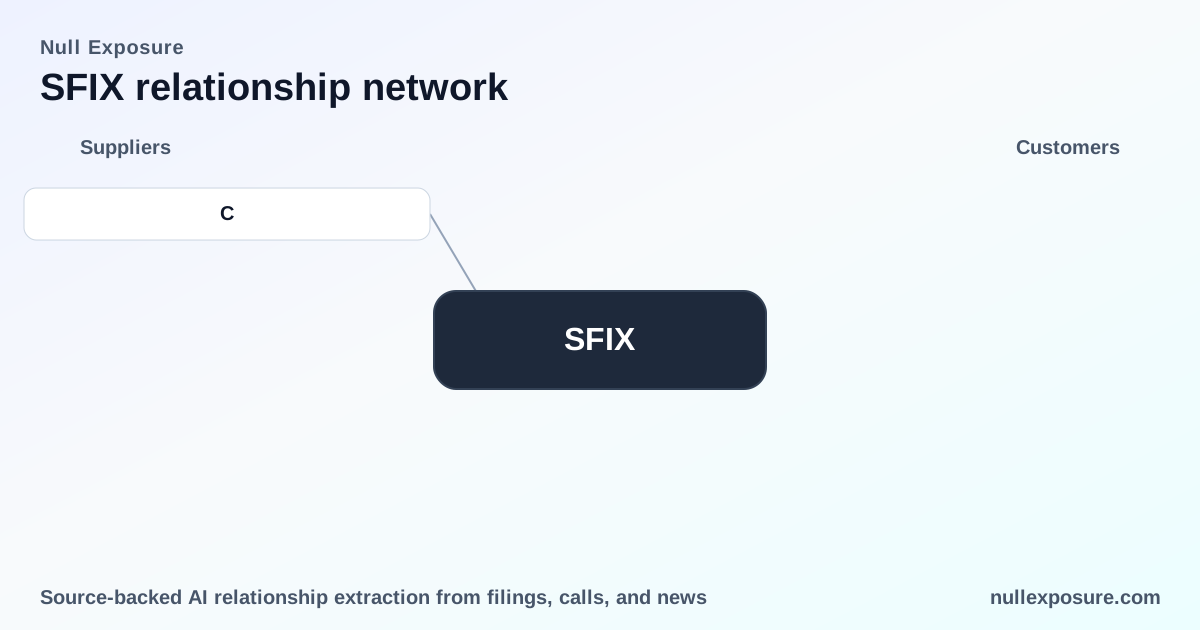
Stitch Fix (SFIX) — supplier relationships, financing, and what investors should price in
Thesis: Stitch Fix operates an online-first apparel retailer that sells clothing, shoes and accessories through its website and mobile app, monetizing primarily through merchandise sales; the balance sheet and supplier posture are shaped by forward inventory commitments and a modest revolving credit facility that supports working capital. Investors should value the business as a retail inventory and supply-chain play with meaningful sourcing concentration in Asia and an active short-term liquidity dependence on bank financing.
If you want a consolidated view of counterparties and supplier exposures for investment due diligence, visit https://nullexposure.com/ for an integrated supplier-risk perspective.
How Stitch Fix makes money and funds the business
Stitch Fix generates revenue by procuring merchandise and selling it directly to consumers through its digital channels; Revenue TTM is $1.32 billion and gross profit is $577.5 million, indicating a healthy gross margin but ongoing operating losses (Diluted EPS TTM -$0.18). The company funds inventory and operations through internal cash flows supplemented by a $50.0 million revolving credit facility and routine purchasing contracts with third‑party vendors that commit capital ahead of seasons. These elements combine to make Stitch Fix a capital-intensive retail operator where supplier and financing relationships directly affect liquidity and margin delivery.
Capital and bank relationships that matter right now
A short bank line, but it matters
Stitch Fix maintains a $50.0 million revolving credit facility with Citibank, N.A., maturing December 4, 2026, and the company reported a $50.0 million borrowing availability as of August 2, 2025. This facility acts as the primary near-term backstop for working capital and seasonal timing mismatches. According to the company's FY2025 SEC filing summarized through TradingView (reported March 2026), the full facility remained available at that snapshot in time.
- Citibank, N.A.: Stitch Fix holds a $50.0 million revolving credit facility with Citibank, N.A., maturing on December 4, 2026; availability was $50.0 million as of August 2, 2025 (company FY2025 disclosure reported via TradingView, March 2026).
Implication: the facility size is modest relative to revenue and inventory cycles, making refinancing timing and covenant flexibility a visible risk heading into late 2026.
Supply chain posture and sourcing signals investors should price
Company disclosures and procurement language give a clear operating posture that shapes supplier risk and margin volatility.
-
Forward contracting posture: Stitch Fix explicitly enters purchase contracts well in advance of a season and often before trends are confirmed by client purchases, which locks in unit economics and exposes the company to trend risk and inventory obsolescence. This is a deliberate, mature procurement approach to ensure timely delivery, but it increases working‑capital volatility.
-
APAC manufacturing concentration: Stitch Fix sources nearly all merchandise through third‑party vendors whose manufacturing is predominantly in China, creating country‑concentration risk in production, logistics, and tariff/policy exposure.
-
Mixed vendor/manufacturer relationships: For its Owned Private Label Brands, Stitch Fix contracts with merchandise vendors—some operate their own factories; others subcontract—so supplier relationships span pure vendors and de facto manufacturers.
-
Third‑party oversight via service providers: The company hires independent firms to conduct initial and ongoing audits of factory working conditions, indicating operational controls over vendor compliance without full vertical integration.
Together these signals indicate a procurement model that is mature but concentrated: long-term purchase commitments reduce stockouts and support assortment planning, but heavy APAC concentration and off‑balance subcontracting increase single‑region risk and supplier dependency.
(These characteristics are drawn from Stitch Fix’s supplier and manufacturing disclosures in its filings.)
If you want a mapped view of Stitch Fix’s counterparties and how these supplier patterns connect to financing risk, see https://nullexposure.com/ for full supplier relationship analysis.
Relationship-by-relationship snapshot (full coverage)
Citibank, N.A.: Stitch Fix maintains a $50.0 million revolving credit facility with Citibank, N.A., maturing December 4, 2026, with $50.0 million borrowing availability reported as of August 2, 2025, per the company's FY2025 SEC disclosure summarized by TradingView (March 2026). This is the primary explicit bank line disclosed in the most recent filing.
What this means for valuation and downside scenarios
-
Liquidity and refinancing risk are front and center. With a modest revolving facility and operating losses (Diluted EPS TTM -$0.18), investors should value the probability and cost of refinancing into late‑2026 as part of downside stress tests. Market cap is $421.4 million against $1.32 billion in revenue TTM, and Price/Sales ~0.32 signals low market expectations that already price execution risk.
-
Inventory and style risk are structural. The company’s practice of purchasing inventory in advance and its concentration of manufacturing in China make Stitch Fix sensitive to misreads in consumer demand and to geopolitical/logistics disruptions. These are operationally critical relationships, not ancillary contracts.
-
Operational controls exist but do not eliminate supplier concentration. Independent audit firms are engaged for factory oversight, which reduces certain compliance risks, but does not change the core exposure to APAC manufacturing hubs.
-
Upside contingent on execution and margin recovery. If Stitch Fix tightens assortment accuracy and reduces inventory write-downs while preserving gross margin, the small market valuation implies upside; conversely, any credit‑market tightening that increases the cost or reduces availability of short‑term bank financing will compress options.
Practical steps for investors and operators
-
For investors: stress test the balance sheet for 2026 refinancing scenarios and model inventory write‑downs under weaker demand. Reassess assumptions about gross margin recovery relative to supplier cost pass-throughs and currency/ tariff shocks.
-
For operators: prioritize diversified sourcing outside a single country and tighten vendor commitments to improve responsiveness; consider negotiating extended, flexible covenants on bank facilities to avoid year‑end concentration risk.
For an integrated view of supplier counterparties and financing lines to inform these scenarios, explore https://nullexposure.com/ — it consolidates supplier exposures and financing counterparties for diligence workflows.
Bottom line
Stitch Fix is a digitally native apparel retailer with material upstream concentration and a small, near-term bank facility that underpins working capital. The company’s procurement strategy—long lead purchase contracts and heavy APAC manufacturing—creates both competitive advantages (assortment reliability) and concentrated operational risk. Investors should weigh the modest capital buffer against the company’s negative earnings and seasonal inventory dynamics when assigning probabilities to recovery vs. downside scenarios.
If you want supplier‑level intelligence and counterparty mapping to inform valuation or operational remediation, visit https://nullexposure.com/ for supplier and financing visibility tuned to investor due diligence.