Simmons First National (SFNC): Supplier relationships and funding signals investors should track
Simmons First National Corporation operates as a regional bank holding company that earns through net interest margin on loan and investment portfolios and through fee income from deposit, treasury and capital markets services. The company monetizes customer flows while managing short-term liquidity with a mix of core deposits and wholesale funding; changes in that funding mix are the primary channel through which supplier and counterparty relationships influence earnings and risk. For investors and operators evaluating SFNC counterparties, the immediate priorities are funding counterparties, strategic advisory relationships, and the bank’s use of third‑party service providers for critical functions. Learn more at https://nullexposure.com/.
Why supplier and funding relationships matter for a regional bank now
Regional banks live or die by access to low-cost deposits and the predictability of wholesale funding. When a bank reduces reliance on higher-cost wholesale advances and leans into relationship-based deposits, net interest margin and earnings stability improve. Conversely, concentration in a small set of counterparties or heavy use of short-term advances creates execution risk if markets re-price. For premium finance investors, counterparties to track are those that supply liquidity (FHLB) and those that influence strategic decisions or governance (investment bankers and advisors).
Who shows up in SFNC’s recent reporting — plain English, investor-focused
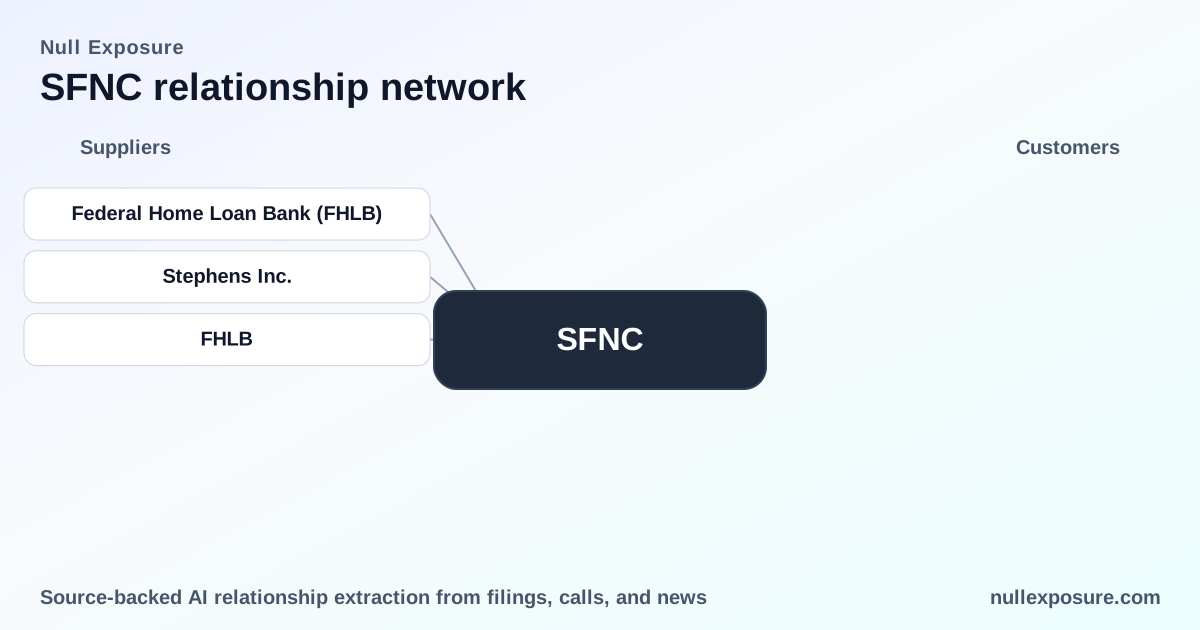
Federal Home Loan Bank (FHLB) — TradingView coverage of the 10‑K (FY2026)
Simmons used proceeds and balance sheet actions to pay down higher-rate wholesale funding, specifically FHLB advances, as part of a deleveraging and cost-reduction initiative. This reflects an active effort to replace non-relationship, higher-cost funding with cheaper alternatives. According to TradingView’s coverage of SFNC’s SEC 10‑K for FY2026, the bank explicitly cited paying down FHLB advances to deleverage the balance sheet.
Stephens Inc. — Arkansas Business profile (FY2025)
Stephens Inc. functions as a long-standing advisory and banking relationship for Simmons, with personal and institutional ties to the bank’s leadership; the new CEO was previously a client at Stephens, underscoring an advisory and capital markets linkage that influences strategy and access to markets. Arkansas Business reported on the CEO transition and noted that Simmons was one of Brogdon’s first clients at Stephens, highlighting a durable advisory relationship reported in FY2025.
FHLB — PR Newswire release on quarterly results (FY2026)
A PR Newswire release reporting SFNC’s fourth-quarter EPS confirmed the year-over-year decrease in other borrowings resulted from paying down higher-cost wholesale funding, primarily FHLB advances, as part of balance sheet repositioning. That disclosure reinforces that FHLB advances were a material, actionable funding source in FY2026 that management prioritized reducing to lower funding costs and de‑risk the liability profile.
What the relationships collectively tell investors about SFNC’s operating posture
- Contracting posture: SFNC is actively shifting its liability mix away from transactional wholesale advances toward relationship deposits and other lower-cost sources. The public filings and press releases describe proactive pay-downs rather than passive attrition, indicating an assertive funding strategy.
- Concentration and criticality: FHLB advances were significant enough to be singled out in annual and quarterly communications; that makes FHLB a critical liquidity counterparty historically, even as management reduces exposure.
- Maturity and predictability: The presence of FHLB advances implies established, institutional credit lines with predictable term structures, but these are sensitive to market pricing; reducing them lowers near-term funding volatility.
- Supplier role diversity: The bank uses third-party service providers for specialized functions — auditors, consultants and cybersecurity experts — which positions those suppliers as operationally important though typically non-revenue-generating.
These are company-level signals drawn from management commentary and reporting rather than assertions tied to any single supplier.
The constraint worth noting: third‑party service providers for cyber and audit
SFNC’s own disclosures state: "In connection with these efforts, we use, on an as‑needed basis, certain third‑parties, including auditors, consultants, and others, that have particular cyber expertise." This signals a contracting posture that relies on external specialists for cybersecurity and advisory functions, implying variable-term engagements and a reliance on external controls rather than building all capabilities in-house. For investors, that structure reduces fixed-cost overhead but increases vendor-control and third-party risk concentration in specialized areas.
Explore how these supplier signals affect counterparty profiles at https://nullexposure.com/.
What this means for premium finance and counterparty risk
- Funding risk is declining as management pays down higher-cost FHLB advances, which reduces immediate rollover and repricing exposure and improves margin stability.
- Advisory relationships like Stephens Inc. matter for strategic moves and capital-market access, offering a pathway to raise capital or execute M&A if the need arises.
- Outsourced cyber and audit expertise is a double-edged sword: it delivers specialized capability quickly but places critical controls outside of internal staff, increasing operational vendor risk that must be monitored through contract terms and SLAs.
Investors should treat the FHLB relationship as a historically material but reducing source of liquidity, and treat advisory and cyber suppliers as operational levers that can be scaled up or down depending on capital strategy.
Recommendations: what to watch next and tactical steps
- Monitor quarterly disclosures for the remaining balance and repricing schedule of FHLB advances; continued paydown is positive for margins and reduces liquidity concentration.
- Track any expanded disclosure of adviser engagements or retained rights by Stephens Inc. that could presage strategic transactions or capital raises.
- Request contract-level evidence of cybersecurity vendor SLAs and audit independence during diligence for any material commercial or capital relationship; these are the practical controls that determine operational resilience.
If you need a quick, professional briefing on these counterparty dynamics, visit https://nullexposure.com/ for tailored supplier-risk summaries.
Closing view: where SFNC stands for investors
Simmons First is executing a clear deleveraging and de-risking play by reducing reliance on higher‑cost FHLB advances while retaining advisory relationships that support strategic flexibility. The operating model combines relationship banking with selective outsourcing for specialized functions, producing a lower‑cost, lower‑volatility liability profile when management’s funding shifts complete. For investors and operators, the priority is ongoing monitoring of FHLB exposure, the scope of advisory mandates, and the contractual robustness of third‑party cyber and audit suppliers. For further research and supplier-level intelligence, start your analysis at https://nullexposure.com/.