Southern First Bancshares (SFST): Supplier relationships, liquidity links, and operational constraints investors should price in
Southern First Bancshares operates as a regional banking holding company for Southern First Bank, originating loans and gathering deposits across South Carolina, North Carolina and Georgia, and monetizing through net interest income, fee income and liability management. From an investor and operator perspective, the supplier footprint is small in count but strategically important: outsourced technology, ATM services and long‑term real estate leases create fixed-cost and operational dependencies, while Federal Home Loan Bank advances provide a predictable liquidity channel. For a quick refresher on supplier risk signals and relationship mapping, visit https://nullexposure.com/.
Quick financial snapshot that frames supplier risk
Southern First is a compact regional bank with market capitalization around $430 million, trailing P/E of ~13.9, and price-to-book of ~1.15. Recent performance shows revenue TTM of $115.1 million, EPS of $3.76 and return on equity about 8.7% — a profitable regional franchise whose operating leverage makes supplier commitments material to margins. Institutional ownership is high at ~82.8%, and the share float is relatively small, which amplifies news flow from vendor or liquidity events.
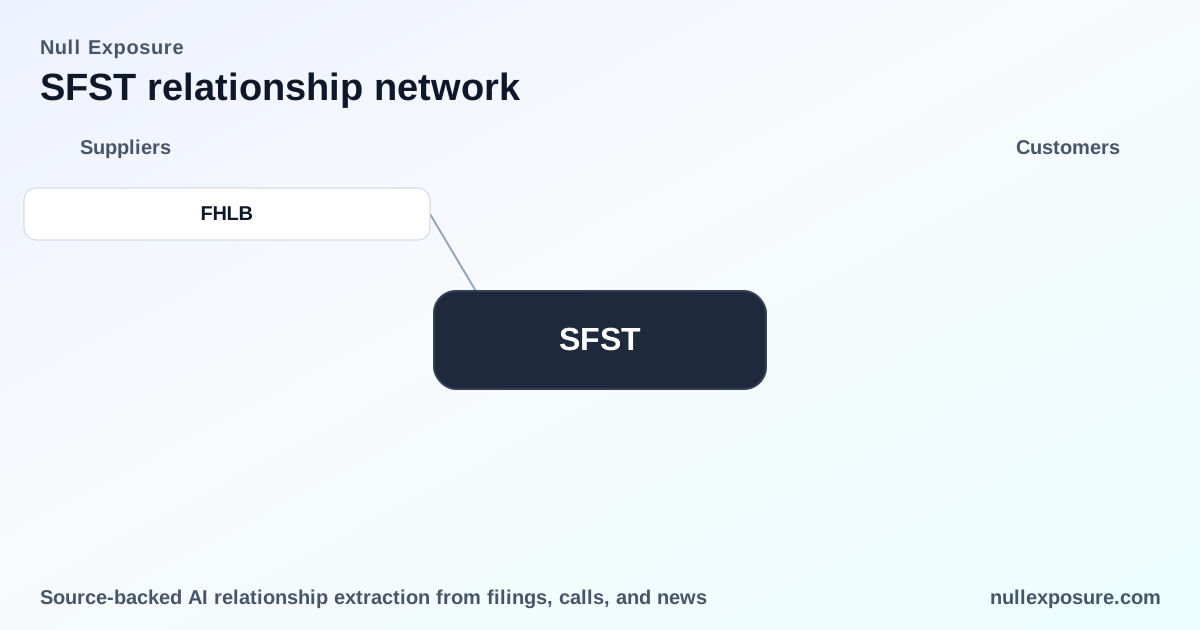
The single supplier relationship in the public results: FHLB
FHLB advances reported in FY2026
Southern First disclosed FHLB advances totaling 240,000 in its FY2026 disclosure, reflecting the bank’s use of the Federal Home Loan Bank system as a liquidity and funding source. According to the company press release reporting fourth-quarter 2025 and FY2026 results (PR Newswire, March 10, 2026), the disclosure explicitly references FHLB advances of 240,000. This is a funding relationship rather than a vendor contract; it signals the bank uses FHLB advances for short-to-medium term liquidity and liability management.
What the constraints tell investors about the operating model
The collection of company-level constraints in Southern First’s disclosures paints a consistent operating profile:
- Long-term lease commitments are baked into the cost base. Leases have maturities ranging from April 2025 to February 2032 with options for multiple five-year extensions, which creates a multi-year fixed-cost runway and reduces flexibility on occupancy expense.
- Core functions are outsourced to service providers. The company explicitly states that third parties deliver data processing, online banking interfaces, network access and ATM services, and that ATM transactions generate vendor fees. That positions vendor performance as critical to customer experience and cost control.
- Supplier relationships are active and capitalized. The company reports operating right-of-use assets (ROU) of roughly $20.6 million as of year‑end 2024 and lease liabilities around $23.2 million, confirming these are not contingency arrangements but active, on‑balance-sheet commitments.
- Lease spend is material for the company’s size. A signal categorizes total lease-related spend in the $10M–$100M band, supported by a reported line for “Total undiscounted lease payments $28,836” in the filing context — a disclosure consistent with mid‑double‑digit millions of committed lease cash flows. Treat this as a company-level signal rather than a single-vendor number.
These constraints together describe a contracting posture that is moderate to high commitment: long-dated occupancy contracts with outsourced critical services translate into concentration and criticality risk even if vendor counts are limited.
How to interpret supplier risk versus strategic benefits
Southern First’s supplier posture combines outsourced execution with in-house risk exposures:
- Outsourcing core banking interfaces and data processing reduces internal capital and headcount needs and supports scalability, which is beneficial for a regional bank growing revenue per share.
- Outsourcing creates single points of failure: a vendor outage, pricing shock or contract non‑renewal for ATM, online banking, or network services directly impacts customer operations and adds remediation cost.
- Long-term leases smooth real estate cost predictability but reduce agility in reacting to branch consolidation or remote-service shifts.
- The FHLB funding relationship offers stable, low-cost liquidity, but it increases sensitivity to interest-rate spreads and collateral availability.
What to monitor next — actionable signals for investors and operators
- Monitor FHLB borrowing levels and trends relative to deposits: rising reliance on advances signals funding stress or deliberate liability management changes; declining advances indicate deposit stability or increased liquidity buffer.
- Track vendor contract renewal dates and extension options tied to lease expirations (notably through Feb 2032) and scheduled lease payments; these are the primary windows where costs and counterparty exposure can change.
- Watch operational uptime and fee trends for outsourced services—ATM fee expense and online-banking exception rates are early indicators of vendor friction.
- Keep an eye on lease-related cash flow and right-of-use asset trends reported in quarterly filings to understand capitalized commitments and their amortization.
- For equity holders, follow net interest margin, deposit growth, and ROE trajectory since supplier cost shocks or funding shifts feed directly into those metrics.
A short checklist for immediate diligence:
- Confirm the current FHLB advance balances in the next quarterly statement.
- Map vendor contracts that support online banking and ATM operations against business continuity plans.
- Quantify the impact of lease expirations and extension elections on cash flow under multiple branch consolidation scenarios.
If you want a deeper supplier-risk brief or a tailored watchlist for Southern First based on these signals, start here: https://nullexposure.com/.
Bottom line — where valuation and supplier posture intersect
Southern First delivers a classic regional bank profile: solid profitability, modest valuation multiples, and high institutional ownership, but with operational sensitivity to a few concentrated suppliers and multi-year lease commitments. The FHLB advances disclosure confirms an active funding channel that underpins liquidity management. For investors, the trade-off is straightforward: a compact, profitable franchise with outsized exposure to vendor execution and lease obligations, so price competition, contract renewals and any change in FHLB access are catalysts for equity performance.
For targeted supplier intelligence, scenario planning and watchlists for Southern First, visit https://nullexposure.com/ and explore the supplier mapping tools that contextualize these risks for investors and operators.