Sweetgreen (SG): how supplier ties shape a low-margin, scale-driven restaurant model
Sweetgreen operates a digitally enabled, fast-casual restaurant chain that earns revenue primarily from in-restaurant and digital food sales across its U.S. footprint, supplemented by strategic licensing and supply arrangements tied to kitchen technology and co-branded menu collaborations. The company monetizes through unit-level sales, delivery channels, and selective licensing/supply deals that extend platform capabilities, while its cost structure and supplier mix directly influence gross margins and operating losses. For investors, supplier relationships are not peripheral — they are operational levers that determine menu innovation speed, unit economics, and rollout pace. Explore more supplier intelligence at https://nullexposure.com/.
Why suppliers matter for Sweetgreen's P&L and growth trajectory
Sweetgreen reported trailing twelve-month revenue of $679.5M with a gross profit of $110.3M and operating margins that remain negative (operating margin TTM: -29.6%). Institutional ownership sits high at ~89%, and the company trades with a market capitalization near $682M, reflecting investor sensitivity to margin recovery and scale economics. Supplier performance — from produce sourcing and distribution to technology licensors — directly affects food cost, same-store economics, and the cadence of new unit openings.
If you want continuous monitoring of supplier risks and partner exposures, visit https://nullexposure.com/ for deeper coverage.
Supplier landscape: how Sweetgreen contracts and sources
Sweetgreen organizes its supply chain into regional distribution networks and works with a broad set of domestic partners — more than 140 active food partners, including farmers, bakers, and distributors. Contracting behavior blends both short- and long-term approaches: pricing and food purchase arrangements are often shorter-term to reflect commodity pricing volatility, while real estate and major operating leases are structured long-term (base terms typically around 10 years with extension options). The company also relies on third-party service providers for delivery and critical systems (payment processors, cloud infrastructure), so supplier criticality ranges from routine distribution to high-impact services that handle payments and customer data.
Key company-level signals:
- Contracting posture: mix of short-term procurement contracts and long-term lease commitments.
- Counterparty mix: large number of domestic suppliers (farmers, bakers, distributors) and external service providers.
- Geographic focus: primarily North America regional distribution networks.
- Relationship roles: service providers, distributors, and manufacturers collectively support the operating model.
- Spend profile: evidence points to meaningful capital and lease commitments (company-level spend band signal in the $10M–$100M range).
Three supplier/partner relationships investors should track
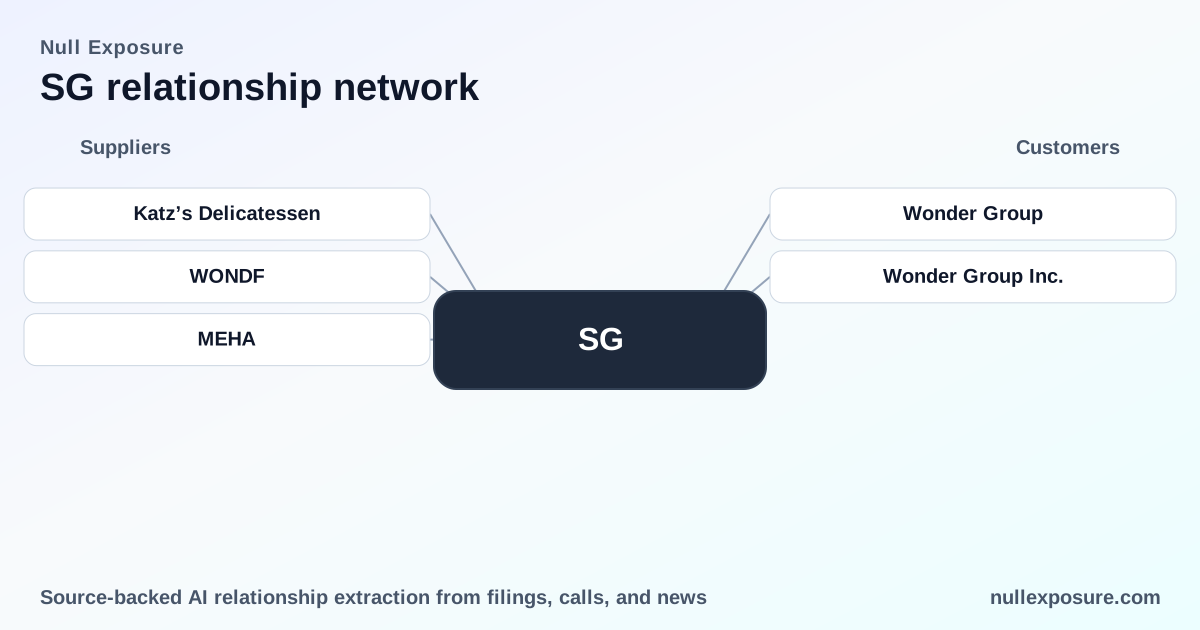
Katz’s Delicatessen — co-branded pop-up and menu collaboration
Sweetgreen hosted a pop-up with New York institution Katz’s Delicatessen at its Lower East Side location, offering a co-created “LES Pastrami Salad” that combined Katz’s signature pastrami with Sweetgreen’s menu format. This is a consumer-facing, brand collaboration designed to drive foot traffic and PR around a new site opening. According to MarketScreener coverage (first seen March 10, 2026), the event occurred at 167 Orchard Street with Katz’s operating a carving station on site.
Wonder (WONDF) — Spyce sale plus ongoing supply and license agreements
In connection with the divestiture of its Spyce assets, Sweetgreen executed a supply agreement and a license agreement with Wonder that allow Sweetgreen to continue deploying Wonder’s “Infinite Kitchens” technology across its restaurants post-sale, preserving the operational benefits of the platform while removing Spyce from the corporate perimeter. Yahoo Finance reported the transaction and the accompanying agreements in March 2026, highlighting Sweetgreen’s intent to retain access to kitchen automation through contractual arrangements.
Function (MEHA) — menu collaboration for nutrient-dense offerings
Sweetgreen introduced a nutrient-dense menu developed in collaboration with wellness brand Function, signaling a vendor relationship focused on product formulation and co-marketing to capture health-oriented consumers. Yahoo Finance coverage (first seen March 10, 2026) described the product launch as part of efforts to refresh menu offerings and differentiate on wellness credentials.
What these relationships imply for operations and investor risk
These partnerships illustrate three distinct supplier roles that matter to investors:
- Brand collaborations (Katz’s, Function) accelerate trial and customer re-engagement without the capital intensity of new unit builds, but they require tight supply coordination and margin discipline on co-branded menu items. Such collaborations can boost traffic while compressing unit-level margins if sourcing is not managed.
- Technology licensing/supply (Wonder) shows Sweetgreen’s willingness to unbundle ownership of capital-intensive automation while preserving access through supply and license contracts; this reduces balance-sheet risk but increases contractual dependency on third-party technology providers for scale economics. Yahoo Finance’s description of the post-sale supply and license arrangement with Wonder clarifies that the company prioritized operational continuity over retained ownership.
- Distribution footprint and short-term procurement create exposure to commodity pricing and logistics volatility. The firm’s mix of shorter-term food purchase contracts combined with long-term real estate leases means revenue variability and fixed-cost commitments move in opposite directions, increasing leverage on same-store performance.
Concentration, criticality, and contract maturity — investor checklist
Investors should monitor:
- Supplier concentration: over 140 domestic partners reduce single-supplier concentration risk, but regional distribution partners become critical nodes; any disruption at the distribution level impacts multiple units simultaneously.
- Contract maturity mismatch: short-term food contracts alongside long-term lease obligations amplify downside in a demand slump.
- Service provider criticality: reliance on third-party delivery and payment processors elevates operational risk and the need for robust vendor SLAs.
- Spend commitments: lease and capital lease exposures are material to near-term cash flow planning and were reported as additional operating lease commitments in fiscal disclosures.
For continuous tracking of these supplier exposures and SLA risks, visit https://nullexposure.com/ and subscribe for alerts.
Bottom line and action items for investors
Sweetgreen’s supplier relationships are strategic levers: brand collaborations can drive traffic and marketing value, licensing agreements preserve technological advantages without capital ownership, and a diverse domestic supplier base supports operational resilience — but only if procurement and distribution are tightly managed to restore margins. Investors should evaluate management’s supplier contract disclosures, monitor the health of regional distribution partners, and assess the company’s ability to translate collaborations into profitable, repeatable sales.
For a focused view of partner-level exposures and to benchmark supplier risk against peers, go to https://nullexposure.com/ for detailed supplier intelligence.