Saga Communications (SGA): Supplier Relationships and the Operating Signals Investors Need
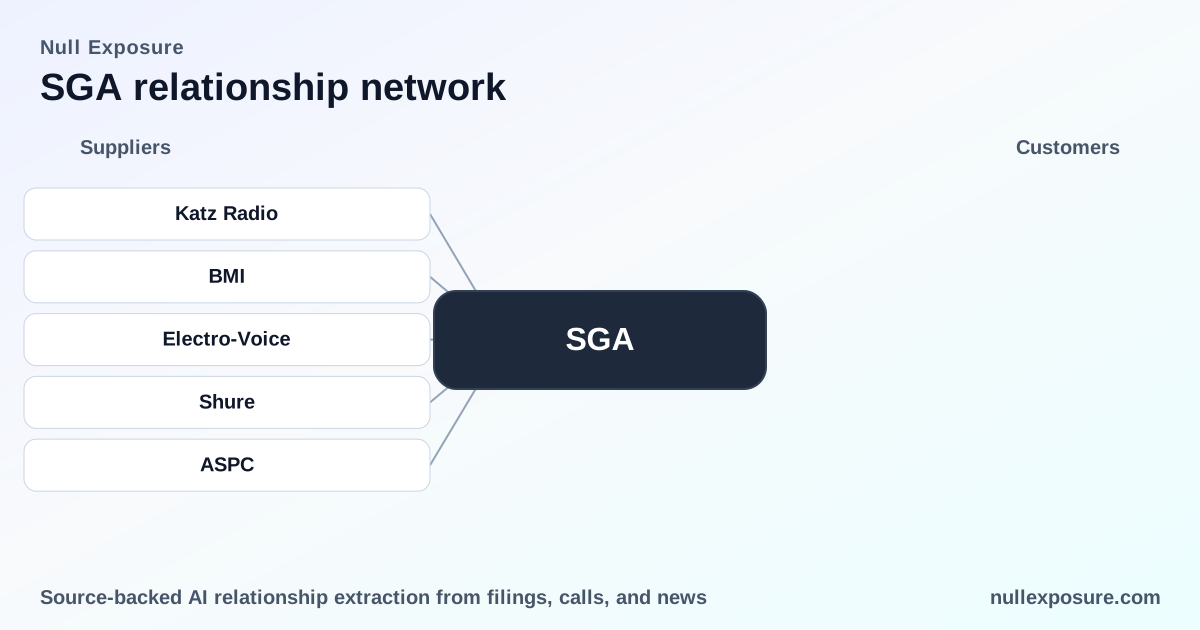
Saga Communications operates and monetizes as a geographically distributed broadcast operator: it owns and operates local radio clusters, sells local and national advertising (augmented by independent national sales representatives), and licenses music content through public performance organizations while sourcing studio hardware from specialty vendors. Revenue is driven by advertising sales and recurring licensing obligations; profitability depends on local ad demand, national sales effectiveness, and the company’s ability to manage royalty and equipment costs. For a concise portal to supplier and counterparty intelligence, visit https://nullexposure.com/.
How Saga’s supplier posture shapes economics and risk
Saga’s commercial model is built around three supplier dynamics that determine cash flow volatility and cost structure.
- Licensing is structural and non-negotiable. Saga secures performance rights and pays public performance royalties through performing rights organizations (PROs) and similar entities; these are recurring, industry-standard cost items that directly affect gross margins. Company disclosures list PROs explicitly and describe the mechanics of paying royalties to rights holders through organizations such as Broadcast Music, Inc. and the American Society of Composers, Authors and Publishers.
- Advertising distribution relies on third‑party national sales partners. Saga uses independent national sales representatives to source national advertising and pays commissions tied to net revenue obtained — a variable cost that scales with national ad success.
- Capital and liquidity are modest but explicit. Saga’s long‑term debt disclosure references a revolving credit facility and scheduled long‑term maturities (for example, a listed 2027 maturity). This indicates a conventional financing posture with a credit facility that underpins working capital for stations and cluster operations.
Key takeaway: Saga operates a low‑growth, yield‑oriented broadcast franchise with recurring licensing costs and a variable national‑sales commission model — investors should prioritize monitoring rate‑setting with PROs and sales productivity from national reps.
Supplier relationships that matter — what the filings and calls show
Katz Radio: a proactive national-sales partner
Saga’s management described Katz Radio as a proactive partner and noted the presence of two outstanding national sales managers, Tom Howe and Bruce Werner, working with Katz to bring national advertising into Saga’s clusters. This relationship is operationally important for augmenting local revenue with national accounts. (Source: Saga 2025 Q3 earnings call.)
BMI: a named performing‑rights counterparty with rate settlements
Management stated that Saga, as a member of the Radio Music License Committee, announced separate rate‑setting settlements with Broadcast Music, Inc. (BMI) in mid‑August; company disclosures also identify BMI as a standard PRO from which Saga obtains licenses and pays royalties. Licensing arrangements with BMI are therefore a contractual cost driver and subject to negotiated rate outcomes. (Source: Saga 2025 Q3 earnings call; company licensing disclosures.)
ASCAP: another PRO with negotiated rate‑setting outcomes
The company confirmed separate rate‑setting settlements with the American Society of Composers, Authors and Publishers (ASCAP) as part of the Radio Music License Committee’s actions in mid‑August. ASCAP functions as a licensor to Saga, and settlements with ASCAP directly affect recurring royalty expense. (Source: Saga 2025 Q3 earnings call; company licensing disclosures.)
Electro‑Voice: studio hardware supplier cited in station write‑ups
A Radioworld profile of Saga cluster studios in Keene, N.H., lists Electro‑Voice RE20 and RE620 microphones in use across multiple Saga stations (WKNE, WINQ, WSNI, WKBK, WWZBK). This indicates Saga’s sourcing of professional broadcast audio equipment from specialist vendors; equipment choices reflect standard broadcast quality requirements rather than a strategic dependency. (Source: Radioworld, “Mics — What’s In Your Studio,” FY2014.)
Shure: remote and auxiliary microphone supplier
The same Radioworld article notes Saga’s use of Shure SM58 microphones for remotes and auxiliary applications, signaling reliance on mainstream broadcast‑grade consumables for field work and events. This relationship is operationally routine and tied to logistics and maintenance across clusters. (Source: Radioworld, “Mics — What’s In Your Studio,” FY2014.)
What the constraints tell investors about contracting, concentration and criticality
Company disclosures and constraint excerpts give crisp, investor‑relevant signals about Saga’s operating model.
- Contracting posture — long‑term with recurring obligations. Saga’s long‑term debt schedule and a revolving credit facility are explicitly disclosed, demonstrating a conventional credit profile rather than a cash‑rich balance sheet. The presence of scheduled maturities implies routine refinancing and liquidity management tasks.
- Licensing is a high‑certainty, recurring cost. The company’s written obligations to secure public performance licenses and to pay royalties — and its listing of specific PROs such as BMI and ASCAP — place licensing in the “critical and non‑discretionary” category for operating cash flow. Rate settlements with PROs are direct drivers of margin pressure.
- Counterparties include non‑profit rights organizations. Saga’s obligations to non‑profit performance organizations (for example, SoundExchange cited in filings) add an element of regulated or committee‑driven price formation versus purely commercial vendor negotiation.
- Service relationships are variable‑cost and commission‑based. National sales representatives are engaged on commission to generate national advertising; this aligns Saga’s cost base with national ad performance and reduces fixed selling overhead.
Key takeaway: Saga’s supplier relationships combine legally binding, recurring licensing obligations with variable, performance‑based national sales partnerships — a hybrid that limits fixed-cost leverage but keeps margins sensitive to licensing outcomes and ad demand.
Investment implications and operational recommendations
Saga is a classic cash‑flow play in broadcast—low beta, modest market cap, and a dividend profile — but supplier dynamics will govern near‑term performance.
- Monitor rate‑setting outcomes with BMI and ASCAP closely; royalty settlements are direct margin levers.
- Track national sales productivity from Katz Radio and internal national sales managers; national ad flow is the main upside lever against local ad cyclicality.
- Capital structure is conventional: manage maturity risk around the disclosed revolver and 2027 maturity line items.
- Equipment relationships (Electro‑Voice, Shure) are operational and replaceable, implying low strategic vendor concentration on the hardware side.
For a focused view on supplier risk and counterparty exposure across public companies, visit https://nullexposure.com/ for deeper supplier intelligence.
Actionable next steps for investors and operators
- Conduct horizon scans of PRO negotiations and any industry rate‑setting committee updates.
- Review national‑sales commission economics and pipeline transparency for evidence of scale beyond local ad sales.
- Reconcile reported long‑term debt disclosures against covenant and liquidity profiles to stress‑test refinancing risk.
For more authoritative supplier relationship analysis and to integrate these signals into your investment workflow, go to https://nullexposure.com/.
Bottom line: Saga’s revenue is fundamentally ad‑driven and its cost structure is anchored by recurring licensing obligations and variable national sales commissions; investors should treat PRO settlements and national ad execution as the primary operational levers that will determine free cash flow and dividend sustainability.