Sigma Lithium (SGML) — what its consultant roster tells investors about execution risk and technical credibility
Sigma Lithium operates as an exploration and development company focused on lithium deposits in Brazil and monetizes through advancing its Grota do Cirilo project toward commercial production and the sale of lithium product into battery supply chains. The company outsources core technical validation to recognized engineering and assay firms, a model that reduces fixed technical headcount but concentrates executional leverage in external specialists. For a detailed supplier-risk view and relationship mapping, visit https://nullexposure.com/.
Why the names on a technical report matter for investors
Technical authorship on a National Instrument 43‑101 report is not cosmetic: it is the backbone of reserve/resource credibility, permitting pathways, and bankability for project financing. Sigma’s reliance on several established consultants signals a contracting posture that prioritizes third‑party validation over in‑house geology and engineering. That reduces some operational overhead while increasing dependency on external timelines, reputational alignment, and contractual scopes of work.
From the available intelligence, these relationships are professional services engagements—geology, engineering, and laboratory verification—that are critical to permitting, investor confidence, and debt/equity sourcing. For a focused supplier-risk dashboard and supplier relationship workflow, see https://nullexposure.com/.
What the record shows: four named contributors and what each brings
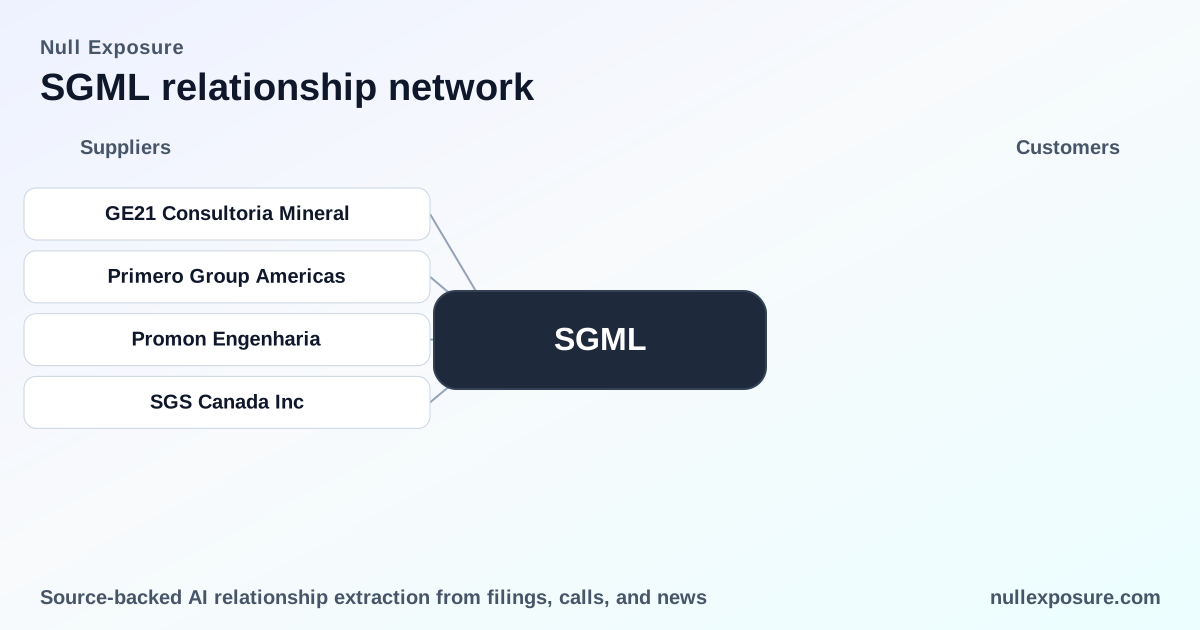
The company’s corrected release on March 10, 2026 points investors to Sigma’s amended and restated NI 43‑101 technical report (issued March 19, 2024) and lists four outside contributors. Each relationship is summarized below with its cited source.
- GE21 Consultoria Mineral — Porfirio Cabaleiro Rodriguez of GE21 is listed as a contributor to the updated NI 43‑101 technical report, providing independent mineral consulting credentials that support Sigma’s resource statements. A Newsfile correction release on March 10, 2026 cites the report authorship.
- Primero Group Americas — Jarrett Quinn, P.Eng., of Primero Group Americas is credited on the same technical report, indicating Primero’s role in engineering review or mine design input for Grota do Cirilo. The March 10, 2026 Newsfile correction references this authorship.
- Promon Engenharia — Homero Delboni Jr., MAusIMM, is named from Promon Engenharia among the report preparers, signaling Promon’s participation in geological or technical evaluations underpinning the project filing. This attribution appears in the March 10, 2026 Newsfile correction.
- SGS Canada Inc — Marc‑Antoine Laporte, P.Geo., of SGS Canada is included in the list of report authors, suggesting SGS’s role in resource validation or assay oversight that underpins reported grades. The March 10, 2026 Newsfile correction cites this inclusion.
Each of these relationships is documented in the company’s corrected public release that references the amended NI 43‑101 technical report; investors should treat those engagements as professional services contracts directly tied to project validation and external assurance.
Operational characteristics implied by these supplier links
Sigma’s supplier mix indicates several company‑level characteristics investors should weigh:
-
Contracting posture: Sigma operates with a vendor‑centric model for technical validation, commissioning established engineering, geological, and laboratory firms rather than expanding internal teams. This is efficient for capital and talent deployment but creates timing and vendor risk when external firms control critical deliverables.
-
Concentration: The reported roster spreads work across multiple firms (Promon, Primero, SGS, GE21), which reduces single‑vendor concentration for technical inputs but concentrates critical dependency in specialist professional services overall.
-
Criticality: These suppliers deliver outputs that are mission‑critical—NI 43‑101 compliance, resource estimation, testwork validation, and engineering inputs. Delays or disputes with any of these providers can directly affect permitting, financing, and off‑take negotiations.
-
Maturity: The counterparties are established names in mining consulting and assay services, implying mature methodologies and defensible outputs that strengthen Sigma’s technical credibility to lenders and partners.
No supplier constraints were reported in the provided data; that absence is itself a company‑level signal—no disclosed contractual restrictions, supply interruptions, or dependency clauses were present in the extracted records. Investors should interpret the lack of reported constraints as neutral rather than as proof of absence of operational risk, and should request contract terms or service‑level disclosures during diligence.
Key investor risk factors tied to these suppliers
- Dependence on third‑party technical authors means project timelines track external deliverable schedules.
- Critical validation is outsourced: any reputational or quality issues at SGS, Promon, Primero, or GE21 would transmit directly to Sigma’s project bankability.
- The public record shows professional engagement but not contract length, scope, or indemnities—gap in transparency that requires direct inquiry.
For quick diligence priorities:
- Confirm contractual timelines, penalty clauses, and data rights with each consultant.
- Request assay chain‑of‑custody and lab turnaround history from SGS.
- Verify engineering deliverable milestones with Primero and Promon.
Practical investment takeaways and next steps
Sigma’s use of established technical suppliers is a strength for credibility and financing, but it introduces concentrated execution risk around external deliverables. For investors underwriting project timelines or financing, the central question is not whether Sigma uses reputable consultants—that is confirmed—but whether contract terms, deliverable milestones, and contingency plans are adequate.
- Perform targeted supplier diligence: obtain copies or redacted summaries of consultancy contracts, scope, and milestone payments.
- Quantify timeline sensitivity: model scenarios where one technical deliverable slips and assess financing and permitting impacts.
- Track public updates tied to these firms’ outputs (e.g., amended NI 43‑101 releases, assay reports).
If you want an organized supplier risk report and relationship map for SGML, start here: https://nullexposure.com/.
Conclusion — how to position on the supplier signal
Sigma has assembled a recognizable roster of technical providers that increases the credibility of its resource and engineering disclosures. That is a positive for financing and offtake discussions. However, the business model’s reliance on external technical validation creates clear execution leverage in favor of the consultants. Investors should require contractual transparency and contingency planning before assuming schedule or cost certainty.
For a practical playbook to convert these supplier signals into an actionable risk score and engagement checklist, visit https://nullexposure.com/ and request the SGML supplier analysis package.