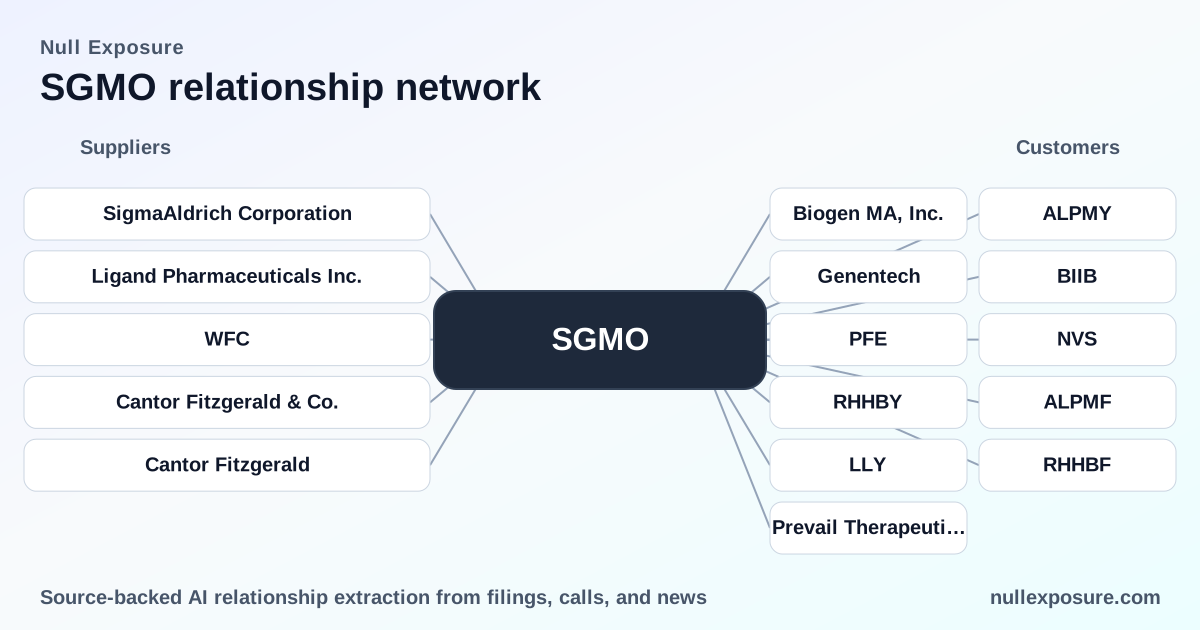
Sangamo Therapeutics (SGMO) — supplier relationships and what they mean for investors
Sangamo Therapeutics is a clinical-stage genomics company that monetizes its platform through collaborative agreements, licensing and milestone/reimbursement flows, while relying on capital markets for liquidity as its pipeline advances through trials. Revenue is currently dominated by collaboration and reimbursement receipts rather than product sales, and the company supplements cash via equity offerings and underwritten financings. For investors and operators evaluating supplier exposure, the key signals are collection concentration on collaboration counterparties, modest short-term manufacturing commitments, and active use of financial intermediaries to shore up liquidity. Read more or engage our monitoring at https://nullexposure.com/ for supplier risk dashboards and counterparty mapping.
How Sangamo structures supplier and counterparty relationships in practice
Sangamo’s operating model is collaboration- and capital-intensive. The 2024 Form 10‑K shows accounts receivable tied explicitly to collaboration agreements and cost reimbursements, making collections and counterparty credit operationally important. Supplier commitments disclosed in the filing show non-cancelable manufacturing-related commitments of $2.9 million that expire in December 2025, which places these contracts in the short-term / near-term bucket and limits long-duration supplier risk. The company also discloses the use of third‑party service providers for cybersecurity and related professional services, which reflects a steady reliance on external vendors for critical operational functions.
- Contracting posture: Short-term manufacturing commitments with non-cancelable obligations through Dec 2025 indicate a tactical, near-term procurement stance rather than long-term lock-ins.
- Concentration and criticality: Accounts receivable concentration around collaboration counterparties increases reliance on external partners for cash flow; this elevates counterparty credit as an operational risk.
- Maturity and spend scale: The disclosed non-cancelable commitment of $2.9M places supplier spend in the $1M–$10M band, a material but manageable level relative to biopharma outsourcing norms.
- Service providers: Use of third‑party cybersecurity and professional service firms signals dependence on vendors for risk management and compliance functions.
Counterparty roll call — each relationship from the record, explained
SigmaAldrich Corporation
Sangamo lists SigmaAldrich under accounts receivable from collaboration agreements and cost reimbursements for FY2023–FY2024, indicating SigmaAldrich is a counterparty that generated receivable balances for Sangamo during those periods. This relationship is documented in SGMO’s FY2024 Form 10‑K filing.
Source: SGMO 2024 Form 10‑K (Accounts receivable from collaboration agreements; FY2024).
Ligand Pharmaceuticals Inc.
Ligand is recorded similarly in the FY2024 10‑K as a counterparty tied to accounts receivable from collaboration agreements and cost reimbursements for the 2024 fiscal year, signaling a reimbursement or collaboration collection relationship during FY2024.
Source: SGMO 2024 Form 10‑K (FY2024).
Wells Fargo Securities, LLC
Wells Fargo Securities acted as a joint book‑running manager on Sangamo’s underwritten offering priced in early February 2026, participating in the equity and warrant sale expected to raise roughly $25 million—an execution that provided immediate liquidity to Sangamo.
Source: GlobeNewswire press release (Sangamo Therapeutics announces pricing of underwritten offering), Feb 3, 2026; media coverage via QuiverQuant and ManilaTimes (Feb 2026).
Cantor Fitzgerald & Co. / Cantor Fitzgerald
Cantor Fitzgerald is listed alongside Wells Fargo as a joint book‑running manager on the same underwritten offering, taking a lead role in distribution and underwriting for the February 2026 financing that targeted approximately $25 million in proceeds.
Source: GlobeNewswire press release (Sangamo Therapeutics announces pricing of underwritten offering), Feb 3, 2026; TradingView/QuiverQuant coverage (Feb 2026).
Duplicate naming entries (Wells Fargo Securities; Cantor Fitzgerald)
Multiple news feeds and outlets repeated the same underwriting relationship across GlobeNewswire, TradingView, QuiverQuant and ManilaTimes in early 2026; the commercial reality is a single underwriting syndicate led by Cantor Fitzgerald and Wells Fargo Securities that executed the offering.
Source: GlobeNewswire press release and syndicated coverage across TradingView, QuiverQuant and ManilaTimes (Feb 2026).
What these relationships mean for valuation and operational risk
- Revenue quality and cash flow: The concentration of accounts receivable with collaboration counterparties such as SigmaAldrich and Ligand indicates that near‑term revenue and working capital are tied to partner reimbursements rather than recurring product sales, increasing sensitivity to collection timing and partner performance.
- Supplier spend posture: The disclosed $2.9M non‑cancelable manufacturing commitment (expiring Dec 2025) signals modest committed spend that is material at the company level but does not lock Sangamo into long-term manufacturing exposure. This supports operational flexibility while creating a predictable short-term cash outflow.
- Capital markets behavior: The February 2026 underwritten offering led by Cantor Fitzgerald and Wells Fargo injected fresh capital and illustrates active use of equity markets to fund operations; underwriting relationships are therefore critical for liquidity management and investor access to future raises.
- Third‑party risk management: Company disclosures around engaging third‑party cybersecurity and professional service firms indicate outsourced functions for critical compliance and security, requiring rigorous vendor controls and oversight from operators.
Read more about managing counterparty concentration and supplier commitments at https://nullexposure.com/.
Practical steps for investors and operators
- For investors: prioritize monitoring of accounts receivable aging with key collaborators, and track announcements from underwriting partners for signs of follow‑on capital access.
- For operators: maintain tight controls on vendor contracts that are in the $1M–$10M band, and formalize cyber/vendor oversight processes given the disclosed reliance on external cybersecurity service providers.
- For credit and procurement teams: ensure visibility into short-term manufacturing commitments and evaluate contingency plans ahead of the Dec 2025 expiration window.
Explore supplier exposure dashboards and counterparty scoring at https://nullexposure.com/ to convert these signals into operational actions.
Bottom line
Sangamo’s supplier footprint is moderate in scale, short in duration, and concentrated around collaboration reimbursements and a small set of financial intermediaries. The company’s near-term risks are concentrated in collection timing from collaborators and the cadence of equity raises executed through established underwriters. For investors and operators, the priority is tracking receivable flows, managing vendor contracts that peak into late 2025, and maintaining relationships with underwriting banks that enable liquidity execution. For continuous surveillance and deeper mapping of these counterparty links, visit https://nullexposure.com/.