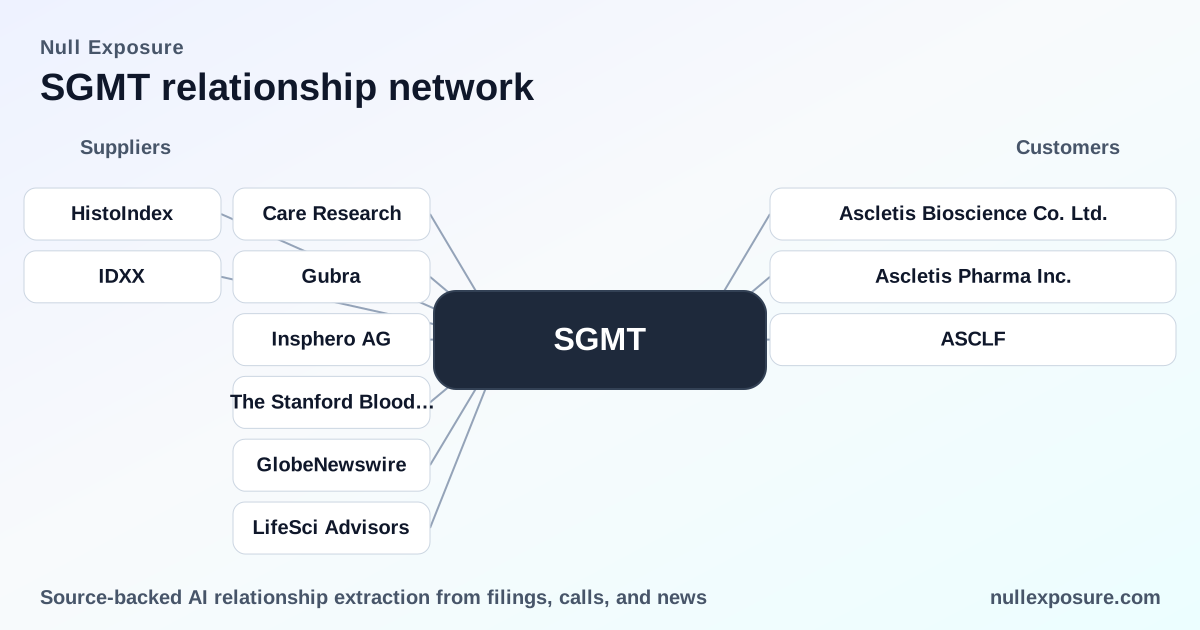
Sagimet Biosciences (SGMT): What its public supplier signals tell investors
Sagimet Biosciences develops and advances denifanstat and other metabolic-disease therapeutics through outsourced preclinical and clinical work; the company monetizes by advancing clinical-stage assets toward regulatory value inflection points and licensing or partnering opportunities, while funding operations through equity raises and investor outreach. For investors evaluating counterparty risk and operational execution, the supplier signals in the public record show a conventional biotech outsourcing model: multiple CROs, CMOs across North America and APAC, specialized assay providers, and PR/IR firms supporting investor communications.
Explore a mapped view of these relationships and implications at https://nullexposure.com/.
Why the supplier map matters to active investors
Sagimet’s business model is R&D-intensive and capital-dependent. The company routinely relies on third parties to execute animal studies, in vitro assays, histology workflows, and clinical trial services. That posture creates four practical operating characteristics investors need to weigh:
- Contracting posture: Sagimet is a third-party intensive operator, contracting CMOs and CROs for manufacturing and trials rather than owning large internal manufacturing capacity. Contract terms can include upfront prepaid fees, investigator grants and pass-through costs.
- Geographic footprint and concentration: Public excerpts identify suppliers and manufacturing activity spanning the United States and China, indicating a bi-regional supply footprint that exposes the company to both NA and APAC operational risks.
- Criticality and maturity: Suppliers perform mission-critical functions (manufacturing, GLP/GMP work, histology and specialized imaging). The relationships are active and operationally critical to trial timelines and product supply.
- Commercial and financing posture: Sagimet supplements R&D funding through equity markets, including an at‑the‑market facility, meaning supplier continuity is tied to capital availability and the firm’s ability to execute on financing plans.
If you want a full supplier-risk index customized to your model portfolio, see https://nullexposure.com/.
Publicly visible supplier and partner mentions — what they show
Below are every named relationship that appears in the provided public results, each described in plain English with the original source noted.
-
Care Research — Sagimet used Care Research (Fort Collins, CO) as a contract research organization for a preventative NASH diet‑induced mouse model in preclinical work, reflecting use of external in‑vivo CRO capacity. (Scientific Reports, 2022: https://www.nature.com/articles/s41598-022-19459-z)
-
Gubra — The company engaged Gubra (Denmark) to conduct a therapeutic NASH diet‑induced model in mice, demonstrating reliance on international CROs for translational efficacy studies. (Scientific Reports, 2022: https://www.nature.com/articles/s41598-022-19459-z)
-
Insphero AG (InSphero) — Sagimet referenced InSphero for work on an LMT (likely microscale liver microtissue) model, signaling use of specialized in‑vitro model providers for mechanism and toxicity assessment. (Scientific Reports, 2022: https://www.nature.com/articles/s41598-022-19459-z)
-
The Stanford Blood Center — Healthy human donor blood was procured from The Stanford Blood Center for ex vivo experiments, indicating Sagimet sources clinical‑grade biological materials from established academic or hospital‑affiliated suppliers. (Scientific Reports, 2022: https://www.nature.com/articles/s41598-022-19459-z)
-
HistoIndex — HistoIndex personnel are thanked for second‑harmonic generation (SHG) analysis, reflecting engagement of image‑analysis and fibrosis quantification specialists for histology endpoints. (Scientific Reports, 2022: https://www.nature.com/articles/s41598-022-19459-z)
-
IDEXX BioResearch — Liver sample processing and histology were performed at IDEXX BioResearch (Sacramento), confirming use of commercial pathology/histology service providers for GLP‑adjacent assays. (Scientific Reports, 2022: https://www.nature.com/articles/s41598-022-19459-z)
-
GlobeNewswire (press distribution) — Sagimet’s participation in the Evercore ISI Healthcare Conference was announced via a press release distributed by GlobeNewswire in 2025; this is an IR/communications channel used to reach investors and analysts. (QuiverQuant report of GlobeNewswire release, FY2025: https://www.quiverquant.com/news/Sagimet+Biosciences+Inc.+to+Participate+in+8th+Annual+Evercore+ISI+Healthcare+Conference+on+December+2%2C+2025)
-
LifeSci Advisors — LifeSci Advisors is listed as an investor contact in the company’s conference release, indicating Sagimet retains an external investor relations firm to manage market communications and outreach. (QuiverQuant report referencing the GlobeNewswire release, FY2025: https://www.quiverquant.com/news/Sagimet+Biosciences+Inc.+to+Participate+in+8th+Annual+Evercore+ISI+Healthcare+Conference+on+December+2%2C+2025)
Operational risk implications and supplier maturity
The publicly visible relationships point to a standardized, third‑party centric operating model for a small clinical‑stage biotech:
- Diversified specialist suppliers: Preclinical CROs (Care Research, Gubra), in‑vitro vendors (Insphero), histology and image analysis firms (IDEXX, HistoIndex) and clinical material sources (Stanford Blood Center) show Sagimet uses domain specialists rather than generalist contractors.
- Cross‑region manufacturing footprint: Company disclosures indicate reliance on CMOs in both the United States and China for denifanstat drug substance and product, which creates operational dependence on transpacific supply chains and regulatory coordination between NA and APAC jurisdictions.
- Contract structure signals: The firm’s engagements include prepaid fees and pass‑through costs with CROs, and an active at‑the‑market equity facility used to fund operations—these are cash‑flow sensitive contractual relationships where supplier continuity ties to financing execution.
These constraints collectively signal an active sourcing posture with moderate supplier concentration in critical functional areas, and an operational maturity consistent with a clinical‑stage biotech that outsources noncore capabilities.
If you want deeper counterparty diligence or a supplier concentration scorecard for SGMT, start here: https://nullexposure.com/.
Investment takeaways and risk checklist
- Operational execution depends on third parties for preclinical models, histology, and manufacturing; monitor contract renewal timing and prepaid fee liabilities.
- Dual‑region manufacturing (US and China) increases geopolitical and logistics risk; assess the company’s contingency planning for API and finished product supply.
- Investor communications are outsourced, indicating the company actively manages market expectations through external IR firms and conference participation—watch these channels for near‑term guidance and capital‑raising signals.
Sagimet’s public supplier map is consistent with a small biotech scaling through external experts rather than building internal manufacturing or extensive in‑house trial teams. For portfolio managers and operators, the priority is monitoring supplier continuity, financing cadence and any signs of supplier concentration affecting trial timelines.
If you would like to convert these public signals into an actionable supplier risk report tailored to your investment horizon, visit https://nullexposure.com/ for a customized analysis.