SGRP: Supplier Network and Strategic Constraints — What Investors Should Know
SPAR Group (SGRP) operates as a global provider of marketing and merchandising services, monetizing through client service contracts, field labor deployment, and technology-enabled merchandising (the SPARview platform and related integrations). The company generates revenue by selling labor and execution services to retailers and by licensing and integrating software functionality that enhances in-store execution and shelf visibility. For investor-grade supplier mapping and relationship analytics visit https://nullexposure.com/.
Quick read: what the relationship map reveals about SPAR Group
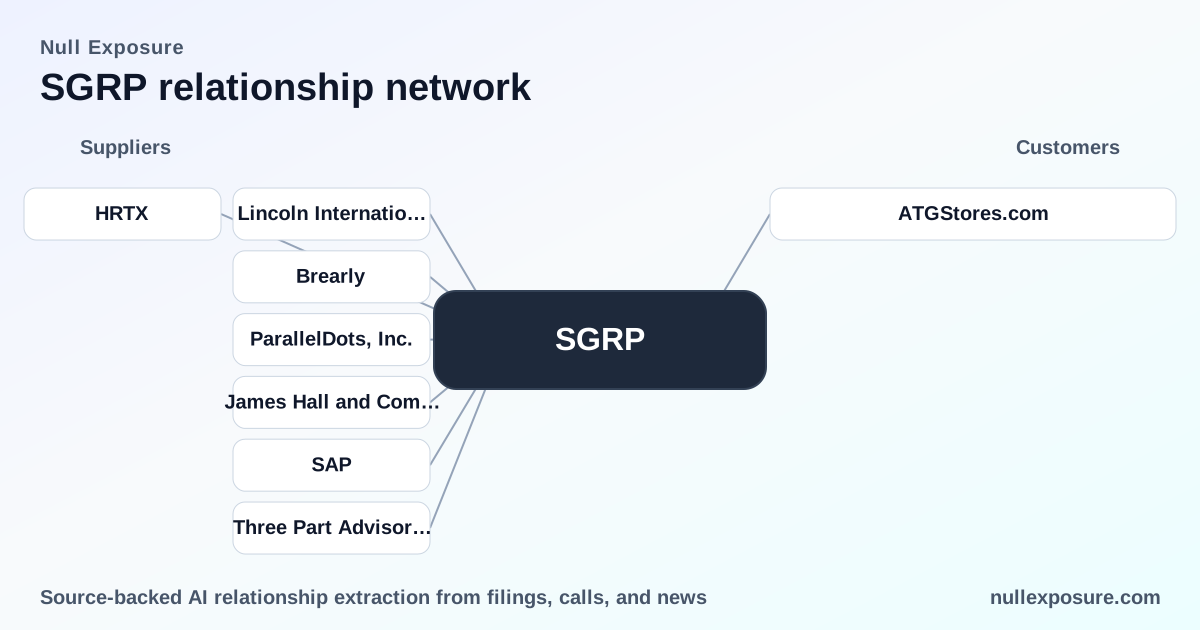
SPAR Group’s public relationships show a dual operating model: labor-intensive service delivery outsourced to third parties and strategic technology and advisory tie-ins that influence both growth options and near-term operational risk. Recent disclosures and news coverage highlight active strategic review processes, tech integrations to extend SPARview, and third-party operational shocks in the UK that translate to real-world store disruptions. These are the practical inputs investors should use when assessing vendor concentration, execution risk, and strategic optionality.
Partner-by-partner readout
Lincoln International LLC
SPAR Group retained Lincoln International as financial adviser to assist in a strategic review, signaling management is evaluating material corporate options such as capital structure changes or a sale. According to a PR Newswire release dated March 10, 2026, Lincoln International is advising SPAR on that process (PR Newswire, March 2026).
ParallelDots, Inc.
SPAR announced a global partnership to integrate ParallelDots’ ShelfWatch technology into the SPARview platform, expanding its technology suite and offering clients enhanced shelf-monitoring capabilities. The integration was announced in a PR Newswire release describing the partnership and product integration (PR Newswire, March 2026).
James Hall and Company
A ransomware event at James Hall and Company forced card-machine outages across roughly 600 stores and caused store closures, underlining third-party cyber and operational contagion risk for SPAR’s UK operations. TechMonitor reported the incident and named James Hall as a wholesale and IT services provider to SPAR (TechMonitor, March 2026).
Brearly
Brearly is listed alongside James Hall and other wholesale providers as a partner to SPAR in the UK and Isle of Man; that grouping was cited by the threat actor during a cyberattack, pointing to a networked supplier footprint in the region. TechMonitor’s coverage included Brearly in the list of wholesale partners connected to the incident (TechMonitor, March 2026).
Heron (HRTX)
Heron is named as another wholesale partner in the UK/Isle of Man portfolio linked to the same operational disruption narrative, which underscores the interconnected nature of SPAR’s regional supply and services relationships. TechMonitor’s article included Heron among the partners referenced by the attacker (TechMonitor, March 2026).
SAP
Legal complaints and supply-disruption claims arose after an SAP enterprise resource planning rollout at a KwaZulu‑Natal distribution center, raising execution and implementation risk tied to large ERP projects. Zawya reported litigation from a franchisee alleging supply disruptions after the botched SAP rollout (Zawya, FY2026 reporting).
Three Part Advisors, LLC
Three Part Advisors is listed as an investor-relations contact in SPAR’s strategic-review announcement, indicating the company engaged external IR resources concurrent with its strategic review. This appears in the same PR Newswire disclosure regarding strategic alternatives (PR Newswire, March 2026).
What the constraints tell investors about SPAR Group’s operating model
The content-extracted constraints present company-level signals that shape risk and opportunity assessment:
- SPAR relies heavily on an outsourced field workforce: filings indicate a labor force of approximately 3,425, with roughly 2,446 field specialists provided by an independent vendor. This is a structural operating choice that reduces fixed headcount but increases third-party dependency (company filings, as of Dec 31, 2024).
- The relationship-role signals show SPAR is both a buyer of services and a service provider — it purchases labor and vendor services while selling merchandising and technology services to retailer clients. The buyer role has high confidence (0.90) and the service-provider role also registers strongly (0.80), underlining a dual-sided contracting posture.
- The counterparty-type signal includes individual providers (confidence 0.60), reflecting that a meaningful portion of the workforce model is delivered by independent field specialists rather than large in-house teams.
These constraints produce an operating profile where outsourcing reduces capital intensity but concentrates operational risk in third parties, and where technology integrations and strategic-advisory engagements materially influence corporate direction.
For a broader supplier-risk assessment and practitioner tools, visit https://nullexposure.com/.
Risk and opportunity framing — what matters now
- Cyber and operational risk is elevated where SPAR’s retail execution depends on third-party wholesale and IT providers; the James Hall/Brearly/Heron incident is a clear example of consequential contagion. That incident shows real revenue and reputational exposure when suppliers fail.
- Technology partnerships are value drivers but also sources of implementation risk. ParallelDots integration expands product capability and upsell potential for SPARview, while the SAP rollout litigation demonstrates the downside of large IT transformations.
- Strategic review activity is a catalyst. Retaining Lincoln International and engaging IR advisors (Three Part Advisors) indicate the company is evaluating substantial corporate options that could reprice equity or change capital structure in the near term.
Key takeaway: investors should balance the upside from technology-enabled differentiation with concentrated third-party execution risks that can produce immediate top-line and cash-flow impact.
Practical next steps for investors and operators
- For portfolio managers: review exposure assumptions tied to third-party operational continuity and model potential short-term revenue loss scenarios from wholesale-provider outages.
- For operational teams: prioritize supplier continuity plans and cyber controls for wholesale/IT vendors in the UK and other high-risk jurisdictions.
- For decision-makers monitoring corporate action: track filings and announcements from Lincoln International and Three Part Advisors for timing and scope of strategic alternatives.
If you want granular relationship maps and ongoing alerts for SGRP supplier events, start here: https://nullexposure.com/.
Closing perspective
SPAR Group is a low-capital, service-oriented operator that monetizes through physical labor deployment and technology integrations. The firm’s value hinges on execution reliability across a distributed supplier base and on successful monetization of SPARview enhancements. Investors should treat ongoing strategic-review signals and recent third-party disruptions as actionable inputs to valuation and risk-management frameworks. For hands-on supplier risk intelligence and continuous monitoring, visit https://nullexposure.com/.