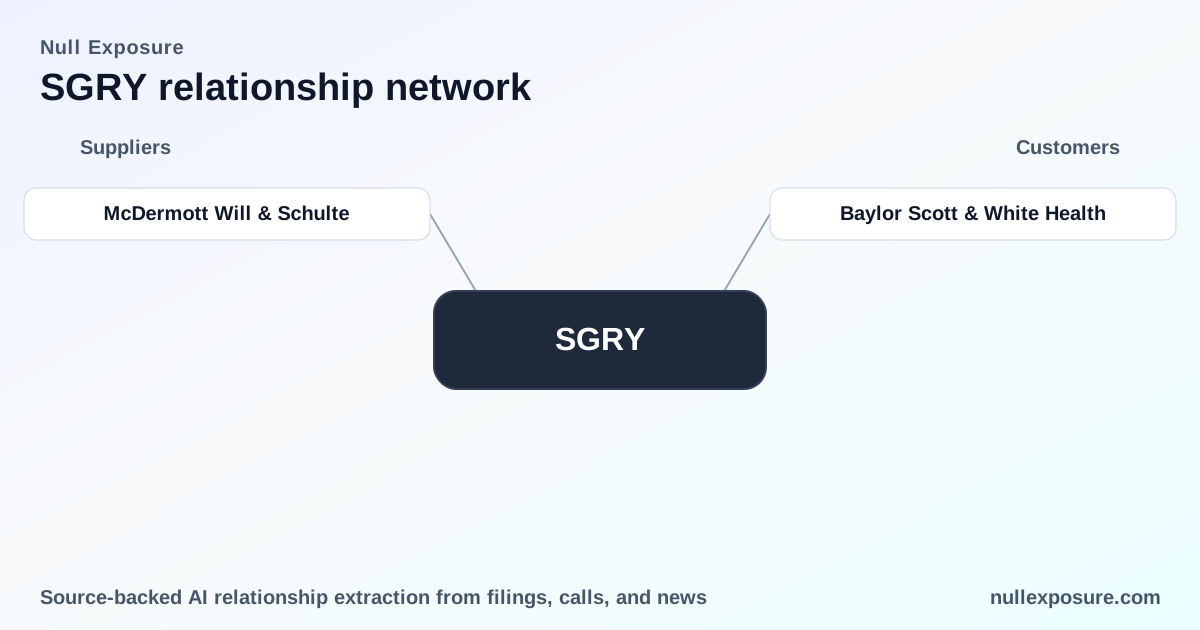
Surgery Partners (SGRY): Legal Counsel, M&A Activity, and What It Means for Supplier Risk
Surgery Partners operates a national network of surgical facilities and ancillary services and generates revenue through facility fees, professional services, and ancillary lines tied to procedural volume. The company grows both organically and through acquisitions that fold independent physician practices and specialty centers into its platform, while profitability is driven by scale in facility operations and ancillary services. For investors assessing supplier relationships, the most visible supplier-level activity in recent filings and press coverage is legal counsel around M&A — a transactional but strategically important supplier function that supports the company’s consolidation-led growth model. Learn more about supplier exposures and signals at https://nullexposure.com/.
Business model essentials: how economics and suppliers fit together
Surgery Partners is an asset-operating healthcare platform: it owns and runs ambulatory surgical centers and related services rather than simply franchising a brand. That operating posture produces predictable revenue when procedural volumes are stable and gives the company negotiating leverage with payors and physician partners through consolidated scale. Key financial signals:
- Revenue TTM $3.31B; EBITDA $655.5M, indicating meaningful operating cash flow potential that funds capital expenditure and M&A.
- EV/EBITDA 9.53 and Price/Book 0.94, which position the company in a mid‑cycle valuation band for healthcare facilities consolidation plays.
- Negative diluted EPS (-$0.61) but positive operating margin (15.1% operating margin TTM) shows cash profitability at the operating level even as shares absorb non‑cash or financing impacts.
From a supplier-risk perspective, Surgery Partners’ model produces two profile characteristics: transactional critical suppliers for M&A and capital work (legal counsel, advisors, lenders) and operational suppliers for facility operations (medical supplies, staffing, payor contracts). The current relationship data flags M&A legal counsel activity, consistent with a company that actively uses external specialist suppliers to execute acquisitions and integration.
Legal counsel and M&A: McDermott Will & Schulte
McDermott Will & Schulte served as legal counsel to Surgery Partners in connection with the acquisition of Preferred Vascular Group, reflecting an active M&A program that uses large law firms to close transactions. According to Finviz coverage dated March 10, 2026, McDermott Will & Schulte is listed as legal counsel for Surgery Partners in the transaction (Finviz, March 10, 2026: https://finviz.com/news/330011/ziegler-advises-preferred-vascular-group-on-its-acquisition-by-surgery-partners).
A PR Newswire release from the same date confirms the role: PR Newswire reported that McDermott Will & Schulte served as legal counsel for Surgery Partners on the Preferred Vascular Group acquisition in FY2026 (PR Newswire, March 10, 2026: https://www.prnewswire.com/news-releases/ziegler-advises-preferred-vascular-group-on-its-acquisition-by-surgery-partners-302704318.html).
What the relationships tell investors about supplier concentration and criticality
- Low supplier concentration signal in this feed: the visible supplier relationships are limited to legal counsel tied to M&A activity; no operational vendors or exclusive supplier agreements are flagged. The absence of additional supplier constraints in the records is a company-level signal that the monitored feed captured transactional external advisors rather than long‑term exclusive suppliers.
- Strategic but non-recurring criticality: law firms engaged for acquisitions are critical at the moment of transaction execution but are inherently transactional suppliers rather than ongoing operational dependencies. That pattern reduces persistent counterparty concentration risk but increases short-term execution risk around deal closings.
- Maturity of supplier relationships: the relationship with large law firms indicates Surgery Partners uses established, market-standard advisers for complex transactions, consistent with a mature acquirer that outsources legal specialization rather than building large in-house deal teams.
Explore broader supplier relationships and historical signals at https://nullexposure.com/ — the M&A advisor footprint is a leading indicator of consolidation cadence.
Operational implications and investor takeaways
- Acquisition cadence drives supplier spend and one-time legal costs. Expect spikes in external legal and advisory expense in quarters with closed transactions; these are manageable but material to near-term profitability metrics.
- No reported supplier constraints in the provided records. The dataset does not flag exclusive sourcing agreements, supply chain bottlenecks, or long-term vendor constraints; this is a positive company-level signal for operational flexibility.
- Risk profile is execution-focused. The primary supplier risk highlighted here is the ability to integrate acquired assets and control transaction costs; this is different from supply-chain scarcity or single-vendor dependence.
On valuation and positioning, Surgery Partners trades with a moderate EV/EBITDA multiple (9.53) and a forward P/E of ~20.9, while analysts’ consensus target sits near $19.34, supporting a thesis that market participants price in steady-state operational cash flow plus acquisition upside.
Actionable guidance for investors and operators
- For investors: prioritize monitoring the company’s M&A calendar and quarterly advisor expense lines as short-term predictors of margin variability; legal counsel engagements are reliable indicators that integration and acquisition costs will influence near-term earnings.
- For operators and partners: focus on the operational suppliers that underwrite day-to-day facility performance (clinical staffing, medical supplies, payor contracting), even though they are not flagged in this particular feed; those relationships determine sustainable margin, while legal counsel enables growth through consolidation.
Final thought: the supplier signal in the current feed is concentrated on transactional legal support for M&A, not on ongoing operational suppliers, which positions supplier risk as execution- and integration-oriented rather than supply-chain constrained. For a deeper read on supplier-level exposure across the competitive set and historical M&A advisor footprints, visit https://nullexposure.com/.
For tailored briefings or to map this supplier network to your portfolio holdings, go to https://nullexposure.com/ and request a supplier risk overview.