Star Group (SGU): Supply relationships and what the Cato deal means for investors and operators
Star Group LP operates a vertically distributed home heating and HVAC business, selling fuel (heating oil, propane, diesel, gasoline) and service/equipment to residential and commercial customers, and monetizes through retail fuel margins, recurring service revenue, and equipment sales. The capital structure and valuation reflect a low multiple on solid cash flow: TTM revenue of $1.78 billion and EBITDA of $136.2 million, a market capitalization near $398 million, EV/EBITDA ~4.7 and a trailing P/E of 7.0, while the company supports a meaningful cash return with a ~6.0% dividend yield (latest company figures through the quarter ended 2025-06-30). These fundamentals position Star Group as a cash-flow-driven operator that uses short-dated commodity purchases and targeted M&A to grow footprint and supply scale.
Explore more supplier-risk and counterparty intelligence at https://nullexposure.com/.
How Star Group runs procurement: short-term, market-priced buying is the baseline
Star Group’s procurement footprint is structured around short-term supply contracts (typically 6–12 months) and market-priced product supply agreements that cover large volumetric requirements. Company commentary and filings describe contracts for approximately 179 million gallons of home heating oil and propane and 56 million gallons of diesel and gasoline, volumes the company plans to utilize over the next twelve months. These are explicit company-level signals about procurement posture: Star Group is a buyer in market-priced arrangements focused on flexible supply coverage rather than long-term fixed-price commitments.
That operating choice creates a distinct trade-off for suppliers and investors: flexibility and scale for the operator versus exposure to commodity price swings and working-capital volatility for the business. Short-term contracts reduce vendor lock-in and permit rapid re-pricing, while increasing the importance of execution and hedging discipline.
What the contract mix implies for supply-side partners
- Contracting posture: Predominantly short-term, giving Star Group negotiating leverage during tightening supply but less certainty for suppliers seeking long tenors.
- Concentration and criticality: Fuel supply is operationally critical—disruption has immediate revenue and customer-retention impacts—so suppliers that can reliably deliver on seasonality are strategically valuable.
- Maturity of procurement: The focus on 6–12 month tenor signals an operational model that values market responsiveness over long-term off-take guarantees; that is a company-level signal, not tied to any single announced deal.
Recent announced relationship: Cato's home-heat division sold to Star Group
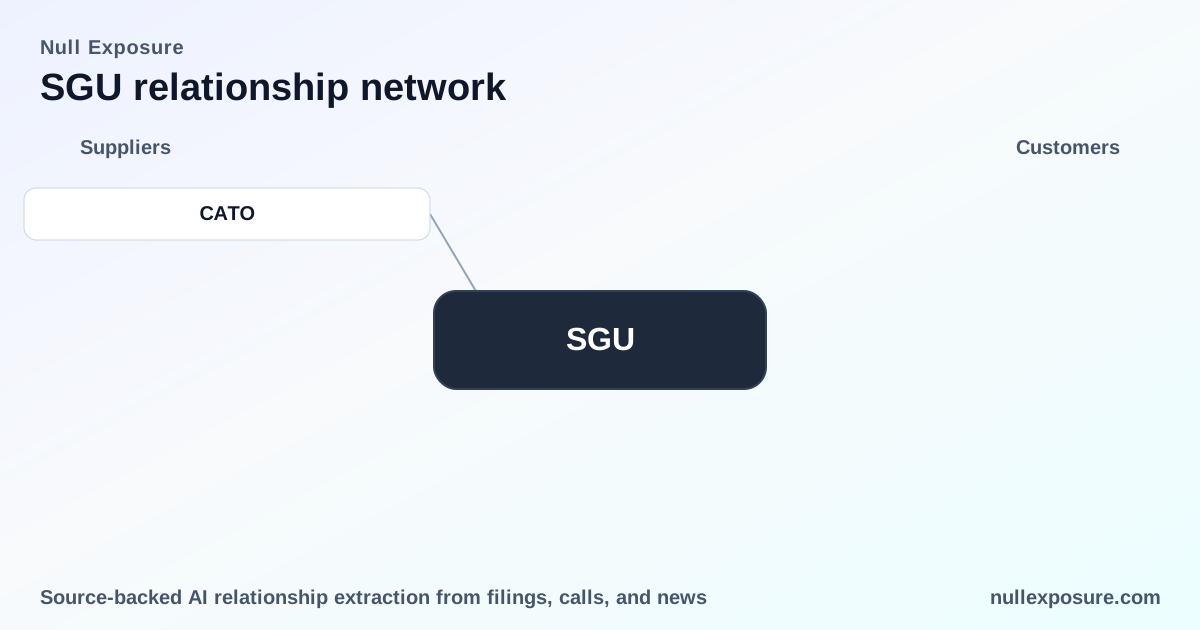
A fuelsmarketnews report (March 10, 2026) confirmed that the home heat and commercial fuels division of Cato was sold to an affiliate of Star Group. This transaction expands Star Group’s local footprint and adds incremental customer volume and fuel needs in the acquired territories, increasing procurement scale and near-term demand for supply contracts. (Source: fuelsmarketnews, March 2026 — https://fuelsmarketnews.com/catos-home-heat-and-commercial-fuels-division-to-star-group/)
Implication for suppliers: The Cato acquisition is an immediate volume and integration event; suppliers and logistics partners will face a short window to align delivery schedules, pricing structures, and credit terms to support combined operations.
How the Cato acquisition changes counterparty dynamics
The addition of Cato’s fuel and commercial-account volumes amplifies Star Group’s short-term purchasing profile and increases the absolute gallons covered under market-priced contracts. For suppliers this means larger but still short-dated commitments, increasing the economic scale of each tender but preserving the cadence of annual renegotiation. For investors, the acquisition is a lever to improve utilization and margin capture if Star Group executes integration effectively; for operators it raises the bar on logistics and working capital management in the next 12 months.
Every public relationship disclosed in the supplier feed
- Cato: The home heat and commercial fuels division of Cato was sold to an affiliate of Star Group, transferring customers and fuel volume obligations to Star Group’s platform. (Source: fuelsmarketnews, March 10, 2026 — https://fuelsmarketnews.com/catos-home-heat-and-commercial-fuels-division-to-star-group/)
This is the single relationship flagged in the supplier intelligence feed; that transaction directly increases Star Group’s supplier demand and operational complexity.
Key takeaways for investors and operators
- Star Group runs a short-term, market-priced procurement model covering large volumes (~179M gallons heating oil/propane; 56M gallons diesel/gasoline) over rolling 6–12 month horizons, which creates high cash-flow sensitivity to commodity prices but preserves flexibility to re-price supplier relationships annually.
- The Cato acquisition is incremental scale: it increases top-line coverage and supply obligations while keeping the same short-term contracting approach—this amplifies the importance of execution in procurement, logistics, and working capital management.
- Valuation reflects cash generation and modest multiple: low EV/EBITDA and P/E imply the market prices the stock as a cash-oriented utility with exposure to fuel cycles; operational execution and integration of acquired volumes will determine whether multiple expansion is achievable.
- Supplier strategy should prioritize reliability and agile commercial terms: suppliers that can offer seasonal coverage, competitive short-tenor pricing, and flexible logistics will be preferred counter-parties.
For deeper counterparty dashboards and continuity planning guidance tailored to energy suppliers and operators, visit https://nullexposure.com/.
Operational risks and what to monitor next
- Monitor commodity price volatility and hedging disclosures: when supply contracts are short and market-priced, margin volatility is direct and immediate.
- Track working capital and inventory financing around winter seasonality and integration periods; M&A driven volume spikes can pressure liquidity.
- Watch integration KPIs after the Cato transaction: customer retention, route rationalization, and realized synergies will define whether the deal enhances margin or simply increases scale with pro rata costs.
- Observe any move toward longer-dated supply contracts or formal hedging programs; those would signal a strategic shift away from the current short-term procurement posture.
Bottom line
Star Group’s model is scale-dependent and procurement-sensitive: acquisitions such as the Cato deal deliver volume and potential margin upside if Star Group translates scale into improved logistics and purchasing efficiency, but the company’s reliance on 6–12 month, market-priced supply contracts places a premium on execution and commodity risk management. For suppliers, the message is clear: offer reliability, seasonal capacity, and commercial flexibility to win business; for investors, focus on integration performance and hedging discipline to assess upside to the current valuation.
If you evaluate supplier relationships or counterparty exposure in energy and fuel distribution, start your analysis and contingency planning with the actionable intelligence at https://nullexposure.com/.