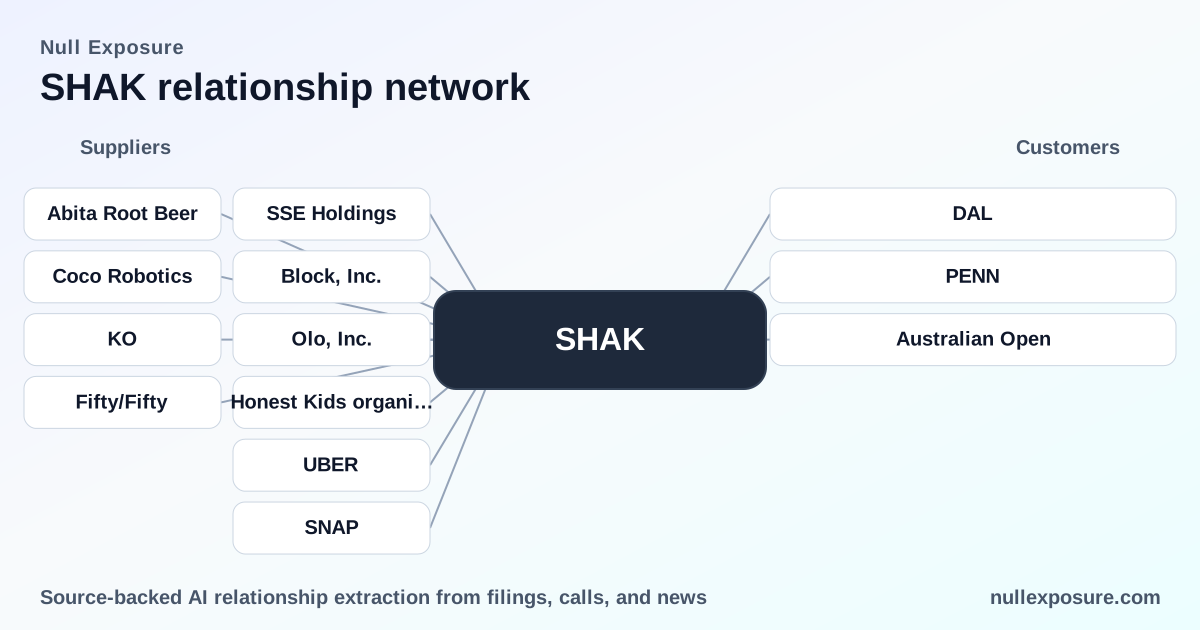
Shake Shack (SHAK) — Supplier Map, Concentration Risks, and Strategic Partners
Shake Shack operates and monetizes a vertically managed restaurant platform: the company owns, operates and licenses Shake Shack restaurants, sells food and beverage through company-operated Shacks and licensing arrangements, and layers digital ordering and off-site sales through third‑party technology and delivery partners. Revenue comes from food and beverage sales, licensing fees, and incremental services (kiosk/mobile ordering, events, delivery) that are supported by a highly centralized supply chain and long‑lived real‑estate footprint. For more structured supplier intelligence and ongoing monitoring, visit https://nullexposure.com/ to see how these relationships evolve.
Executive takeaways for investors
Shake Shack’s operating model combines high fixed commitments (long lease terms) with a critical, centralized distribution backbone and selective supplier concentration on core ingredients. That configuration drives both scale benefits and acute supply‑chain sensitivity:
- Centralized distribution is critical: roughly 95% of certain ingredients flow through a single U.S. “broadline” distributor, making that relationship operationally systemic. (Company 2024 Form 10‑K)
- Fixed occupancy cost intensity: real‑estate leases have initial terms of 10–15 years with renewal options, locking in long‑term occupancy commitments.
- Ingredient concentration is mixed: ground beef and a handful of other inputs have concentrated sourcing, while other categories use multiple approved suppliers.
- Digital and delivery partners increase customer reach but also introduce vendor and platform dependencies (POS, mobile ordering, robot and platform delivery pilots).
If you evaluate supplier counterparty risk or underwriting exposure for SHAK relationships, these are the structural constraints to prioritize. Learn more about supplier mapping and risk scoring at https://nullexposure.com/.
Supplier and partner relationships cited in filings and press
SSE Holdings
Shake Shack describes itself as a holding company whose principal asset is its interest in SSE Holdings and states that it will depend on distributions from SSE Holdings to pay taxes and certain expenses, including payments under a Tax Receivable Agreement; this is a corporate‑level funding dependency disclosed in the FY2024 Form 10‑K. (Shake Shack FY2024 10‑K)
Block, Inc.
Shake Shack uses certain point‑of‑sale applications, payment processing services, hardware and enterprise platform services in connection with kiosk technology and off‑site sales, and its former CEO serves on Block’s board—indicating both commercial and governance linkages with Block. (Shake Shack FY2024 10‑K)
Olo, Inc.
The company leverages Olo as a technology platform for its mobile ordering application, and a member of Shake Shack’s board also serves as a director of Olo, linking product use with board‑level interaction. (Shake Shack FY2024 10‑K)
Honest Kids organic apple juice
Menu disclosures in market coverage list Honest Kids as one of the branded beverage items offered at Shacks, underscoring brand partnerships in the retail beverage mix. (MarketScreener coverage referencing FY2025 menu mentions)
Uber Technologies, Inc.
Shake Shack expanded delivery experiments through a partnership involving Uber and robot operator Coco Robotics, demonstrating a multi‑partner approach to last‑mile innovation in Chicago. (Sahm Capital report on the November 2025 pilot)
Snap Inc.
Shake Shack was named among brand partners in Snap’s Arcadia AR launch, indicating marketing and experiential partnership activity that augments digital customer acquisition. (Snap Inc. press release, FY2021 launch)
Coco Robotics
Shake Shack introduced Coco Robotics’ sidewalk delivery robots at select locations in Chicago as part of its autonomous delivery pilot program, signaling willingness to test automated delivery modalities. (Sahm Capital report on the November 2025 pilot)
Coca‑Cola
Beverage supply references are straightforward—Shake Shack sells Coca‑Cola products as part of its beverage lineup, a standard branded beverage agreement that supports in‑store offerings. (Earnings call transcript coverage, Q4 2025)
Abita Root Beer
Abita Root Beer is listed among specialty beverages served at Shack locations, reinforcing Shake Shack’s use of regional beverage partners to supplement core refreshments. (MarketScreener menu mention, FY2025)
Fifty/Fifty
Fifty/Fifty beverage is included in Shake Shack’s beverage roster, another example of curated nonalcoholic beverage partnerships on the menu. (MarketScreener menu mention, FY2025)
Operational constraints and what they imply
Shake Shack’s disclosures present a consistent set of company‑level constraints that shape supplier risk and contractual posture:
- Long‑term real estate commitments: Leases with 10–15 year initial terms and renewal options create predictability in site economics but raise fixed cost exposure if revenue weakens.
- Centralized U.S. distribution: The company operates a centralized U.S. distribution model with a single “broadline” distributor delivering nearly all food distribution services; this is a single‑point dependency for U.S. operations and is characterized as critical.
- Critical materiality of distributed ingredients: Approximately 95% of certain food and beverage ingredients (e.g., chicken, fries, custard) move through the broadline distributor and collectively represent about 45% of total purchases—evidence of both scale concentration and operational criticality.
- Mixed supplier concentration for manufactured inputs: Ground beef sourcing is regionally managed with nine approved raw beef suppliers and nine approved ground beef processors, but one processor supplies ~40% of ground beef patties; other categories (buns, custard base, fries, sauces) range from single suppliers to multiple approved vendors.
- Roles span distributor, manufacturer, service provider, licensor: Shake Shack contracts across the vendor spectrum—from manufacturers and distributors to technology and licensor relationships—implying varied contractual risk profiles and service SLAs.
These constraints translate into high operational leverage on a small set of counterparty relationships; supply interruption, distributor failure, or a concentrated supplier recall would exert immediate pressure on margins and same‑store sales.
Investment implications and risk focus
Shake Shack trades with elevated multiples (trailing PE ~83, EV/EBITDA ~22.8) against modest operating margins, so operational shocks to COGS or sales volume amplify valuation risk. The company's dual strategy—scale via centralized distribution and experimentation with delivery/tech partners—offers margin upside if digital channels scale; however, concentration in distribution and select ingredient suppliers is the primary measurable supply‑side vulnerability. Monitor distributor contract continuity, supplier audit practices, and the pace of multi‑channel revenue growth.
For actionable supplier due diligence and continuous monitoring of these relationships, see our platform at https://nullexposure.com/.
Bottom line and recommended next steps
Shake Shack’s model pairs durable real‑estate commitments with a centralized, critical distribution backbone and selected supply concentration in key ingredients—an operational structure that delivers consistency at the cost of counterparty concentration risk. For investors and operators assessing SHAK supplier exposures, prioritize (1) the broadline distributor relationship, (2) concentration among ground beef processors and single‑source items, and (3) vendor continuity for digital and payment platforms. These three vectors drive the most immediate operational and valuation sensitivity.
To begin a deeper supplier risk review or to subscribe to ongoing monitored intelligence for Shake Shack and peer restaurateurs, visit https://nullexposure.com/ and request a briefing.