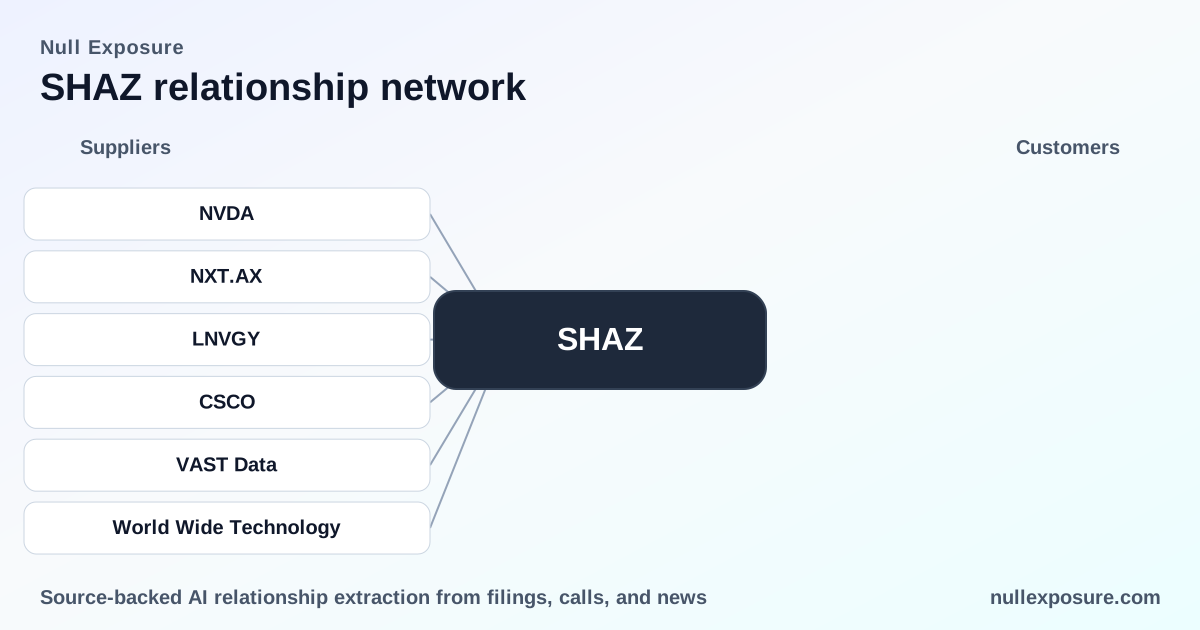
SharonAI (SHAZ) supplier map: what investors need to know
SharonAI Holdings operates as a specialized AI infrastructure and cloud GPU provider that monetizes by deploying high-density compute clusters and packaging them into managed neocloud services and secure AI solutions for enterprise customers. The company scales through vendor financing and service partnerships—selling compute capacity, deployment engineering, and factory-style secure AI stacks—rather than through large, legacy software contracts. Revenue is still small relative to market capitalization (TTM revenue ~$1.48M vs. market cap ~$404.7M) and the business is scaled through supplier relationships and platform rollouts. For a quick company-level dossier and ongoing relationship monitoring, visit https://nullexposure.com/.
How the supplier map translates to strategy and risk
SharonAI’s commercial model is supplier-led: hardware and ecosystem partners supply the capital-efficient building blocks while SharonAI assembles, integrates and sells a turnkey AI runtime to customers. Key operating-model characteristics flow directly from that posture:
- Contracting posture: SharonAI leverages vendor consumption/TruScale-style arrangements and integration partnerships to accelerate deployment without carrying full capex alone, signaling a flexible supplier-first contracting model.
- Concentration: A small set of infrastructure partners account for most deployment capacity and go-to-market momentum, concentrating operational risk in a few vendors and data-center operators.
- Criticality: Tier IV colocation and NVIDIA GPU architectures are core to SharonAI’s product; those relationships are operationally critical because they determine available capacity, product performance and service SLAs.
- Maturity: Financials and fleet rollouts indicate early commercial scale—small revenue base, negative operating margin, and material market valuation—so supplier execution will determine near-term credibility with customers and capital markets.
These signals are company-level characteristics derived from reported supplier arrangements and public financial indicators; the firm’s constraints list does not disclose additional supplier-specific restrictions.
Supplier relationship: NVIDIA
SharonAI’s GPU backbone is heavily NVIDIA-centric: the company’s fleet includes A40, L40s, H100, H200 and now B200 architectures, and it has launched integrated offerings that prominently feature NVIDIA technology. According to AI Journ (Mar 10, 2026), SharonAI expanded to include NVIDIA B200s as part of a 1,000-unit cluster deployment, and MarketScreener (Mar 10, 2026) reports joint product launches positioning Nvidia as the preferred accelerator in SharonAI’s secure AI factory initiative. NVIDIA is a strategic supply bottleneck and a product-defining partner.
Sources: AI Journ, 2026-03-10; MarketScreener, 2026-03-10.
Supplier relationship: NEXTDC
SharonAI plans a 1,000-unit B200 cluster deployment at NEXTDC’s Tier IV M3 data center in Melbourne, making NEXTDC the primary colocation host for this major rollout. AI Journ (Mar 10, 2026) documents the expected deployment at NEXTDC’s M3 facility. NEXTDC provides the physical resiliency and location footprint that underpins SharonAI’s service SLAs in Australia.
Source: AI Journ, 2026-03-10.
Supplier relationship: Lenovo
The 1K B200 cluster rollout is being delivered under SharonAI’s existing Lenovo TruScale agreement, which enables scalable, vendor-managed infrastructure procurement and fast expansion. AI Journ (Mar 10, 2026) specifically cites the TruScale agreement as the contractual vehicle supporting the rollout. Lenovo’s financing and engineering relationship reduces SharonAI’s capex burden and accelerates time-to-deploy.
Source: AI Journ, 2026-03-10.
Supplier relationship: VAST Data
SharonAI integrates VAST Data’s high-performance storage fabric alongside Lenovo’s compute to provide a develop-to-deploy pipeline that eliminates traditional storage throughput bottlenecks for large AI models. AI Journ (Mar 10, 2026) highlights VAST Data’s role in the stack. VAST supplies the storage performance necessary to unlock large-model training and inference at scale.
Source: AI Journ, 2026-03-10.
Supplier relationship: Cisco Systems
SharonAI and Cisco jointly launched Australia’s first Cisco Secure AI Factory built around NVIDIA accelerators, indicating a go-to-market and security architecture partnership for enterprise customers. MarketScreener (Mar 10, 2026) reports the SharonAI–Cisco launch as a marquee commercial product. Cisco brings enterprise networking, security posture and channel credibility that complements SharonAI’s infrastructure offering.
Source: MarketScreener, 2026-03-10.
Supplier relationship: World Wide Technology (WWT)
SharonAI partnered with World Wide Technology for deployment of large-scale high-performance compute infrastructure, positioning WWT as a systems integrator and deployment partner in certain rollouts. MarketScreener (Mar 10, 2026) covers the WWT deployment partnership. WWT functions as an integrator that expands SharonAI’s delivery capacity and enterprise reach.
Source: MarketScreener, 2026-03-10.
Visit https://nullexposure.com/ for an at-a-glance supplier risk matrix and continuous monitoring of these vendor relationships.
Strategic implications for investors
The supplier roster shows a deliberate strategy: pair leading GPU architectures (NVIDIA) with vendor-financed compute (Lenovo TruScale), high-performance storage (VAST), resilient colocation (NEXTDC), and enterprise security/channel reach (Cisco, WWT). That combination accelerates product delivery and lowers upfront capex for SharonAI, enabling rapid fleet growth. However, commercial scale is small today—TTM revenue of roughly $1.48M with negative operating margins—and the balance between growth through partnerships and the need to convert deployments into recurring enterprise revenue will define valuation trajectories.
Key investment takeaways:
- Execution risk is concentrated. A large share of capability depends on a few suppliers (NVIDIA, Lenovo, NEXTDC); supplier delivery, pricing or supply constraints will directly impact capacity and revenue ramp.
- Capital efficiency via TruScale is positive. Vendor-financed infrastructure reduces capex needs and supports faster scaling, improving cash flow dynamics if utilization and pricing hold.
- Commercial proof points matter. Joint launches with Cisco and integration partners like WWT signal enterprise go-to-market intent, but conversion of capacity into contracted demand is the next investor milestone to track.
- Market volatility is elevated. SharonAI’s equity exhibits high beta and a pronounced valuation premium relative to current revenues, so supplier execution updates will be material to short-term market moves.
A few practical monitoring metrics
Track the following supplier-driven indicators each quarter: announced capacity additions (GPU units by architecture), Lenovo TruScale contract amendments, NEXTDC facility occupation and SLAs, VAST storage performance integrations, and joint product announcements or proof-of-concept conversions with Cisco/WWT.
For ongoing supplier intelligence and alerts customized to institutional workflows, return to https://nullexposure.com/—the homepage provides tailored monitoring and report services.
Conclusion: operational leverage sits with suppliers
SharonAI’s path to scale is clear: expand GPU-dense clusters, lock in vendor financing and enterprise channel partners, then convert capacity into recurring contracts. The supplier map is both a competitive enabler and a concentration risk; near-term performance will be determined by vendor deliveries, deployment velocity, and the company’s ability to monetize capacity into enterprise-grade recurring revenue. For a consolidated supplier risk report and continuous updates, visit https://nullexposure.com/.